Author name: Jack Sullivan

Jack Sullivan Obituary

John H. (“Jack”) Sullivan, 90, of Alexandria, Virginia, an international development specialist and civic activist, died at home August 16, 2025, surrounded by family.Born in Toledo, Ohio, in 1935, he was the son of John E. Sullivan, D.D.S., and Emma (…

Jack Sullivan Obituary

John H. (“Jack”) Sullivan, 90, of Alexandria, Virginia, an international development specialist and civic activist, died at home August 16, 2025, surrounded by family.Born in Toledo, Ohio, in 1935, he was the son of John E. Sullivan, D.D.S., and Emma (…

Livingston & Co. Reached East for Whiskey


  In 1864, as the American Civil War was winding down, an immigrant wholesale liquor dealer named Louis Livingston opened a wholesale liquor house and grocery in San Francisco at 221 California Street with a business strategy, while not unique, was unusual.  He imported top grade whiskeys from major Eastern distillers, paying the transcontinental shipping costs and advertising vigorously his premium liquor.


After forming a partnership with three San Francisco locals in 1876, Livingston 
abruptly sold out to them several years later and returned to his native Germany.  The new owners, Issac Levy, Abram P. Wiiiams, and Joseph May wisely kept Livingston’s name on the door and maintained his business strategy. The founder, however, apparently never returned. 


With May as president, the three inheritors found that whiskey men beyond the Rocky Mountains were more than eager to help Livingston & Co. import their brands for the West Coast, claiming to be sole West Coast distributors and sharing bottle space with their name.  A key supplier was the  W.A. Gaines Co. of Frankfort, Kentucky and its Hermitage Distllery, named for Andrew Jackson’s home place.


W. A. Gaines had been making and selling “Old Crow,” named for the master distiller James Crow, exclusively in bulk in 40-gallon barrels for a flat $3.50 a gallon. Liquor houses around the country could bottle it and slap whatever label on it they wished.  Brand identification and quality control by W. A. Gaines was virtually impossible. With the arrival of a group of New York investors from Paris, Allen & Co. headed by Edson Bradley, things changed drastically. [See  post on Bradley, Sept. 19, 2011.]  


Bradley quickly saw to the incorporation of W. A. Gaines with all assets and trademarks officially under company ownership.  He also determined that those liquor houses selling Old Crow bourbon should not be self-selected chaos, but chosen to represent the brand targeting specific markets.  In New York City Bradley wisely anointed the H.B. Kirk Company.  In San Francisco he selected Livingston & Co.  The result was the exclusive right to sell Gaines whiskey on the West Coast and to advertise Livingston & Co. as its sole agent.  The company name appeared prominently on every quart.


The management of Livingston & Co. was not willing to stop, however, with engaging just one Eastern whiskey producer.  It also made an exclusive agreement with Cook & Bernheimer headquartered in New York City.  Founded in 1863, in the midst of the Civil War, the liquor house experienced a burst of energy in the late 1800s attributed to the addition of Financier George Carragan.  The company began operating from an imposing building at 144-150 Franklin Street, shown here, and in 1897-1898 opened offices or arranged for other local partners in Chicago, Cincinnati, and Terre Haute, Indiana.


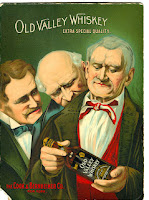
Cook & Bernheimer also reached out across America to San Francisco and arranged collaboration with Livingston& Co.  Among the New York brands chosen was AAA/Old Valley Whiskey.  The label announced it this way:  “WE HAVE APPOINTED MESSRS. LIVINGSTON & CO. 220 & 222 CALIFORNIA ST. SAN FRANCISCO SOLE AGENTS FOR THE PACIFIC COAST, AND HAVE GIVEN THEM EXCLUSIVE CONTROL OF THIS MAKE OF BOURBON. COOK & BERNHEIMER NEW YORK”.  Shown below are Livingston & Co. “Old Valley” bottles, left a  flask and right a labeled quart.


A third distillery providing whiskey to Livingston & Co., although apparently not exclusively in the San Francisco area,  was the Sunny Brook Distillery, owned by the Rosenfield family of Chicago.  By 1904, Sunny Brook had declared itself to be the largest producer of  whiskey in the world — and may have been right.    Its distilling capacity had been expanded to 20,000 gallons daily and warehouses held 10 million gallons of aging liquor.  After several business moves in Chicago, the Rosenfields established their main offices at 174 Randolph Street and opened a New York City office. For a time they also had a Philadelphia branch at the city’s Bourse.  The Rosenfields were also picking up awards.  At the St. Louis Exposition and World’s Fair their Sunny Brook Whiskey was given both a gold medal and grand prize.


The image here implies that Livingston & Co. also had an outlet in Covington, Kentucky, just across the Ohio River from the important whiskey hub of Cincinnati.  The reference is a sham.  The location given is “SE Corner Front and Scott Streets.” I have found at least other 15 other companies at the same address, many of them purporting to be distillers.  This was a common practice in the liquor industry.  A legitimate distiller would lease a small amount of space to a whiskey dealer to store whatever he wished and then allow him to claim a Kentucky distilling address for his company.  Begun in 1900 the “Covington sham” was phased out after 1906.


Throughout the growth of Livingston & Co, Joseph May guided its fortunes, making agreements with Eastern whiskey sources that brought nationally known brands to the West Coast.  He also promoted an exclusive company brand called “Pride of Kentucky” shown here in amber quarts.  Needing more space for his growing liquor business, May moved to a four-story building  at 206-208 Davis Street that provided substantially more space for expansion.  The structure is shown above on an 1890 letterhead. 


Unfortunately, the building would be in the path of the Great San Francisco fire and destroyed.  May and his colleages had sufficient resources to surmount the monetary losses from the fire, moving the company initially to 3443-3445 17th Street.  The final move of the liquor house was in 1911 to 639 Howard Street. In the interim, Joseph May died, replaced, it is said, by his wife as chief operating officer.


Livingston & Co doors closed for good in 1917, likely anticipating the imposition of National Prohibition.  The liquor house Louis Livingston had founded — and left behind — had survived for more than a half century.   During that period a major development had taken place, linking Eastern whiskey producers more closely with Western liquor dealers.  Despite the founder’s departure to Europe, Livingston & Co. proved to be one of the major beneficiaries.


Note:  The story of Livingston & Co. was developed from a number of sources.  Among them were prior posts on this website:  Edson Bradley, September 19, 1011; Cook & Bernheimer, November  7, 2016, and the Rosenfelds, September 4, 2013.

Special Notice:  Given my age (90) and infirmities,  I have suspended adding additional posts to this blog, this being #1201 in the series.  Instead I will be reviewing previous posts for accuracy, spelling, and typos and responding as necessary  to comments.  Thanks to all my loyal bloggers for their continued patronage.

Three “Bad” Women of the West


Foreword:  The “Wild West” chiefly has been thought of as a man’s domain, one where the male of the species could express himself without the undue strictures of Eastern America.  Yet for a few women the West afforded opportunities that would have been difficult to achieve elsewhere.  Recited here are vignettes of three women of the West who found their fortunes there.


Sarah Bowman became a legendary figure for her size, strength, and exploits as a participant in affirming American military control in the Great Southwest.  Reputed to be the first woman commissioned as a U.S. Army officer and buried with military honors, Sarah brought liquor, food, water, “comfort” and, upon occasion, a gun to the task, as shown here in an artist’s view.


Sarah often was called “The Great Western,” a reference to her height, estimated at over six feet tall, at the time taller than most men, and her weight, well over 200 pounds. At the beginning of the conflict with Mexico, General Zachary Taylor ordered Sarah and other women cooks to Fort Brown, Texas. When Mexican forces mounted a siege of the fort, The Great Western came to the fore for her bravery in providing food, drink, and other assistance to the soldiers. By the time Taylor’s troops relieved the garrison, Sarah’s legend was made.

Subsequently she met a newly discharged soldier named Paddy Graydon, an Irish immigrant, who was running a hotel and bar on the banks of the Sonora River.  The pistol-packing Sarah took over running the saloon and hotel, able keep order among the tough gun-toting clientele that mixed desperadoes with soldiers — and women.  After military adventures and dalliances with men, she opened a saloon and hotel in Fort Yuma, California, adopting several children and caring for them.

Sarah died in Yuma in December 1866 at the age of 53, reputedly from the bite of a poisonous spider.  A Catholic priest, Fr. Paul Figueroa, in his memoirs of Yuma wrote this eulogy about Sarah: “Mrs. S. Bowman was a good hearted woman, good souled old lady of great experience, spoke the Spanish language fluently…opened the first restaurant and kept it until she died.”  


Josephine Airey.  During her relatively short life, she was known by multiple other names:  Mary Welch, “Chicago Joe,” Mrs. James Hensley, and the “Richest Woman in Helena. Montana.”  She perhaps is best remembered today for her career as a saloonkeeper and brothel madam of the Old West.


No amount of controversy seemed to impede Josephine’s upward trajectory in Helena.  When a fire in 1874 damaged buildings owned by residents who lacked the resource to rebuild, she bought up the properties, refurbished them and rented out the space. As a result, she became one of the largest—and richest— landowners in Helena.  By this time she also opened the largest brothel in town, shown below, located at the corner of State and Joliet Streets.  Josephine called it the “Grand,” a building that stood until torn down in the 1970s.


Josephine continued her ascent in Helena. She built and opened the Red Light Saloon and a large variety theatre, costing $30,000 to construct.  (That is equivalent to just short of $1 million today.)  she called it “The Coliseum.”  The venue was a success with its fancy furnishings, beautiful girls who performed — and an adjoining brothel.


A crushing financial blow for came for Josephine, however, with the Financial Panic of 1893. The effects of stock crash on Wall Street reached Helena where Josephine found herself highly leveraged and her creditors demanding payment. She watched as one by one her large property holdings were lost. Left virtually penniless, except for the Red Light Saloon, she was forced to live in small quarters above the drinking establishment. In October 1899 Josephine was struck down by pneumonia at the age of about 55. The glory of her early days in Helena was no more.


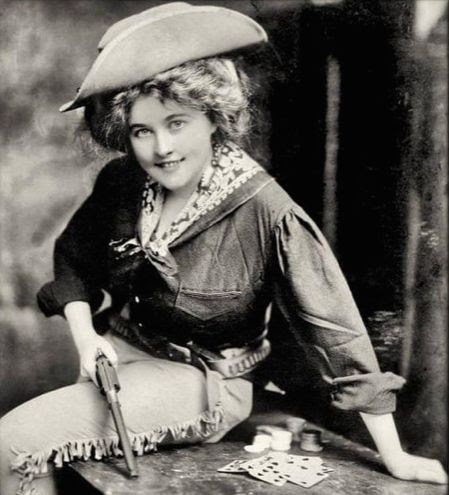
Kitty Leroy. During her abbreviated life, Kitty Leroy (sometimes given as LeRoy) was by turns a dancer,  faro dealer, gambler, sharpshooter, and finally saloon owner.  Shown here, Kitty blazed a trail from Michigan to Texas to California to Deadwood, South Dakota, where she became proprietor of the Mint Gambling Saloon.  In her wake were five husbands, one of whom she shot and killed, another who shot and killed her. Women like Kitty Leroy make Western legends. 


With her drive and ambition, Kitty in another day, another time, might have been a nationally known American entertainer, perhaps with her shooting skills, another Annie Oakley.   Of her early life little is known.  She was born in 1850, but opinions differ on where.  My guess is Michigan where she first attracted attention as a 10-year-old performer in dance halls and saloons. There, as one writer has observed, “…She either picked up or augmented an innate ability to manipulate, along with gambling and weaponry skills that would serve her well for most of her life.”


Within a few months Kitty had earned sufficient money to open her own “watering hole.”  She called it Leroy’s Mint Gambling Saloon. The Mint proved to be successful.  In addition to the booze available, Kitty provided gambling, entertainment and women, a combination that the prospectors and other fortune seekers found highly attractive. 

On June 11, 1877, Kitty married 35-year-old Samuel R. Curley, a Deadwood gambler and card shark. This time she had picked a husband besotted with her and a very jealous man.  Curley learned that Kitty had never divorced one or more of her earlier spouses and heard rumors of her having affairs other men.  After a stormy confrontation with Kitty, he stomped out of the Mint Saloon, moving to Cheyenne where he dealt faro in a saloon. Learning that Kitty had taken a new lover, Curley swore revenge on the couple and returned in a rage to Deadwood.  Kitty agreed to see him in her rooms. Curley was waiting for her, drew his revolver, and fired once. The bullet killed Kitty instantly.   Curley then fatally turned the gun on himself.


Note:  The foregoing are short summaries of three women each of whom made her mark in the West.  This website has posts on each one that tell a more complete story and also may be of interest:  Sarah Bowman, December 4, 2024;  Josephine Airy, September 27, 2024, and Kitty Leroy, June 18, 2023.


Three “Bad” Women of the West


Foreword:  The “Wild West” chiefly has been thought of as a man’s domain, one where the male of the species could express himself without the undue strictures of Eastern America.  Yet for a few women the West afforded opportunities that would have been difficult to achieve elsewhere.  Recited here are vignettes of three women of the West who found their fortunes there.


Sarah Bowman became a legendary figure for her size, strength, and exploits as a participant in affirming American military control in the Great Southwest.  Reputed to be the first woman commissioned as a U.S. Army officer and buried with military honors, Sarah brought liquor, food, water, “comfort” and, upon occasion, a gun to the task, as shown here in an artist’s view.


Sarah often was called “The Great Western,” a reference to her height, estimated at over six feet tall, at the time taller than most men, and her weight, well over 200 pounds. At the beginning of the conflict with Mexico, General Zachary Taylor ordered Sarah and other women cooks to Fort Brown, Texas. When Mexican forces mounted a siege of the fort, The Great Western came to the fore for her bravery in providing food, drink, and other assistance to the soldiers. By the time Taylor’s troops relieved the garrison, Sarah’s legend was made.

Subsequently she met a newly discharged soldier named Paddy Graydon, an Irish immigrant, who was running a hotel and bar on the banks of the Sonora River.  The pistol-packing Sarah took over running the saloon and hotel, able keep order among the tough gun-toting clientele that mixed desperadoes with soldiers — and women.  After military adventures and dalliances with men, she opened a saloon and hotel in Fort Yuma, California, adopting several children and caring for them.

Sarah died in Yuma in December 1866 at the age of 53, reputedly from the bite of a poisonous spider.  A Catholic priest, Fr. Paul Figueroa, in his memoirs of Yuma wrote this eulogy about Sarah: “Mrs. S. Bowman was a good hearted woman, good souled old lady of great experience, spoke the Spanish language fluently…opened the first restaurant and kept it until she died.”  


Josephine Airey.  During her relatively short life, she was known by multiple other names:  Mary Welch, “Chicago Joe,” Mrs. James Hensley, and the “Richest Woman in Helena. Montana.”  She perhaps is best remembered today for her career as a saloonkeeper and brothel madam of the Old West.


No amount of controversy seemed to impede Josephine’s upward trajectory in Helena.  When a fire in 1874 damaged buildings owned by residents who lacked the resource to rebuild, she bought up the properties, refurbished them and rented out the space. As a result, she became one of the largest—and richest— landowners in Helena.  By this time she also opened the largest brothel in town, shown below, located at the corner of State and Joliet Streets.  Josephine called it the “Grand,” a building that stood until torn down in the 1970s.


Josephine continued her ascent in Helena. She built and opened the Red Light Saloon and a large variety theatre, costing $30,000 to construct.  (That is equivalent to just short of $1 million today.)  she called it “The Coliseum.”  The venue was a success with its fancy furnishings, beautiful girls who performed — and an adjoining brothel.


A crushing financial blow for came for Josephine, however, with the Financial Panic of 1893. The effects of stock crash on Wall Street reached Helena where Josephine found herself highly leveraged and her creditors demanding payment. She watched as one by one her large property holdings were lost. Left virtually penniless, except for the Red Light Saloon, she was forced to live in small quarters above the drinking establishment. In October 1899 Josephine was struck down by pneumonia at the age of about 55. The glory of her early days in Helena was no more.


Kitty Leroy. During her abbreviated life, Kitty Leroy (sometimes given as LeRoy) was by turns a dancer,  faro dealer, gambler, sharpshooter, and finally saloon owner.  Shown here, Kitty blazed a trail from Michigan to Texas to California to Deadwood, South Dakota, where she became proprietor of the Mint Gambling Saloon.  In her wake were five husbands, one of whom she shot and killed, another who shot and killed her. Women like Kitty Leroy make Western legends. 


With her drive and ambition, Kitty in another day, another time, might have been a nationally known American entertainer, perhaps with her shooting skills, another Annie Oakley.   Of her early life little is known.  She was born in 1850, but opinions differ on where.  My guess is Michigan where she first attracted attention as a 10-year-old performer in dance halls and saloons. There, as one writer has observed, “…She either picked up or augmented an innate ability to manipulate, along with gambling and weaponry skills that would serve her well for most of her life.”


Within a few months Kitty had earned sufficient money to open her own “watering hole.”  She called it Leroy’s Mint Gambling Saloon. The Mint proved to be successful.  In addition to the booze available, Kitty provided gambling, entertainment and women, a combination that the prospectors and other fortune seekers found highly attractive. 


On June 11, 1877, Kitty married 35-year-old Samuel R. Curley, a Deadwood gambler and card shark. This time she had picked a husband besotted with her and a very jealous man.  Curley learned that Kitty had never divorced one or more of her earlier spouses and heard rumors of her having affairs other men.  After a stormy confrontation with Kitty, he stomped out of the Mint Saloon, moving to Cheyenne where he dealt faro in a saloon. Learning that Kitty had taken a new lover, Curley swore revenge on the couple and returned in a rage to Deadwood.  Kitty agreed to see him in her rooms. Curley was waiting for her, drew his revolver, and fired once. The bullet killed Kitty instantly.   Curley then fatally turned the gun on himself.


Note:  The foregoing are short summaries of three women each of whom made her mark in the West.  This website has posts on each one that tell a more complete story and also may be of interest:  Sarah Bowman, December 4, 2024;  Josephine Airy, September 27, 2024, and Kitty Leroy, June 18, 2023.


American “Drys” — Loving the Russian Czar

 Foreword:  The professed affection of President Trump for the Russian dictator, Vladimir Putin, brought to mind the attraction of American prohibitionists to the autocratic Czar of Russia.  Despite being more than a century old,  the story deserves to be told.


In 1914 members of the American Prohibition Movement fell in love with the Russian Czar, He was Nicholas II, shown here in his prime. With the outbreak of World War One, Nicholas was convinced by his ministers to prohibit all forms of alcohol because of their assumed detrimental impact on the readiness of Russia’s military forces. Drinking vodka and other spirits was a daily habit with many Russians, including members of the armed forces.   A considerable number regularly imbibed to excess.


The ease with which the Czar could cut off the alcohol spigot was made possible by the fact that since 1894 the Russian government had controlled all production of vodka and other spirits, reaping huge revenues in the process. American Prohibitionists took admiring notice of the Czar’s action and cheered as liquor was spilled on Moscow streets.


Under a 1914 headline entitled, “A Despot Needed,” one American commentator rhapsodized that: “Enlightened Russia knows the way, great Russia, with her tyrant czar; he twists his wrists and in a day the lid is placed on every bar….I wish we had a despot here, just to end ‘Old Booze.”  The Washington DC Evening Star editorialized that a “miracle” had occurred in Russia, noting cheerfully that the miracle had been made possible by Russia’s autocratic form of government.


As two cartoons published by the U.S. Dry lobby suggested, the Czar had become someone to be looked up to and emulated. In the first a Cossack has arrested a vodka bottle and is marching it off to detention. In the second “King Alcohol,” personified as a wicker covered bottle, salutes a Russian official while four apparently Americans look on approvingly.


Seen in the light of history, however, the Czar’s decision was a disaster. Fully one-third of Russia’s revenues came from the sale of vodka, even then an annual billion dollar business. Without the funds from alcohol sales, the government entered World War One with substantially less money than it needed. 


Moreover, prohibition made large segments of the Russian population angry. The rich still were able to buy vodka and other drinks at their clubs and in fancy restaurants. Only the lower classes were forced to give up drinking.


The country’s poor showing in the war and the growing unpopularity of Czar Nicholas gave rise to the Russian Revolution of 1918 in which the Communists came to power. The Czar and his family were executed. The new rulers led by Lenin, shown here, initially were opposed to drinking but Russians gradually had ceased to worry about the ban on vodka. Just as Prohibition in the U.S. (1920-1934) gave rise to bootleggers, in Russia,  potatoes were everywhere and so were illegal stills. By Soviet official count they tripled in numbers in the period from 1922 to 1924.


Gradually the Communist government ban on alcohol eased. Wine was legalized in 1921, beer in 1922, other alcohol in 1923, and, finally, in 1924 vodka sales again were permitted. Russians, as shown below, now could drink freely once again.  And do it legally.


By that time the United States, yielding to the “dry” fervor sweeping the country in 1920 had enacted its own National Prohibition.  America’s outlawing of spirits would be imposed until 1934, a span of some fourteen years.  The Russian ban on alcoholic drink lasted only about ten. 


Scroll to Top