Author name: Jack Sullivan

Native Americans Selling Whiskey II

 Forward:   The official Government view about selling liquor to Native Americans was expressed in an 1833 report by the Commissioner of Indian Affairs to Congress:   “The proneness of the Indian to the excessive use of ardent spirits with the too great facility of indulging that fatal propensity through the cupidity of our own citizens, not only impedes the progress of civilization, but tends inevitably to the degradation, misery, and extinction of the aboriginal race.”  Given that warning and federal laws against selling booze to indigenous peoples, it is startling to realize how many distillers and liquor dealers used Indian images on their whiskeys.  This post, my second on the subject, documents nine more.

The first example is a label from Calumet, Michigan, showing a comely maiden in  a headdress advertising “Copper Queen Whiskey,” a blend.  It was produced by Nariso Bianchi, an italian-born 1897 immigrant to the U.S.  About 1904 Bianchi, with a partner, opened a saloon and liquor store.  Although he was a “rectifier” not a distiller, that is, blending whiskeys for color, taste and smoothness, he did his own bottling and labels, advertising Copper Queen Whiskey as proprietary.

By coincidence Calumet at the time was named “Red Jacket,” the same name and personage as the next whiskey.  Red Jacket was a Seneca chief who had fought on the side of the British in the American Revolution and was named for having worn the British military red coat.  His real name was Sagoyewatha (He Keeps Them Awake), and was adamant against the white man, his ways and especially the Christian religion.  Nevertheless, Buffalo distiller Thomas Clark named his facility and whiskey after him.  Red Jacket is shown here wearing a medal later bestowed on him by George Washington, a reward for abandoning the warpath.


Meanwhile, in Chicago a young Bennett Pieters was profiting greatly from selling a highly alcoholic Red Jacket Stomach Bitters.  By wrapping his remedy in an Indian motif, Pieters was tapping into the rampant myth of the times that Native Americans possessed special knowledge of medicines.  For a time it made him rich, until several fraudulent schemes and his own alcoholism led to his downfall.  Abandoning his family, Pieters joined the U.S. Cavalry in 1871, went West, and became an Indian fighter. 


Searching for an image to illustrate his “Old Redskin” blended whiskey, Thomas A. Brownrig of Portsmouth, New Hampshire, chose a scowling chief with a downturned mouth, carrying a hatchet.  American Indians of the Abenaki and other Algonquian languages-speaking nations had inhabited that part of coastal New Hampshire for thousands of years before European contact.  Brownrig advertised widely in local media  calling himself a “Dealer in Foreign and Domestic Liquors, Imported Goods a Specialty.”  He also claimed be Portsmouth exclusive agent for the popular I. W. Harper Whiskey.  


Meanwhile on the West Coast, the Gottstein brothers of Seattle chose a canoe-borne indigenous American to be embossed on their liquor flasks.  Chief Seattle (1786-1866) was a leading figure of the Suquamish and Duwamish tribes who pursued a path of accommodation toward white settlers.  A widely publicized speech arguing in favor of ecological responsibility and respect of Native Americans’ land rights has been attributed to him.  


An Indian maiden illustrated “Tippecanoe,” a double fire copper whiskey from Joseph Pfeffer, a Cincinnati liquor wholesaler.  For saloon signs, almost always displayed in places where women and children were excluded, the Tippecanoe husky lass was shown bare-breasted.  When used on the label of a bottle that might find itself on a grocer’s shelf or a druggist’s display case where the eyes of the world might see, the maiden was more chastely dressed. At the bottom of a shot glass, as shown here, it is hard to tell.  


From a letterhead came the Indian chief advertising “Sachem” brand whiskey.  The term “sachem” is defined as a North American Indian chief especially the chief of a confederation of the Algonquian tribes of the North Atlantic coast.  In this case the whiskey was the product of the Rehm-Zeihler Company located in Louisville, Kentucky.  This firm was established by O.E. Rehm in 1904 and continued in business until closed by National Prohibition.
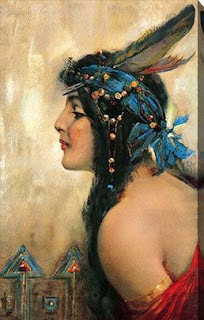

The comely Indian maiden seen here was an advertising element of Isaac and Bernard Bernheim Bros., acclaimed as the most successful distillers in American history.   Located in Louisville, the brothers registered the famous “I.W. Harper” brand. The “I W” initials were borrowed from Isaac’s own name, while Harper was the surname of a well known Kentucky horse breeder. The whiskey went on to win multiple medals for quality, the first being at the New Orleans Exposition in 1885.

Our final Native American selling whiskey is a stern-looking chief whose face graced the label of “Old Yock” brand straight rye whiskey from Dillinger Distilleries of Ruffdale, Pennsylvania.  For several years before the Civil War Samuel Dillinger drove a large Conestoga wagon pulled by six horses across the Allegheny Mountains on the Nation Pike, transporting merchandise between Baltimore and Pittsburgh.  After settling down in Pennsylvania, he became the second largest distiller in the state, hauling out fifty newly filled whiskey barrels every day from his distillery to store in his warehouses and then delivering a quality aged rye like “Old Yock” to his customers.


Note:  My first article on this subject was posted on June 8, 2023.  Longer posts on five of the whiskey men noted here also may be found on this website:  Clark, August 17, 2018; Pieters, Jan. 29, 2019;  Pfeffer, Dec. 12, 2016; Bernheim, Dec.10, 2014, and Dillinger, Feb. 12, 2016.

Steuben County to Chicago: The Trek of the Van Housens

Born in Steuben County New York in 1826, by the time he was six years old John Henry Van Housen had witnessed his father, Joseph, die at 28 years old; watched as his mother, Katherine, soon remarried, and he himself sent alone to live with a large family of her relatives.  Shown here in maturity,  Van Housen overcame his beginnings to found a wine and liquor business hailed as “one of the largest and most complete establishments in the wholesale trade” in America. He named it the Steuben County Wine Company, an enterprise he eventually located 600 miles west in Chicago.  

Despite growing up without his parents, young Van Housen early exhibited intelligence and a hard working persona.  After receiving a basic public education in  the schools of Central New York, he left his studies at about 17 to work in dry good store in Bath, New York. Four years later at 21 he was made a partner.  Van Housen continued in that line until 1860 when he left to work in a Bath wine and liquor business.   


That move may have been occasioned by his marriage in January 1854 to Charlottte A. Torrey of Naples, New York.  They would have three sons in rapid succession, Beach Torrey (B.T.), Harry L., and Charles, the latter who died in infancy.  After nine years working in the Bath liquor store, Van Housen struck out on his own in 1869, establishing a wine and liquor house he called “The Steuben County Wine Company.”  

By 1872, Van Housen was finding Bath too small for his ambition.  Moreover, during the 1860s the town had lost population.  Looking for a larger customer base for his enterprise, he chose Jackson, Michigan, a town five times larger than Bath and moved the Steuben County Wine Company there. 


At the time Jackson was doing well economically, with several railroad connections linking it to markets all over the Midwest. The family stayed five years but Van Housen’s vision of his future imagined even wider possibilities.  Looking further west he saw Chicago, then in the midst of boom years.  Uprooting Charlotte and their two boys who now were reaching maturity, Van Housen moved the family to The Windy City in 1876.


There Van Housen incorporated his Steuben County Wine Company at $200,000, installing his two sons as incorporators, stockholders, employees, and eventually as executives.  Beach became secretary and Harry, treasurer.  The company initially was established at 220 Wabash Avenue, moving between 1878 and 1911 to successive locations on Madison Street, the busy Chicago thoroughfare shown here.  With growing success the Van Housens needed more space, finally settling into large quarters at 227-229 West Madison..


Van Housen was wholesaling his alcoholic products in ceramic jugs of varying sizes from a single gallon to three gallons.  Those would be distributed by his saloon, hotel and restaurant customers into smaller containers and then poured over the bar into glasses.  Shown above are two jugs bearing the earlier 212 Madison Street address and below are jugs from the West Madison Street headquarters.


The company issued only limited whiskey brands, chiefly bearing the name of the German general who helped Washington train his Revolutionary War troops:  Baron Friedrich Wilhelm August Heinrich Ferdinand von Steuben. For obvious reasons he is usually just referred to as Baron von Steuben.  Shown below is “Old Steuben Rye” in half-pint and pint flasks. 


Van Housen also marketed a highly alcoholic “Steuben Celery Bitters,” advertised on a colorful trade card showing a youngster dressed in a military uniform carrying a lighted pipe.  Although it is a puzzling image, it is very like  figures found on German beer steins of the time.  The message on the back is equally perplexing.  It begins by extolling the nostrum’s medicinal qualities:  “A sure cure for Dyspepsia, Indigestion, Sleeplessness, Sick Headache and General Nervous Disability, affording immediate relief, and if its use is continued a permanent cure guaranteed by the proprietor.”  That proprietor (one assumes Van Housen) then suggests that wine merchants sell his Celery Bitters as a mixer for drinks, for just plain drinking and for soups because “it imparts a delightful flavor and is a wonderful Nervine.”


Van Housen rapidly gained a reputation as a leader in Chicago and throughout Illinois as a result of his strong support for domestic wines and whiskeys against imported goods.  His liquor house carried only American made products and he publicly preached the ascendancy of domestic alcoholic beverages.  Noted a biographer:   “The prediction made by Mr. Van Housen years ago, that, owing to the advantage of the American climate,…America would excel the world in the manufacture of pure wines, brandies, champagne and whiskey, has been verified and the public now realize that that the American product, in every respect, is as good as the foreign and of purer quality.”


Van Housen’s foresight, along with his personal qualities, gained him a reputation  as one of the leading businessmen of Chicago, extolled in print for his “…native sagacity, sound business judgment and tireless energy, coupled with a frank, genial and generous temperament that wins him many friends.”   Van Housen’s  trek across America had ended in success.


As he aged, Van Housen apparently moved into another profession, becoming known as a contractor and builder in Chicago.  The liquor house was turned over to Beach and Harry. It was reported that their father’s “…remarkable success in business is attributable, in part, to the efficient cooperation of his two sons, who are actively associated with him in management.”  By 1911 Beach was heading the company as its president and Harry was secretary.  The company added a new brand to its list of whiskeys called “Beach Run,”  trademarking the name in 1905.


With advancing age, Van Housen, with wife Sarah, retired to the family home, shown here, and watched helplessly as National Prohibition shut down the Steuben County Wine Company he so carefully had nurtured and taken cross country.  Van Housen died at age 81 in May 1936 and was buried at the family burial site in Chicago’s Mount Hope Cemetery. Charlotte would join him there five years later.


John Henry Van Housen lived long enough to have the satisfaction of seeing National Prohibition repealed.  He had followed his vision across 600 miles and four states to foster American wines, liquors and whiskey, achieving resounding success and personal recognition.  Now, after a 14 year hiatus and Repeal,  made in the USA libations once again were flowing. Van Housen must have been proud.


Note:  Among a number of sources for this article, by far the most important was “Encyclopedia of Illinois, Cook County Edition (Vol. II),” by Dr. Newton Bateman and Paul Selby, Munsell Publishing, Chicago, 1905.  


Savagely Stabbed, W.S. Edwards Survived & Flourished

Eli Cobb, a failed saloonkeeper, was waiting for W. S. Edwards on a main street of Salida, Colorado, on the evening of September 1, 1910. Cobb knew  that the whiskey dealer would come looking for payment of Cobb’s large unpaid debt for liquor.  When Edwards approached, Cobb, seemingly unconcerned, was standing cutting his fingernails with a pocket knife.  Suddenly he whirled and sank the blade to the hilt into Edwards’ abdomen, twisting it upwards, puncturing his intestines in six places.  Believed fatally wounded, Edwards nonetheless survived to a future no one could have foreseen.

William Sandy Edwards was born in Tennessee in 1872.  According to early records his parents were  Mary Green and William Van Buren Edwards,  his father an immigrant from Wales.  Of Edwards’ early life, details are scant.  At the age of 28, he appeared in the 1900 census living in Salida, Colorado, working as a miner.  He was married to Margarite Crawmer, a woman seven years older than he. The couple had two children, William Van Buren II, three years old, and Etta, one.  The couple had wed in June 1896 in Colorado Springs.


Shown above, Salida was a “Wild West” town just beginning to settle down.  Founded originally as a stagecoach stop, Salida in its early years could count its share of gunfights and lynchings.  The Denver and Rio Grande Railroad reached there in 1880, bolstering its population and economy. The  downtown burned twice, in 1886 and again in 1888.  It was rebuilt with bricks, making Salida today the site of Colorado’s largest historic district.


The city offered opportunities that stimulated Edwards to action.  Early in the 20th Century he opened a saloon at 151 East First Street.  While apparently quite successful Edwards soon determined that it was more profitable to operate a wholesale liquor business in addition to selling whiskey by the glass over the bar.  The proliferating saloons in Salida proved to be active customers.  By 1905, Edwards had achieved sufficient prosperity to take the additional step of building his own bottling plant.  Shown below, the building also held his saloon and wholesale liquor business.


No longer solely dependent upon liquor and wine sales, Edwards was manufacturing
 and selling soda waters, advertising his ginger ale, cherry phosphate, cider, raspberry julep, and seltzer water.  He also sold beer, cigars, fountain supplies and empty bottles. Shown below are two angles on an Edwards whiskey jug, one that held whiskey or wine.


Like other wholesalers, Edwards also on occasion extended credit to local saloons buying his merchandise.  That is how he came to know Eli Cobb, who had opened a short-lived saloon in Salida, failed at being a publican, closed the drinking establishment, and was unwilling to pay a large bill owed Edwards.  Now working on a nearby ranch, Cobb had been married only about a year.


As recounted in the Salida Mail of September 2, 1910:  “Friends of both men knew there was hard feelings between them because of the failure to settle on Cobb’s part and were suspicious that the two men might come to blows.”  They clearly had not reckoned on Cobb stabbing Edwards “almost unto death.”  There the rest of the story fades into the mists of time.  Edwards received successful medical treatment, unusual for the period and place, surviving for another 42 years.  The fate of Cobb after committing this brutal stabbing is unclear. 


Eventually recovering from his injuries, Edwards remained in Salida churning out his beverages.  Shown above are two Hutchison bottles embossed with the city name.  About 1902, however, the miner-turned-entrepreneur decided to move his operation 380 miles southeast to Amarillo, Texas.  To what extent his stabbing had contributed to that decision is unclear.  Edwards clearly saw opportunities in the larger Texas city not available in Salida.


Edwards’ original management team had been other locals;  in Amarillo, they were relatives. Chief among them was his son, W. Van Edwards, employed as the secretary-treasurer of the Edwards Bottling Company.  Shown here, the young man was described by a friend: “Van was, in fact, one of the most outgoing extroverts, this writer has known.  Jovial, generous and friendly.  Van had no detractors — every acquaintance became a friend.”  Working together, the father and son Edwards built a thriving business in Amarillo working from the spacious building shown below,  strategically located across from the Amarillo railroad station. Initially called the Whistle Bottling Co., the company subsequently was re-named for Edwards. 


As the Prohibition tide began to rise, Edwards Bottling Co. put increasing emphasis on its soft drink trade.  It was one of the first bottlers in America to have a Dr. Pepper franchise.  (And Amarillo in 1960 the first place I tasted Dr. Pepper.)  Among company offerings were Canadian Club Ginger Ale, Pabst Malt Syrup, “Crazy Well Water,” and bottles.  When Texas went dry at the time of National Prohibition, Edwards Bottling was well position to survive.


Just as its Edwards was able to withstand a savage knife attack, the company he founded proved just as resilient.  When Margarite died in 1924, he married again, to a Mississippi-born woman, Corrinne Cage.  Edwards also would outlive this second wife by a year, dying in June 1952 of heart failure.  Despite his grievous wounding, Edwards had lived to be 79.  He was buried in Amarillo’s Llano Cemetery, Section U, Lot 156, Space 5. His gravestone is shown below.


Edwards died not knowing that he had created a bottling dynasty. With his father’s death Van Edwards and a relative, Martin V. B. Edwards, took over management of the bottling company.  With their retirements, Van’s son. James Jackson “Jack” Edwards, inherited the business, to be followed by his wife, Frances Exum Edwards.  She became owner and manager, when few women held such positions in a male dominated industry.  Frances served until the business was sold in 1965.


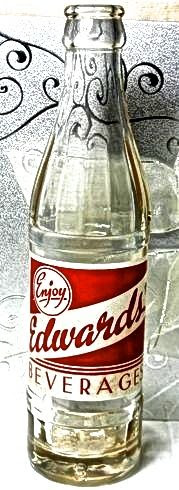
In sum, the Edwards name had dominated the bottling trade in two cities over most of the 20th Century despite the near fatal stabbing of the founding father. In his memory the company later produced a soft drink named “Edwards Beverage.”  W. S. would have been proud. 


Notes:  This story of a stabbing and its aftermath has some notable “holes.”   Chief among them are events immediately following the stabbing.  How was Edwards saved?  What happened to Cobb?  Other details are needed.  I am hoping some sharp eyed reader — perhaps a descendant — will be able to help fill in the blanks. 


The Hegners Were 115 Years in Cincinnati Whiskey

 For most of the 19th Century, the center of the American liquor trade was Cincinnati, Ohio.  Close to Kentucky and Pennsylvania, two major distilling states, and a major national hub for river and railroad traffic,  the so-called “Queen City” was home to hundreds of distillers, rectifiers (blenders), wholesale and retail liquor dealers.  Among them was the Hegner clan — three generations encompassing six decades in the whiskey trade.

The Hegner saga began with the arrival of Johan Hegner in the United States in 1843.  Born in Germany in1823, Johan at the age of 20, was said to be “like thousands of ambitious young men of the old country, determined to seek his fortune in America.”  He also may have been trying to avoid being conscripted into the Prussian military.  Johan is shown here as depicted on a Hegner grave monument.


Johan appears to have had some experience in his homeland with the distilling trades.  He early headed to Cincinnati with its strong German population and lively liquor industry. There Johan is credited with being a pioneer distiller and yeast manufacturer.  “He furnished stock yeast to the distilleries of this city and the tributary territory for many years,” noted a Hegner biographer.


In Cincinnati, Johan met and about 1847 married Catherine Kuespert, a child of immigrant parents. She was three years his junior  They would have three children, Anna Barbara, born in 1848; Margaretha, 1854, and Gottfried, 1855. Shown here as depicted on the grave monument, Catherine died in 1879 at the age of 54.  The couple is buried in the Hegner plot in Cincinnati’s Spring Grove Cemetery.


Johan lived until 1904, long enough to help educate his son in the whiskey trade.  Gottfried had attended public schools until reaching 12 years and then went to work in the distilling business, serving apprenticeships in Cincinnati and Terre Haute, Indiana.  In 1875, the young man returned to Cincinnati and gained employment as a bookkeeper with William Fuller & Co., a wholesale dealership and whiskey rectifier.   This was a highly responsible position because of the need to keep careful track of the federal taxes owed.  Federal agents particularly targeted tax cheating on rectified whiskey.  The penalty was stiff and could include jail time.


At William Fuller & Co. Gottfried met Augustus Kayser, Fuller’s junior partner in the liquor house.  Born in Germany, Kayser was seven years older and an established personage in the Cincinnati liquor trade.  The two men became friends and eventually Gottfried introduced him to his older sister, Anna Barbara.  The two fell in love and were married, bringing Kayser firmly into the Hegner family fold.  


In 1878 Fuller dissolved his firm leaving Kayser and Gottfried’s free to organize their own liquor business.  They founded it that same year as Kayser & Hegner Company.  Augustus was president and Gottfried secretary.  Their first address was 86 East Second Street (1878-1883) and subsequent larger quarters over a span of 40 years all were located on East Second.


In February 1879, Gottfried met and in Cincinnati married  Annie E. F. Lachtrop, the daughter of a well known local tavern keeper, the proprietor of Eight Mile House, located on the Lexington and Covington turnpike.  Growing up in the roadhouse atmosphere Annie was well attuned to her husband’s occupation.  The couple would have three children, Harry born 1880 , Fred, 1883, and Pearl, 1886.


Kayser & Hegner featured a number of proprietary “house” brands.  They included “Red Hen,” “Avondale Club,” “Belle of Washington,” “Moscow Rye.” “Selby Run,” “Small Still,” “T. P. A,” and “Yacht Club.”   In 1887 the partners registered Yacht Club, their flagship brand, with the Patent and Trademark Office.  When Congress strengthened copyright laws in 1905, they re-registered the name and added Avondale, Belle of Washington, and Selby Run.  As shown here Kayser & Hegner bottled their whiskey in both ceramic and glass.


From the outset the partner’s exhibited a strong sense of merchandising.  They provided their customers in saloons, hotels and restaurants with well crafted signs advertising their whiskey.  At left is a Kayser & Hegner gifted sign of a smiling boy done in the  Dutch or German realistic genre.  In an era when depictions of female nudity were common in drinking establishments, this picture was suitable for display in finer settings where women were invited.  Below is a second example of the company advertising.  This saloon sign celebrates Yacht Club as well as two other Kayser & Hegner brands.  Although the central focus is on two sailboats, look to the left, very small, is a line of battleships, suggesting a wartime dating.


As was common then in  the liquor trade, the partners also gifted their customers with decorative shot glasses.  Those would be distributed to both wholesale and retail patrons.  Not expensive to make, those glasses were virtually indestructible and capable of being used over and over.  Today advertising shot glasses find an avid collector base willing to spend a high dollar figure for particular pieces. 


Kayser & Hegner did a vigorous business throughout the Middle West by sending salesmen out on the road.  They would be announced by imaginative post cards, often including the proposed date of the visit, as on the card below.  The company tried to make them as interesting as possible with illustrations.  The card at left serves to introduce the third in the line of Hegners in the whiskey trade, Henry Hegner, who began in the business as a traveling salesman for Kayser & Hegner.


As he advanced into his 60s,  Augustus Kayser ’s health faltered.  Earlier he had been highly active, running the liquor house and making a name as an inventor.  He owned patents on “Improvements in Low Water Alarms for Steam-Generators” (1871) and “Improvement in Low Water Alarms for Steam Boilers” (1972).  His wealth allowed him to house his wife Barbara and children, Augustus Jr. and Luella, in a spacious home at 1710 Kinney Avenue in Cincinnati, shown here.


Augustus was living there amid his family when in September 1910, he died and was buried in the Hegner family plot.  Gottfried had taken over the management of Kayser & Hegner a year earlier.  Said a biographer:  “Having early gained thorough knowledge of his business, Mr. Hegner applied himself with great diligence and has won high standing among the distillers and wholesale dealers of the country….Possessing a generous and kindly nature, he is a liberal contributor to worthy causes.…”


With the help of Henry, promoted to management, the Hegners prospered even as the noose of Prohibition tightened around the liquor industry.  The family finally conceded, closing down their establishment in 1918.  Gottfried would live another 12 years, succumbing in August 1930 at the age of 75.  He was buried in the Hegner plot adjacent to the monument to Johann and Catherine and near wife Annie and son Henry, both of whom had preceded him in death.  In Cincinnati, home to a multitude of liquor establishments, the Hegner/Kayser clan had made its mark.


Notes:  This post relies heavily for information from ancestry.com and the biographies of Johann and Gottfried Hegner in the volume, “The Queen City, 1788-1912,”  Vol. III, Clark Publishing, 1912.


Whiskey Men and Divorce

Foreword:  While in past posts I have dealt with “whiskey men” who engaged in multiple marriages,  those stories frequently involved the death of a spouse and remarriages. [See post of May 14, 2019.]  In other instances whiskey men have been involved in marriages that ended in divorces that were “messy” or involved “high society,” some meriting newspaper headlines.  The four short narratives that follow demonstrate a range of circumstances surrounding the breaking of marriage bonds.  Note that in each case it was the wife who sued for divorce.

George Buente:  Booze for Indians, Blows for Wife.  Buente was the owner of a St. Louis shipping company whose principal trade was illicitly selling whiskey on Indian reservations.  Having outraged officials involved in Native American affairs, he ultimately became the government’s “poster boy” for the greed of American citizens prospering from the sale of “firewater.”  In St. Louis Buente made other headlines for wife beating.


In 1874 Buente returned to his native Prussia where he found a bride in 26-year-old Augusta, a women eleven years his junior, and brought her back to the U.S.  In quick succession they had three children.  A clue to Buente’s character may be Augusta’s petition for divorce in 1881 after seven years of marriage.  During the three preceding years, according to her testimony, her husband whipped and maltreated her on many occasions, beating her with his fists, throwing her violently against the wall and striking her while she was pregnant. 


Augusta further alleged that Buente frequently taunted her with a description of his illicit amours.  Her divorce petition stated:  “She bore this treatment until it became intolerable, and was at length compelled to appeal to the court for relief.”  Augusta sought custody of their children and considerable alimony, noting Buente’s lucrative business and real estate holdings.  The judge agreed, granted her the divorce, child custody and alimony.


Buente fared no better in a second court appearance.  Having been caught shipping liquor into Indian Territory,   Buente was arrested and brought before a federal court.  He feigned ignorance of the law but nonetheless pled guilty to the charges.  He was fined $500 (equivalent to more than $12,000 today) and court costs.   Whether this conviction was enough to discourage him from sending liquor again into Indian Territory is unclear.


J. C. Philpot:  While Wife Fed Chickens, Did He “Hen” Hop?  If you chanced to meet Jay George Philpott at one of his Michigan enterprises, he almost certainly would become an instant friend and confidant — and have something to sell you  It might be liquor, oysters, insurance, used cars, or even worthless Russian bonds.  Attractive to women, Philpot, shown here, had all the qualities of a confidence man.


While still in his 20s Philpot established liquor stores in two small Michigan cities: Port Huron, located in the northeastern most part of the state on Lake Huron,  and Adrian, 130 miles south, not far from the Ohio border.  On the outskirts of Adrian Philpot bought a 20 acre spread on which he raised prize poultry.  A biographer noted:  “He is a great fancier of finely bred chickens, and his pens…have won many prizes at different fairs and poultry shows where they have been exhibited.”


In June of 1890 Philpot married 22-year old Gertrude Durham of Romeo, Michigan, and settled her on the farm.  There would be no children. Leaving Gertrude miles away in Adrian to feed and nurture his chickens,  Philpot spent the bulk of his time in Port Huron expanding his liquor trade there. His rapt attention to business may have been explained by a local news report:  “A large number of people are employed…In the labeling department a number of girls find employment.”  After nine years of doling out feed to Philpots’ leghorns, houdans, and brahmas, Gertrude called it quits.  Charging him with “extreme cruelty” she obtained a divorce.


Philpott wasted little time in remarrying, having a child, buying a large Port Huron home, and settling there.  When Michigan went “dry” in 1917,  he began to deal in foreign securities, including Russian Imperial bonds, above, issued before the Communist Revolution.  According to press accounts:  “Philpott is said to have disposed of virtually worthless Russian bonds to Michigan investors at a considerable loss to the latter.”  By 1929, the Michigan Securities Commission in Lansing had had enough. The Commission revoked his brokerage license.  A year later Philpot after a brief illness died in Port Huron, age 58.


Fred Hipsh:  The Con Man Cuckolded.  Fred Hipsh was a Hungarian immigrant who spent much of his working life in New York City acting as a “distiller’s agent”  representing whiskey distillers and rectifiers, selling client alcoholic products, and conducting tastings and other promotional events.  But Hipsh had abent toward chicanery, claiming to own a non-existent Kentucky distillery and selling fraudulent bond certificates for whiskey allegedly being aged in a non-existing warehouse. 


While Hipsh was cheating in the whiskey trade and getting away with it, his wife, Anna, was cheating on their marriage. Fourteen years younger than Hipsh, Anna was attractive and was working as a stenographer when the couple married.  Now her lover was Theodore P. Shonts, one of New York’s richest and most powerful men as president of a New York Interborough Transit Company and an officer in several large railroads. Hipsh sued Shonts for $200,000, (more than $4 million today) for “alienation of affections.”  Known to be in an unhappy marriage, Shonts, shown here, lamely claimed Hipsh’s charges were a case of mistaken identity and that the real culprit was his “double.”


When Hipsh confronted Anna with solid evidence of the adultery, she packed a suitcase and bolted for the train station.  When the New York press caught up with her, Anna was in Reno, Nevada, apparently there for a “quicky” divorce.  Possibly with Shonts’ assistance, she was staying at the posh Riverside Hotel.  Anna acknowledged to reporters that she knew Shonts, saying: “He has always treated me as a gentleman should treat a woman.”  But she denied they were having an affair.


Subsequently Fred and Anna divorced, a settlement was reached with Shonts, and the railroad magnet, who clearly had a roving eye, went on to other women and scandals.  Hipsh, now single, moved to New York’s Marseilles Hotel.  His days in court were not over, convicted in 1913 of welshing on a large debt. Hipsh died the same year.  Anna’s fate is unknown.


Augustus Goodwin:  Rich, But Wife Yearned for Royalty.  Goodwin was a wealthy Boston merchant, CEO of a chain of specialty grocery stores that featured at least thirteen brands of his proprietary whiskeys.  Despite his success, Augustus found his New York socialite wife enamored of European royalty to the point of dumping him for a hereditary count.  Shown here is Frances Thorley Goodwin, subsequently known widely to New York society as “Countess von der Palen-Kar,” a designation as questionable as the origins of her second husband’s title.


Goodwin attempted to keep Frances content by agreeing to a major remodeling of their mansion home at 130 Commonwealth Avenue, in one of Boston’s most elegant neighborhoods. (In 2015 the house sold for $11.6 million.)  Despite her husband’s exertions Frances was not satisfied.  She had developed a yen for royalty in the person of Count Adolphe J. von der Palen-Klar, living in Brooklyn, likely under modest circumstances.  Adolphe’s family is said to have achieved nobility in 1799 when Emperor Paul the First of Russia, for reasons unknown, gave Peter Ludwig von der Pahlen and all of his descendants the rank of count.  The family coat of arms was something of a jumble.


How Adolphe got to Brooklyn and what he did there mattered little to Frances who had enough family money for them both.  She divorced Augustus and  married the Count in November 1927 at the American Church in Paris.   After a honeymoon they returned to live in New York.  Frances quickly appropriated the title of “countess,” however murky its origins.   Adolphe moved out of Brooklyn for lodgings with his new wife at one of upper Manhattan’s swankiest addresses, 920 Fifth Avenue, also home to movie star Gloria Swanson. The New York press paid close attention to the social whirl of Count and Countess von der Palen-Klar.  Clothed in royalty, Frances Thorley had arrived at the pinnacle of Gotham’s social set.


Meanwhile back in Boston, Augustus Goodwin, remarried, was busy running his businesses and indulging his hobby as an owner/breeder of thoroughbred racehorses.  Goodwin’s love for horses was his undoing.  In July 1934, he dressed in his riding outfit and drove to the nearby stables where he kept his steeds, mounted one and rode off.  Somewhere along his journey the horse threw him to the ground.  Goodwin may have died almost instantly.  The cause was recorded as “fracture at base of skull.”  Countess Frances died in 1944 in New York. The Count followed four years later.


Note:  More complete stories of each of these “whiskey men” may be found elsewhere on this website:  George Buente,  January 21, 2018;  J. G. Philpott, December 21, 2022;  Fred Hipsh, April 3, 2019, and Augustus Goodwin, August 9, 2021.


Tom Dennison—The Old Gray Wolf Who Ate Omaha

 Regular readers of this website know that I often feature “whiskey men” who have contributed to their communities by public service or philanthropy.  There were dozens of them.  Occasionally, however, the story is about an individual whose activities were so despicable that he deserves attention.  So it is with Tom Dennison, the early 20th Century saloon owner, political boss and crime kingpin of Omaha, Nebraska.  Shown here, he was known by locals as “The Old Gray Wolf.”

Born in Dehli, Iowa, in October 1858 of Irish immigrant parents,  Dennison moved with his family to Nebraska at the age of two.  At 15 he left home and headed to the “Wild” West. Over the next two decades Dennison traveled widely as prospector, gambler, and (some said) bandit.  As he matured he bought and operated gambling and drinking establishments, including the Board of Trade Saloon in Butte, Montana, and the Opera House Saloon in Leadville, Colorado.


Dennison was 34 years old in 1892 when he arrived in Omaha.  By that time highly experienced in “business,” he went there with $75,000 in cash, roughly equivalent to $2.5 million today.   He quickly understood that Omaha, a city of about 140,000, was “wide open” with minimal legal control over liquor, gambling, prostitution, and other nefarious enterprises.  More important, Omaha had no political boss.  His pockets budging with cash, Dennison about 1900 deftly moved into that role.


For the next quarter century, Dennison was the “king” of Omaha politics. He never held public office, instead buying influence through lavish campaign contributions and his ability to get out the vote. Acting as a power broker between the business community and the criminal element, it is said that: “His power was such that no crime occurred in the city without his blessing, the police reported to him daily, and the mayor himself answered directly to him.”


Dennison’s much quoted mantra was: “There are so many laws that people are either law breakers or hypocrites. For my part, I hate a damn hypocrite.”  This attitude, however, apparently did not prevent him from teaming up with local prohibitionists to close down half the saloons in Omaha,  sparing the half in which he had a monetary interest.  Dennison also operated a private bank, loaning money to privileged residents and providing a very private repository for individuals who for various reason avoided traditional banks.


While Dennison was building his criminal empire, he was also having a family life.  In Omaha he met Ida I. Provost. She had been born in Council Bluffs, Iowa, the daughter of Charles Provost, a prominent Iowa  newspaper editor and publisher.  When they married in 1893, Dennison was 37, Ida was 26.  Their first child, Frances, lived to maturity.  Twin sons conceived 15 years later were dead at birth.   Amid the family sorrow the couple named them John and Thomas.


The 1919 Omaha Race Riot and Lynching 


The Old Gray Wolf recognized that his operation required controlling City Hall in Omaha.   He installed as mayor a crony named Jim Dahlman, shown here, who had come to Nebraska to escape murder charges for shooting and killing his brother-in-law in Texas. Dahlman, through Dennison’s machinations served eight of nine terms between 1906 and 1930.  The one exception was in 1918 when a reform candidate named Edward Parsons Smith won office promising to “clean up Omaha” and as mayor proceeded to do it.   This led Dennison to his most despicable deed — fomenting the Omaha Race Riot of 1919.


Smith

In an effort to force Smith out of office, Dennison contrived to create a situation that questioned the mayor’s ability to keep order.  With the help of the Omaha Bee newspaper he created false stories of assaults on white women by black men, sometimes using white police officers in blackface.  Each time the Bee blamed Smith’s administration.  Those stories plus the difficult economic situation facing returning World War One veterans created a racial tinderbox in Omaha. 


Then the Old Gray Wolf lit the fuse.  In late September, 1919,  a young white woman was with her crippled companion when a man with a black face beat the man mercilessly and raped the girl.  Police officers in Dennison’s pocket arrested an African-American named Will Brown, who was hapless enough to be near the scene.  He was thrown into the Douglas County Jail located in the County Courthouse.


Over the next several months, through the Bee and other resources, Dennison whipped up public fury against Brown.  On December 28, 1919, a mob led by Dennison’s cronies headed for the courthouse, looking for Brown, as shown above.  The rioters gained access to the building, found Brown, carried him out, hanged him from a lamppost, riddled him with bullets, then took him down and burned his body.


Mayor Smith, endangering his own life, attempted to help Brown.  He was grabbed by the rioters who attempted to hang him as well.  Smith narrowly missed Brown’s fate when  Omaha police detectives intervened in the nick of time to save him from the noose.  Cut down, Smith required hospital treatment and lost his taste for politics, declining to run again. Jim Dahlman, known as “The Perpetual Mayor,” was returned to office, much to Dennison’s delight.


Along with Brown two rioters died in the melee and dozens of Omaha police officers and other citizens were injured.  The courthouse was torched.  Some 1,700 federal troops from nearby Fort Omaha and Fort Crook were dispatched to Omaha by the Governor, equipped with cannons and machine guns.  By the next day order had been restored.  In the aftermath not a single rioter was arrested.  Shamelessly, Dennison, while not admitting to his role publicly,  was said to gloat about it when closeted with cronies.


The Old Gray Wolf and National Prohibition


Fast on the heels of the Omaha riot came a new challenge for the Old Gray Wolf when January 1, 1920,  brought National Prohibition. Nebraska ostensibly had gone “dry” earlier. As usual Dennison had an answer.  Early on Dennison created the Omaha Liquor Syndicate to monopolize the bootleg booze traffic in Omaha, creating alliances with Al Capone in Chicago and Tom Pendergast in Kansas City. [See post on Pendergast, Dec. 2, 2013.]


In 1919 Dennison bought a mansion home in an upscale neighborhood of Omaha, shown above.  When Prohibition arrived he arranged for a series of underground tunnels to be built connecting his residence and his downtown offices.  The tunnels are believed to have led to a location where the tracks of the Chicago, St. Paul, Minneapolis and Omaha Railway intersected and freight could be unloaded and carried into town.  As one commentator has noted:  “The unobstructed path to the railroad would have been an ideal way to transport liquor by moonlight.”  As shown here, vestiges of the tunnels still exist in the neighborhood of the former Dennison home.


In 1922 Dennison suddenly sold the house and moved away.  The change may have been linked to the death that year of Ida, his wife of almost 30 years.  Known for her charitable work in Omaha, Ida was a foil for Dennison’s reputation.  At age 54,  after suffering a stroke that left her paralyzed and on the brink of death, she was allowed go home from the hospital and died there with Tom and a daughter at her bedside.  Her visitation at home and funeral at Holy Angels Catholic Church were thronged with mourners.  Burial was at Forest Lawn’s Memorial Park.  Shortly after, Dennison sold their mansion home. Perhaps the house held too many memories.


Ida’s death, however, did not distract Dennison from his criminal enterprises. He was still strongly in control of the city’s politics and the Omaha liquor trade.  A survey in 1929 found more than 1,500 outlets in the city illegally selling alcohol, many controlled by  Dennison. The Old Gray Fox also ran Omaha’s Flatiron Hotel as a lodging for mobsters running from the law in Kansas City, Chicago and St. Louis.


The End Game in Omaha


In the early 1930s Dennison hold on Omaha weakened.  The unsolved murder of one of his most outspoken opponents shocked the community.  Public opinion began to turn against him.  His hand-picked candidates began losing at the polls.  Dennison’s marriage at 72 years to 17-year-old Neva Jo Truman not only raised eyebrows in Omaha but made him the subject of ribald jokes.  The oddly matched couple is shown below. The marriage lasted just three years before Neva Jo filed for divorce. 


As he entered his 70’s, Dennison’s heath began to falter.  In June 1932 he suffered a stroke but recovered quickly.  The following December, however, when a bout of pneumonia nearly killed him, he formally announced retirement.  The Old Gray Wolf was, however, finding that it was not as easy to control federal lawmen as it was Omaha’s.  In August 1932 Dennison and 58 of his cronies were put on trial by federal authorities for violating Prohibition laws.  That trial ended in a hung jury and was declared a mistrial.  Hauled into court again a few month later on conspiracy charges, Dennison and his lackeys were acquitted.


Probably relieved to have escaped justice a second time, Dennison took off for a holiday with friends in Chula Vista, California, in February 1934.  There he was fatally injured in an automobile accident.  Ironically, National Prohibition would end the same year.  His body was returned by train to Omaha for burial.  Suggestive of the hold Dennison still held on Omaha, an estimated 1,000 people attended his funeral at St. Peters Catholic Church.  He was buried in Forest Lawn Cemetery next to Ida and the stillborn twins.  While some may have grieved his passing, many others in Omaha celebrated knowing that the Old Gray Wolf was dead at last.


Note:  This post was drawn from two principal sources:  The Wikipedia entry on Dennison and his obituary in the Omaha Bee of February 18, 1934.  By the way, it is just a remarkable coincidence that this article, published on the eve of New Years Day, 2024, would be  #1111 in the series of posts.


The Terrells and Three Centuries of Paducah Whiskey

War of 1812 era soldier, slaveholder, and pioneer Kentucky distiller, Caleb Terrell,  shown here as he appeared on a whiskey label, in 1835 began a family dynasty making whiskey in Paducah that stretches down to the present day — an astounding 188 years. 

Born in Virginia in 1791, the son of Jonathan and Mary Terrell, Caleb first appears in public records in 1808, as an 18th-year-old private in Battalion One of the 19th Virginia Regiment, stationed in Richmond.   Accounted as a War of 1812 Era veteran, Caleb actually saw no fighting and his unit was disbanded in 1809

by official orders of the U.S. President and Virginia governor that “it was “no longer required to be held in readiness for actual service.”  Caleb was discharged and apparently did no further soldering.


He next appeared in the 1830 United States Slave Census recorded living on a farm in Montgomery, Tennessee.  Still single at 39, Caleb owned seven slaves, three males and four females.  By 1840, Caleb had moved to a new site in Ballard County, Kentucky, near Paducah. Still single, he was recorded now owning twelve slaves, five males and seven females.  It was there in 1835 that Caleb began his distillery as an adjunct to farming, accounted among the earliest distilleries in Western Kentucky.  It was a common practice to use slaves in making whiskey below the Mason-Dixon Line and they played an important role in early American distilling, as illustrated below.


The 1850 Slave Census indicated the growth of Caleb’s distilling enterprise over the decade.  Now he had a total of 15 slaves,  of whom six were children, ages three to thirteen.   He died in May 1861, accounted 69-70 years old and was buried in Ballard County’s Jenkins Cemetery, a burying ground located on a farm 2 and 1/2 miles east of LaCenter, Kentucky, the county seat.  With Caleb’s death his distillery was shut down.


Meanwhile, back in Paducah, Caleb’s nephew Thomas was prospering as a pork packer, general trader and commission merchant for tobacco.  He and wife, Mary Francis, would have a family of eight sons.  Among them was Albert Sidney “Sid” Terrell, born in 1862, a grandnephew of Caleb’s.  As he grew to maturity, learning about the earlier Terrell distillery, Sid vowed to resurrect what Caleb had begun.


Of Sid’s early life, details are lacking.  Kentucky whiskey guru Michael Veatch has this to say about him:  “Sid was something of a legend in western Kentucky, during a time when notoriety was often earned through mischief, storytelling, and a bit of hellraising. The Wild West was taking shape, and Sid Terrell certainly embodied that spirit in the western-most part of Kentucky.  


My supposition is that Sid had spent sometime learning the whiskey making trade working at one of the many distillers dotting the Kentucky landscape.  When in 1903 he resurrected what Caleb had begun, Sid was about 41 years old, married, and had at least one child.  Almost immediately he faced one major problem. Unlike Louisville, Lexington, Bardstown and other Kentucky distilling centers at that time,  Paducah lacked railroad access for shipping.  Everything had to be brought in and out by water over the Ohio and Tennessee Rivers that have their confluence at Paducah. Sid was undaunted and eventually the Illinois Central line was extended there.


As shown above in an early ad, Sid named his flagship sour mash whiskey after his ancestor, calling it “Old Terrell,” and providing a portrait of a stern-looking Caleb and a motto:   “Quality not Quantity.”  As noted in the Sanborn fire map below, Sid built his distillery about two miles northwest of Paducah’s city hall.  Called the Old Terrell Distillery, in Federal parlance it was RD #34, 2nd District.   The facility was run only five months of year, yielding four gallons of whiskey per bushel of corn. It featured a bonded warehouse seven tiers high capable of storing 12,000 barrels of aging product.


In an early ad, Sid Terrell came out slugging:  “The only sure way to get pure Whiskey is from an actual distiller. The United States government allows no adulteration on the distillery premises. When Whiskey passes to the dealer, then the doctoring commences.  The cheaper they sell, the more water and adulteration you get. When you buy from me you get it from first hands and save dealers’ profits and adulterations.”   He further advised:  “Now appreciate it by sending in an order.”


Subsequent Terrell ads emphasized the same themes:  “Pure Still House Whiskey.  direct from actual distiller to the consumer. Sold at DISTILLER prices—better than WHOLESALE prices, as you save the wholesaler’s profits and have the satisfaction of knowing you are getting pure whiskies direct.”  Ignoring the time gap between Caleb’s operation and his, Sid also urged:  “Patronize home industry.  The first distillery in Paducah.”   Subsequently an artist’s label on Old Terrell bottles included an alternate, seemingly more benign portrait of Caleb.


As the years advanced, Sid was able to increase production to mashing 60 bushels of grain a day and annually bottling 1,800 barrels of bourbon.  Says Veach:  “Sid’s passion for doing things his own way brought great success to the Old Terrell distillery…Old Terrell became well known throughout the South prior to World War I.”   After 14 years of notable progress, several factors apparently conspired to end Sid Terrell’s distilling.  Among them were wartime restrictions on grain supplies, the increasing pressure of prohibition through “local option” laws, and a damaging fire.  In 1917 Sid, now 55, shut down the Old Terrell facility in 1917.


When he died eight years later Sid was buried in Louisville’s Cave Hill Cemetery where so many Kentucky whiskey greats are interred.  His widow, Ella, followed him in 1862.  Their joint burial site is shown below.


The story does not end with the termination of the Old Terrell distillery and Sid’s death.  Flash forward to the present.  A three times removed great nephew of Sid named T. Logan Davis has set about to revive the Old Terrell brand.  A successful Kentucky financial planner and real estate entrepreneur, Davis has sold his business interests to dedicate full time and effort to reviving the Old Terrell brand, in keeping with his family tradition.  He intends to build the new distillery on farmland he owns near Paducah.  The Terrell tradition goes on!


Notes:  This post was assembled from a number of sources, including a brief conversation with Logan Davis.  This is the last post of 2023.  On to 2024!


\


The Life and Death of “Mr. Dry”


In the decades of struggle over the banning of alcoholic beverages in the United States the proponents on each side were branded as “Wets” and “Drys.”  The Wets were those who opposed a ban on strong drink on the grounds that it was an unwarranted infringement on personal liberty; the Drys saw alcohol as the devil’s work and were certain America would be a much better place without it.


By careful manipulation of public opinion, such as marches by substantial citizens as shown above, the Drys eventually  were able to pressure “finger in the air” politicians into doing their bidding.  With the passage of the 19th Amendment to the Constitution and Congressional implementing legislation known as the Volstead Act, National Prohibition,the so-called “Great Experiment,” became the law of the land in January 1920.


Among those outraged by Prohibition was a middle-aged aged native of Illinois named Rollin Kirby, shown here in a portrait,  When Kirby’s career as an artist and illustrator proved disappointing, he turned to political cartooning.  After working for two other New York City newspapers, he made his home and reputation at the New York World.  He was there in 1920 when the saloons closed, bars were shuttered and liquor dealers by the thousands were left unemployed. 


Out of his anger, Kirby invented a character who would become the symbol to many of what Prohibition meant.  In an editorial cartoon that was dated January 17, 1920 he depicted a tall, lean foreboding figure wearing a frock coat, stovepipe hat, and black gloves, carrying a black umbrella.  He quickly became known as “Mr. Dry.”  In his first  appearance Dry was depicted standing in front of a giant water bottle looking like a choral director and commanding: “Now then, all together, ‘My country ’tis of thee.”  


The image was an immediate success and Kirby followed up with other cartoons of Mr. Dry.  Christmas, a holiday that always had been a time of convivial drinking, had now been made bleaker by the ban on alcohol.  The cartoonist memorialized that sad situation by showing a grinning Mr. Dry dowsing an unsuspecting Santa Claus in the face with water from his syphon.


The spectural figure soon “went viral” and became the icon for anti-Prohibition emotions being felt and expressed by millions of Americans.  It was natural then that others would adopt the image and turn it to their own mocking purposes.  Shown here is the patent design submitted in 1932 by inventor Alfred Flauder of Trumbull, Conn.  Here Mr. Dry is just a head with in two phases, an evil grin and a fierce scowl.  Approved as Design Patent No. 87,658, the device combined a bottle opener (the mouth), a jigger (the hat), a corkscrew, and on the back a swing down cocktail stirrer.  It was manufactured by the Weidlich Bros. Mfg. Co. of Bridgeport, Conn. and marketed as the “4 -in- 1 Friendship Kit.”


Multipurpose drink accoutrements proliferated to celebrate Kirby’s cartoon figure. The “Old Snifter” opener bears a strong resemblance to Mr. Dry even down to the umbrella.  Snifter’s hat concealed a swivel corkscrew, his hand is the bottle opener, and, as is helpfully noted on the box, the base can be used to crush ice.   This imaginative device was the brainchild of John Schuchardt of New York and the casting was done by the Dollin Die Casting Company of Irvington, New Jersey.


The wide and gaping mouth on the next Mr. Dry indicates that it has lost some metal over the years opening, I hope, bottles of beer.  Meant to be attached to a vertical wooden surface by screws though its ears, the cast iron face was the product of Wilton Products Co. which produced the item in a variety of shapes, sizes and colors.  The Wilton family began casting metal along the Susquehanna River in 1893 and eventually became known for producing hand-painted cast iron objects, including bottle openers, trivets, candle holders and a wide variety of novelty items.  From the number of them available on-line, this opener must have been a best seller.


In 1896, Gustav Schafer and Gunther Vater founded the Schafer and Vater Porcelain Factory in Thuringa, Germany, with the purpose of making high quality porcelain items. By 1910 the reputation of the pottery for craftsmanship and design had grown to international proportions and Sears Roebuck was importing and selling large quantities of Schafer and Vater pottery in the United States.   Among their products were a host of small figural liquor bottles for distribution by American distillers and saloons, often called nips.”  With the coming of National Prohibition to the United States, this major business opportunity was largely denied to the German potters.  Profits from their American exports were severely curtailed. The company response was to design and sell objects lampooning the notion of abolishing alcoholic drink.  Among them was this figural flask with a Mr. Dry look-alike who is drinking and described as “one of the boys.”


With the progression of Prohibition into the 1930s, Kirby continued to satirize its adherents.  In one cartoon published about 1930, shown below, he depicts the gent in three modes. In the first a neatly dressed Mr. Dry simply holds a sign reading “Thou shalt NOT!” The second Mr. Dry, gloating, holds a newspaper describing a “rum-runner” having been “shot by dry agent.” In the third Kirby depicts a ragged Mr. Dry holding a tin cup and wearing a sign reading “I am starving.”  It was an allusion to the fact that a backlash against the ban on drink was taking hold in the Nation.


An early 1930s statuette (and bottle opener) that reads “The End of the Trail,” is a spoof of the famous statue by American artist James Earle Fraser that depicted an American Indian warrior slumped over his horse.  Here Mr. Dry has replaced the Indian and a camel (who can go days without drinking) has been substituted for the horse.  The message was clear:  The era of National Prohibition is about over.  And it was.


The final picture below, taken shortly after Repeal, documents the “death” of Mr. Dry, hanged in effigy on a city street by a group of seven men.  The sign affixed to the dummy indicates considerable lingering hostility to those who had engineered 14 years without legal strong drink.  It read “Death to the Drys.” 


Mr. Dry disappeared from Rollin Kirby’s cartoons for the New York World but his ability was to win him the very first Pulitzer prize given to a political cartoonist.  He would go on during his career to be awarded two more.

Note:  This article was posted just as this website hit the 1.6 million mark for “hits.”  Thanks to all my viewers for reaching this landmark number.


Posted by Jack Sullivan at 1:03 PM

Labels: Alfred Flauder, John Schuchardt, Mr. Dry, Rollin Kirby


No comments:


Post a Comment


To leave a comment, click the button below to sign in with Google.


SIGN IN WITH GOOGLE


Newer Post

Older Post

Home


Subscribe to: Post Comments (Atom)

Christmas Whiskey — Those Pre-Prohibition Flasks


From ancient times, the holiday season has been identified with the imbibing of alcoholic beverages.  It has nothing to do with the religious aspects of Christmas and everything to do with celebrating those two other occasions that come along about  the same time.  I refer to the Winter Solstice, when daylight slowly begins to return to the Northern Hemisphere and to the inauguration of the New Year.  Both events traditionally have involved considerable liquid celebration.  One pre-Prohibition expression was the Christmas flask, very popular in the 18th and early 19th Century until outlawed permanently, beginning in 1920. 


The first four Christmas flasks shown here are label-under-glass (L-U-G) bottles, that is, the container was hand blown, probably in a mold, with a recessed area in the front.  Then the painted or lithographed image was placed into the recess, sometimes held by bee’s wax.  Then another very thin piece of separately prepared glass asvery carefully put over the top of the image and glued.


The process of creating these bottles obviously was tedious and time-consuming. Wages  for glassblowers and other workers at that time were very low.  As a result, glass houses could produce the bottles in great numbers at low cost and sell them cheaply to saloonkeeper and liquor dealers.  They in turn would fill them with no-name liquor and put their own identifying labels, careful not to spoil the image on the front.  Often these labels began with the words, “Compliments of….”  With few exceptions, pre-Prohibition Christmas flasks were not sold — until today when they command healthy prices from collectors.


Noted for their sense of humor, the three sons of Melchior “Melky” Miller, a farmer distiller of Accident, Maryland, were responsible for the Christmas flask showing an aproned bartender about to open a bottle of rye whiskey dated 1891.  Melky’s boys had an evident genius for business and built Miller’s Maryland Rye Whiskey into a highly respected local and regional brand. Although production was relatively small — only 29 bushels of grain processed daily according to Federal records — the quality of the company’s whiskey was high. [A more complete account of the Millers may be found on this site at Oct. 28, 2011.]


John Hrobsky & Son obviated the problem of having the label washed off their Christmas  flask by including it under the glass.   Their saloon was on Vliet Street on Milwaukee’s near North Side and just a few blocks from my Milwaukee residence of several years.  My favorite tavern on Vliet Street was the “Trails End Lodge.”  As a frequent customer during the 1950s I sometimes was given a bottle of egg nog for the holidays, the special recipe of the owner, Mitzi.  Although the bottle in which it came was not special like Hrobsky’s, the egg nog was excellent.


The next flask was issued by C. M. Emrich, a hotel owner in Washington D.C.  In addition to his hotel on Pennsylvania Avenue near the railroad station, Emerich also operated a “European plan” hostelry across from the B&O depot on New Jersey Avenue at C street.  He advertised that the latter had been “Remodeled and Refurbished throughout”  and now featured “Electric Light & Steam Heat.”


Although paper labels were much less likely to survive in their original mode than a protected ones, some did.  An example is flask from 1902-1903, shown here.   Proclaiming “Holiday Chimes” it was a standard label to which the distributor could overprint his name.  In this case it was Otto F. Lieders.  As a proprietor, Lieders was described by a contemporary as “one of Buffalo’s most popular hotel men.”   No doubt giving away whiskey contributed to his popularity.


The flask shown here, a particulate favorite of mine, is in generally good condition with a just a bit of damage to the paper at the left top. The boy must have had a full bladder since he has been able to write extensively in the snow to wish us a “A Merry Christmas + a Happy New Year,” as his dog looked on.  This flask bears the identification of Dan Longbrake, a liquor dealer from Lake View, Ohio, a suburb of Cleveland. 


The next flask, is also bears a slightly damaged paper label, one that depicts a strange Christmas scene.  It appears to be a Father Christmas (or Santa Claus) looking back over his shoulder at a large two-masted sailing ship apparently about to sink in heavy seas.  Not the most merry of holiday illustrations.  The label identifies Joseph Horter of Zanesville, Ohio, as the benefactor.  An immigrant from France,  perhaps the label reflects the perils of Horter’s travel across the Atlantic.


C.C. Conrad of Harrisonburg, Virginia, issued a Christmas flask with traditional looking label featuring holly branches and a greeting.  Conrad apparently  began his career in liquor as a local saloonkeeper but determined that selling booze by the bottle was more lucrative than pouring drinks over the bar.   His price list of whiskeys and other liquor was a long one. Conrad’s flagship brand was “Oakwood Whiskey,” sold four quarts for five dollars.


A benign flask featuring Santa Claus from Fred Singer of Booneville. Illinois, belies the tumult being caused by local prohibitionists.  In July 1916 they reported Singer to the local police for failure to obtain a proper license.  The authorities obliged by raiding him and seizing his entire inventory.  Singer retaliated by demanding an invoice be made of all the alcohol seized and vowed to replace his stock immediately and resume business.  A  Booneville newspaper account commented:  The “wet” and “dry” fight here is causing an upheaval in the city’s affairs.”  


The Empire Liquor Co. flask is unusual by appearing on an amber rather than clear bottle and bearing a label that wraps around much of the body.  Located at 43 Peachtree Street in Atlanta, this liquor house was operated by Asher F. Furstenburg.  The liquor house first appeared in city directories in 1880 and was in business into the early 1900s.


Christmas flasks disappeared with the coming of National Prohibition in 1920.  When Repeal came 14 years later,  Congress passed elaborate new laws on how liquor was to be prepared, labeled, packaged and sold.  Among restrictions were those on giveaway items.  Liquor purveyors could sell their products in special containers for the holidays but they could not give them away.  Thus the tradition of the small gifted Christmas flask was not resurrected.  Most such examples, including all the flasks shown here, are over 100 years old and considered antiques. 


Note:  Thanks go to John Pastor, former publisher of the American Bottle & Glass Collector magazine, bottle auctioneer, and a collector himself of Christmas flasks.   Several of the bottles shown here are from his personal collection.  To learn more about label-under-glass, see my post of November 1, 2023.


The Kerr Brothers: Buffalo Whiskey Men

As armed struggle over slavery between North and South became increasingly likely, in Erie County, New York, Rosetta Tucker, 21, and Patterson Kerr, 25,  shown below, produced two boys, Abram, born in 1835 and Albert, seven years later.  Both Kerr sons were eligible for Civil War service. Abram chose to stay at home and learn the whiskey trade. Albert enlisted in the Union Army and served until the South surrendered in 1865.   With peace the brothers created Buffalo liquors houses that would endure for almost a half century.


At 19 years Abram moved in 1954 to nearby Buffalo where he worked as store clerk for two years and then two more as a bookkeeper for a plumbing firm.  In 1858, apparently determining that he had learned a sufficient amount of merchandizing and numbers crunching, Abram jumped to the whiskey trade,  as a partner in a Buffalo liquor house, called Kerr & Laing.  Despite being of draft age, he spent the duration of the Civil War selling whiskey.


Meanwhile, his younger brother, Albert, had enlisted in the 64th New York Infantry in December 1861.  He served as an enlisted man throughout the war, engaging in sixteen major battles, including Gettysburg and Cold Harbor.  Albert witnessed the Appomattox surrender.  During the war the 64th New York suffered the death of 283 enlisted men and 18 officers.  Albert appears to have been among the more fortunate ones.  I can find no record of his even being wounded.    He returned a hero to his family.


In 1870 Abram broke his partnership to start his own wholesale liquor house at 59 Main Street in Buffalo.  Apparently successful from the outset, in 1873 he moved to larger quarters at 99 East Seneca St., A major Buffalo commercial avenue, shown here about 1890, it would be the company location for the next 35 years.  The building was a brick structure 25 x 125 feet in area, with four floors and cellar  for wines and other goods requiring low temperatures.  Abram carried a stock valued then at $30,000, equivalent to $750,000 today.   In 1875, his brother Albert came to work for him.


In the meantime, Abram and Albert both were having a personal lives.  Abram married Rebecca Marshall.  Their first son, Abram T. would be born in 1873 and a second, Frank M. in 1876.  Albert married Francis Price.  They would have four sons, including George A., born in 1871;  Fred H., 1873; Albert D., 1876, and Harry P., 1876.  Both men were able to house, clothe and feed their families in comfort with the ample proceeds of the Kerr liquor business.


The Seneca Street quarters gave Abram the space to feature his own brands of whiskey,  including “Monongahela,” “Adam Crowe,” “Buck Run,” and “Fern Cliff, rye and bourbon advertised to be “distilled for this house and handled exclusively by it.”  His flagship brand was “Old Amber,” a label that he neglected to trademark, possibly because of the expense and lax enforcement at the time.  Abram sold his liquor to his wholesale customers — saloons, hotels, and restaurants — in a variety of ceramic jugs, several shown here.


A “puff piece “ in an 1885 Buffalo directory commented:  “For twenty-five years connected with the business interests of Buffalo, the head of the house, Mr. A.T. Kerr, has secured for himself an enviable name in the trade; and those who appreciate a first class article in wines and liquors of any kind should bear in mind the house of A.T. Kerr & Co.”  The piece goes on to extoll the the “fair and gentlemanly treatment” to be found at Abram’s establishment whose customer base was said to include Western New York and adjacent Pennsylvania.


After almost three decades at the head of the liquor house that bore his name, Abram died at the age of 64.  His demise caused a split in the family.  He had left his worldly goods, including the liquor business, to his widow, Rebecca. His son Frank Kerr, who was already working at the establishment, quickly claimed the presidency.  He was only 23 tears old.  Albert, his uncle, after more than two decades years working side by side with Abram, was, in effect, “left out in the cold.”


Albert retaliated by quitting and opening his own competing liquor business several doors away at 85 Seneca Street.  Shown here is a 1903 city directory listing for both.  The competition was destined to last only a short time.  In 1903, only four years after Abram’s death, Frank Kerr at 27 years old suddenly died.  The liquor house bearing his father’s name struggled along until 1906 and then went permanently out of business, leaving Albert to carry on the Kerr tradition in alcohol.


Albert wasted no time in cloaking himself in the mantle of Abram’s success, implying in ads that he was responsible for establishing the business on Seneca Street and had blended whiskey there ever since.  Headlining a story “A.D. Kerr Company Has Been in Distilling Business Half Century,” the Buffalo News opined:  “It is therefore one of the oldest whiskey stores in Western New York.”  The article completely ignored Abram’s role, or that Albert had joined his brother’s business in 1875, or that A.D. Kerr Co. had existed only since 1903 — far short of the half century mark.


Nonetheless, Albert set his own mark in Buffalo.   Early on the he took ownership of the “Old Amber Whiskey” brand,  trademarking it in 1906.  He also introduced several new proprietary brands, all blends. They included “Kerr’s Genuine Rye,”  “Onondaga Whiskey” and “Russett Whiskey.”  Albert sold some whiskeys in ornate jugs, designed to stand out “back of the bar” and on store shelves.  Below are two views of a decorated jug advertising his liquor house crafted by the Fulper Pottery of Flemington, New Jersey. 


Albert employed five traveling salesmen who covered New York as far east as Utica and Northwestern Pennsylvania.  He brought into the company his son, George, to assist in management. As a premier “bottled-in-bond” Kentucky bourbon, Albert added “Beechwood Whiskey” to his offerings.  That quality brand was the product of the Vogt – Applegate Company of Louisville [See post on Applegate, June 21, 2012.]


Already in his 60s when he founded A. D. Kerr, Albert’s health declined over the  next decade and he died in 1916, having run his liquor house for just over a dozen years.  Already pressed by prohibitionary forces, the company in effect died with him.  Albert was buried in Buffalo’s Forest Lawn Cemetery in a Kerr family plot.  Abram’s resting place is not far away.  Their proximity is a reminder that even though the lives of the Kerr brothers were closely intertwined, generational outcomes are not easily predicted.


Note:  This post was researched from a wide number of sources of which two were particularly important: ancestry.com and “Find a Grave.”  Although I was able to find and include pictures of the parents of the Kerr brothers, I have not discovered photos of either. I am hoping some alert relative will see this post and help fill that gap.

Scroll to Top