Author name: Jack Sullivan

Baltimore’s Stewart Distilling Company

Foreword:  Readers of this blog are aware that from time to time I feature other writers who treat similar subjects.  Recently I was researching Baltimore’s Stewart Distillery when I came across an Internet article on that subject by Mike Cavanaugh, a resident of Long Island, New York, and ask his permission to reprint it.  He graciously agreed.  Mike’s blog, baybottles.com, features some 300 posts.  I am pleased to bring his excellent research and information to a new audience and recommend his website.


The Stewart Distilling Company was in business from 1909 until the mid-1920’s but the company’s roots date back much earlier to an Irish immigrant named Robert Stewart. According to 1900 census records, Stewart was born in 1836 in County Antrim, Ireland and immigrated to the United States in 1854. His July 10, 1901 obituary in the Baltimore Sun stated:   When a lad of 18 years he came to this country and settled in Baltimore. In 1886 he started a distillery in Highlandtown.


Between 1887 and 1894 Robert Stewart was listed with the occupation “distiller” in the Baltimore city directories. His distillery was located at the southeast corner of Bank and 5th and the office was at 32 S Holliday.  In 1894 his business incorporated under the name “Robert Stewart Distilling Company” The incorporation notice was printed in the January 15, 1894 edition of the Baltimore Sun:


 Certificate of the incorporation of the Robert Stewart Distilling Company was put on record in the clerk’s office at Towson. The company is formed to continue the distilling business already established by Robert Stewart at Canton. The capital stock is $125,000, in shares of $100 each, and the directors are Robert Stewart, Benjamin Bell, Isaac W. Mohier, Jr., Diedrich Wischhusen and Thos. W. Donaldson.


During this period, the distillery produced a whiskey called “Robert Stewart Rye.” Their agent, at least in New York, was the well established firm of H.B. Kirk who included their brand in several of their advertisements between 1893 and 1895. This December 6, 1893 advertisement in the New York Times stated that it was “bottled at the distillery,” and referred to it as the “Best Eastern Rye.”


Robert Stewart continued to run the business until December, 1897 when he sold the business and retired. The December 31, 1897 edition of the Baltimore Sun ran a story announcing the sale.


                                     A Highlandtown Distillery Sold


The Robert Stewart Distilling Company have transferred to Daniel H. Carstairs and J. Haseltine Carstairs, of Philadelphia, the plant and equipment of their distilling business and three lots of ground on Bank Street and Eastern Avenue. The price paid is not stated. A mortgage for $40,000 for part of the purchase money has been given.


Another story, this one in the January 14, 1898 edition of the Baltimore Sun provided some additional information:    The distillery has a capacity of 1,200 or 1,500 gallons of whisky daily, which will be increased to about 3,000 gallons daily by an addition to the plant now in course of construction.


The Carstairs Brothers served as proprietors of the distillery between 1898 and 1908 which was still listed at Bank and 5th in the Baltimore directories. Many of their early 1900’s advertisements included an aerial view of the distillery, which I assume by this time included the additions mentioned in the 1898 story above.


At the same time the Carstairs Brothers were managing the distillery they were also managing the firm of Carstairs, McCall & Co., a business that their family had been connected with as far back as the late 1700’s. Headquartered in Philadelphia, the company was heavily involved in the wine and liquor trade as importers, exporters and wholesale dealers.


A story on Carstairs & McCall in the October 6, 1908 edition of the Philadelphia Inquirer described the early history of the business:  The present firm style was adopted in 1867, in which year the late James Carstairs and John C. McCall associated themselves as general partners. They were both recognized as imminently enterprising and progressive men of affairs, and under their aggressive management the interests of the house were considerably broadened and extended. The death of Mr. Carstairs, in 1893, was followed by that of Mr. McCall, in 1894, since which time the business has been conducted under the management of Messrs. Daniel H. Carstairs and J. Haseltine Carstairs, sons of the late James Carstairs, who entered the firm in 1885, and representatives of the fourth generation of the Carstairs family in continuous connection with the house.


The Philadelphia headquarters of the firm were located at 222 South Front Street for many years, but were removed in September, 1904, to the commodious and modernly equipped four-story and basement double building now occupied at 254-256 South Third Street. New York offices are maintained in the Park Row Building.


The story went on to say that while the distillery of the firm was located in Highlandtown, the business was done altogether in Philadelphia. This leads me to believe that while they may have been separate business entities, Carstairs Brothers and Carstairs & McCall were in effect operating as one. During this period they called their whisky “Stewart” Pure Rye Whisky.” A January 12, 1905 item printed in the “Wine & Spirit Bulletin” described it like this:


                                 Carstairs Bros. – A Fine Whisky


The absolutely essential elements for a fine blending whisky are a heavy body and strong character and flavor. The same characteristics are equally attractive, after proper aging, in a fine bar whisky.  Among the best in this line either for blending or bar use or for bottling in bond is the “Stewart” pure rye whisky, made by Carstairs Brothers, of Philadelphia Pa., at their distillery at Highlandtown, a suburb of Baltimore Md.


    The Carstairs Brothers are gentlemen of a remarkably high order of intelligence and ability and character. They, as well as their goods, are thoroughly reliable, which fact will be attested by the trade at large wherever they have had dealings and that covers nearly every section of the country where fine rye whiskies predominate.


The 1908 Philadelphia Inquirer story called Stewart Pure Rye Whiskey their oldest and most well known product and demonstrated that it had grown quite a bit since being acquired by Carstairs:   It has a production of over 15,000 barrels per year and is sold all over the United States. A market for it abroad has rapidly increased of late years and many barrels are forwarded to London, Paris and Bremen every year.


Sometime in early 1909 a newly formed company called the Stewart Distilling Company was incorporated in Pennsylvania to consolidate the operation of Carstairs Brothers’ Stewart Distillery and the business of Carstairs, McCall & Co. A story in the April 25, 1909 edition of the Baltimore Sun covered the new corporation’s acquisition of the distillery:


The Stewart Distilling Company, of Pennsylvania, has purchased from Messers. Daniel H. Carstairs and J Haseltine Carstairs, of Philadelphia, trading as Carstairs Brothers, the distillery at Highlandtown, located on Eastern Avenue and Bank Street. The conveyance was recorded yesterday at Towson. The deed transfers 13 lots, 10 in fee and 3 leasehold: also the entire plant, machinery, tools, etc., office fixtures, furniture, whisky brands and trademarks known as “Stewart” brands, formerly owned by the Robert Stewart Distilling Company.


Four days later the Philadelphia Inquirer covered the acquisition of the facilities owned by Carstairs, McCall & Co.:  The two buildings at 254-56 South Third Street have been conveyed by J Haseltine Carstairs to the Stewart Distilling Company for a consideration recited as nominal. On a combined lot 50.10 x 180 feet the buildings are four-story brick structures assessed at $30,000.


 The new corporation remained under control of the Carstairs brothers with Daniel serving as president and J. Haseltine serving as vice president and treasurer.  The company remained listed at the former Carstairs, McCall & Co., South Third Street address through 1918, changing their Philadelphia address to 301 Bellevue Court Blvd. in 1919. In New York their address was listed as 21 Park Row in 1909 and 1910 and 2 Rector Street from 1911 to 1919.


The brand I see advertised the most during this period was called “Carstairs Rye.” A series of advertisements printed in several of the NYC newspapers over the course of 1911 mention that its “the oldest American Whiskey,” dating back to 1788, which is certainly a reference to the first generation of Carstairs.  A labeled bottle found on the internet confirms that they continued to produce the Stewart brand as well, now called “Stewart Pure Old Rye”


By 1921 the Stewart Distilling Company was no longer listed in Philadelphia but the distillery in Baltimore survived for several more years.  On April 22, 1919, a “liquidation sale” was held at the distillery to dispose of the entire plant, including real estate and equipment as well as the trade name of “Stewart Pure Rye.” Notices announcing the sale were printed in several April editions of the Baltimore Sun.


The day after the sale a story in the Baltimore Sun announced that J. Haseltine Carstairs had purchased the plant in an effort to protect his own interests.


                       Philadelphian Buys Plant to Protect Interests


J. H. Carstairs, of Philadelphia, was the purchaser of the plant of the Stewart Distilling Company, Eastern Avenue and Fifth Street, at Highlandtown, at public auction yesterday afternoon for a consideration said to have been $125,000. The property has said to have been acquired by Mr. Carstairs to protect his own interest, the transfer involving no immediate solution to the future of the big plant. The property includes four blocks of ground, with nine bonded and free warehouses, , besides the equipment, and is said to have been appraised at $1,150,000 before adverse legislation closed its doors.


 Edward Brooks, Jr. attorney for the Stewart Company, said yesterday that after July 1, should the Prohibition law go into effect, a portion of the floor space will continue to be devoted to the storage of liquor now on hand. It is possible, he said, that the remaining buildings will be torn down to make room for improvements for some other line of business.


Sometime in 1921 it appears that the business was reorganized and the Carstairs were no longer involved. In 1922, the Stewart Distilling Company was listed in the Baltimore directories with Arthur Benhoff named as president. A year later in 1923, Robert Pennington and Vincent Flacomio were listed as president and secretary-treasurer respectively.


During this time the distillery may have been producing whisky for medicinal purposes but it was certainly storing liquor in their warehouses. This was evidenced by an incident that occurred in February, 1923 that was covered in newspapers across the country. A condensed version of the story was printed in the February 8, 1923 edition of the New York Daily News:


Discovery that bootleggers have got at least 100 barrels of whisky by tunneling from an unoccupied house to the Stewart Distillery was made today when a bootlegger had bared the plot to authorities. The tunnel is 150 feet long and large enough for a man to crawl through. Barrels in the distillery warehouse were tapped and the liquor pumped through a one and a half inch hose to containers in the unoccupied house.


The Baltimore Sun covered the story in much greater detail and actually provided a sketch associated with the theft:


According to a story in the April 18, 1924 edition of the Reading (Pa.) Times this wasn’t the only whisky vanishing from the Baltimore distillery:


Indictments charging two distillery officials with illegal sale of liquor were returned by a special federal grand jury here today.The men indicted were Jacob Katz, vice president and manager of the local warehouse of the Stewart Distillery, Baltimore, and Morris G. Waxler, local manager of the Sherwood Distillery.  The indictment against Katz contains thirteen counts alleging illegal sale of 3,000 cases of whisky and twenty-five barrels in September 1922 and with maintaining a nuisance where the whisky was stored…


Ultimately the end of the distillery came in the mid-1920’s. A story in the August 5, 1925 edition of the Baltimore Sun, stated the distillery property changed hands again:  Title to the old Stewart Distillery property on Bank Street between Fifth and Seventh Streets was conveyed by the Stewart Distilling Company to W. Guy Crowther, Jacob Ott and Herbert A. Megrow, through the Title Guarantee and Trust Company. The consideration was $75,000.


A month later, this advertisement in the September 6, 1925 edition of the Baltimore Sun announced that the distillery was being dismantled and that much of its contents and equipment was for sale.  Finally a June 15, 1927 Baltimore Sun article stated that the distillery property had been sold sold to the Crown Oil and Wax Company:


The former Stewart Distillery property on Bank Street, including eighteen two-story leasehold brick dwellings at 3804 – 3838 Bank Street and machinery, equipment, lumber, etc., was acquired at public auction yesterday by the Crown Oil and Wax Company. The consideration was $25,000 subject to mortgages totaling $54,566.22. Purchase was from Henry Goldstone, trustee, through Sam W. Pattison & Co., auctioneers. No plans for the property have been made by the purchasing Company, it is said.


The last listing I can find for the Stewart Distilling Company was in the 1926 Baltimore City Directory. As far as I can tell, their corporate charter was ultimately forfeited for failure to pay franchise taxes in 1925 and 1926.


Toward the end of Prohibition several different organizations were planning to revive some of the well-known Carstairs trade names. One, actually calling themselves the “Stewart Distilling Company,” was chartered June 14, 1933, and another calling themselves the “American-Stewart Distilling Company,” was a revival of the previously forfeited Stewart corporate charter.  D.H. and J.L. Carstairs brought suit to restrain them and two other companies, the “Carstairs Rye Distilleries, Inc.,” and the “Maryland Stewart Distillery Company” from using the Carstairs trade name.


An article in the March 15, 1934 edition of the (Allentown Pa.) Morning Call announced that the U. S. District Court of Maryland had ruled in favor of Carstairs in the case against Carstairs Rye Distilleries. I have to assume that they ultimately came down with similar rulings against the other companies as well because all three were included on a list of delinquent corporations that had forfeited their charters that was printed in the February 11, 1937 edition of Baltimore Sun.


The Morning Call article summarized the situation like this:  Carstairs rye whiskey, a favorite with drinkers since colonial times, is off the market unless the famous Philadelphia family bearing the name decides to re-enter the liquor business.


Based on this advertisement for Carstairs Rye, “Back In Baltimore Again,” that appeared in the September 6, 1934 edition of the Baltimore Sun  the family did re-enter the liquor business as Carstairs Bros. Distilling Co., Philadelphia, Pennsylvania. There’s no mention of Stewart.


The bottle I found (that opens this post) is machine made with what looks like a double ring lip. It’s embossed with this rather awkward phrase in small letters  around the shoulder:  “LICENSED ONLY FOR USE ON PATENTED VALVE MECHANISM HERE OF BOTTLES WHEN FILLED BY US. RE-USE PROHIBITED. STEWART DISTILLING CO. ONE FIFTH GAL.”

The bottle is consistent with the non-refillable bottle that the company introduced in 1914 calling it “The Supreme Achievement of Standardized Quality, insuring delivery of contents unchanged to the purchaser.”  This most likely dates the bottle no earlier than 1914 and and no later than 1919 and the start of Prohibition.

Note:  Mike Cavanaugh’s use of newspaper and other resources has done a  marvelous job of tracing the history of this distillery, its ownership and brands.  It is just one of some 300 posts he has written for baybottles.com and I recommend his blog to all those interested in whiskey bottles, other artifacts, and history. 


J. H Bufford & the Art of Whiskey Cards


The not-so subtle humor of a liquor trade card entitled “Five O’Clock in the Morning”  led me to the artist whose name appears below the image of the squalling babies and their apparent father.  The illustrator was John Henry Bufford, shown here,  the first employer and art teacher of Winslow Homer and in his time a successful competitor of Currier & Ives.  Subsequently overshadowed by both, Bufford’s prowess as a highly creative American illustrator unfortunately has been largely forgotten. 

John Henry Bufford

Shown below is a billhead from 1859 in which Bufford describes himself as a “practical lithographer,” meaning that he was turning out not just attractive pictures but items such as maps, covers for sheet music, and “show cards,” usually referred to today as trade cards.  On many of those cards an illustration would fill two-thirds, leaving space for a message by a liquor dealer such as Benjamin J. Holl & Son of Philadelphia whose flagship brand was “Riverside Whiskey.”  Holl trade cards designed by Bufford’s firm can be found throughout this post.

Born in Portsmouth, New Hampshire, Bufford apprenticed in Boston and by 1835 briefly moved to New York, where he opened a lithography business. Five years later he returned to Boston and formed a partnership with his brother-in-law in a new lithographic printing firm, for which he did most of the drawing. The business, with and without his brother-in-law as partner, thrived for the next forty years.

As the company matured and lithographic techniques improved, Bufford remained among the leaders.   He employed what he called “the best talent in the world” as his artists.  Winslow Homer was put to work in his studio at age 19 drawing covers for sheet music.

The trade cards drawn for Holl often had competitions depicted.  They ranged from horse races to rowing contests, both men and women.  One of the most inventive depicted a large wheel bicycle race that seemingly was endangering a pair of cats.  

The back of such cards typically featured testimonials to the quality and purity of Holl’s whiskey.  The statements almost always were attributed to individuals with scientific backgrounds.  Many were identified as “analytical chemists.”  Their comments were critical of “fusel oil” for contaminating other whiskey brands— a product declared not to be found in Holl’s liquor.  That claim ignored the presence of fusel oil as a natural product of the distilling process.

After Bufford’s death in 1870, his sons Frank G. Bufford and John Henry Bufford, Jr. continued the business. By 1879, “J.H. Bufford’s Sons, Manufacturing Publishers of Novelties in Fine Arts” worked from offices at 141-147 Franklin Street, Boston; and in 1881–1882 expanded the enterprise as far as New York and Chicago.  The company continued to turn out attractive and inventive images. Its lithographs are found today in the collection of the Smithsonian Museum of American Art in Washington, D.C. and other galleries. The Bufford legacy lives on.


Henry Frank Changed Butte, Montana — Then He Changed

From an immigrant family, Henry Frank, a self-made millionaire from liquor sales and mining, became a major modernizing force in Butte, Montana, and the town  mayor.  A disaster at one of Frank’s mines that killed at least 90 people seemingly unhinged his mind, leading to a tragic early death.

Shown here, Henry Luplin Frank was born in July 1951 in Ironton, Ohio, an industrial town on the Ohio River.  His father, Moses Frank, was born in Alsace, France, and his mother Esther in Bavaria.  The couple met and married in southern Ohio.  Henry was their firstborn, the eldest of eight children, educated in local schools as the family moved from Ironton, to Gallipolis, to Pomeroy City, Ohio.  The 1870 Census records Henry, at 18 working for his father, a merchant running in a dry goods store near the Ohio River. 


A Butte newspaper, in a biography, later would report of young Frank:  “From that position he was soon advanced to the position of traveling salesman.  At the age of 21 he embarked in business for himself and this was the beginning of a most successful business career.”  Leaving home to find his fortune in the West about 1875 the young Frank spent two years roaming Colorado and New Mexico before arriving in Butte, Montana, in 1877.  It would prove to be a historic meeting of a man and a town.

Butte Montana

Henry Frank in Butte.  Frank began his Montana career modestly, running a saloon and wholesale liquor business run out of a log cabin with a dirt roof in Butte, shown above as it looked in the 1880s.  In 1897 Author Guy Pratt described Frank’s rapid ascendancy in the liquor trade:  “Mr. Frank remained in that location for three years, and then removed to the corner of Main and Broadway, remaining there four years.  Next he located at the corner of West Broadway and Hamilton street for six years, when, his largely increasing business necessitating larger quarters, he removed to his present location on East Broadway.” 


“He has a fine large store, occupying two floors 42×100 feet, besides a building at the depot 40×100 feet for storage, refrigerator and bottling. These facilities for doing business give some idea of the growth of his trade since he first started out in it. His business also extends into the various portions of the State.”


Frank’s flagship brand was “Overland Rye,” advertised widely on signs in Butte and surrounding communities and registered as a trademark in 1905 by his Montana Liquor Company.  The whiskey was sold in Redwing ceramic jugs of varying sizes and labels, as shown above.  The company also sold its liquor in glass quarts, as below, marked with a medallion identifying it as a Butte product.


Like many whiskey wholesalers, the Montana Liquor Company
 also featured a number of items to be given away to customers operating saloons, hotels, and eateries featuring its liquor.  Those included back-of-the bar bottles advertising Overland Rye and a serving tray featuring a comely young woman holding flowers also plugging the flagship brand.


In addition to his highly successful liquor sales that over time resulted in considerable wealth, Frank was active in Butte’s development, elected its first mayor in 1885 and returned for a second term.  That was followed by service in the Montana State Legislature from 1889 to1891. He was nearly nominated for the US Senate in 1901 during a dramatic overnight debate (a clock was smashed so that nomination could be completed before a midnight deadline), eventually supporting another candidate. Additionally he was chosen as a Presidential Elector at a Democratic National Convention.  Frank achieved the 33rd degree of Freemasonry and in 1905 was named “grand master” of the Masonic Lodge of Montana, and also was active in the Elks and Knights of Pythias lodges.  

This political and social success was the direct result of Frank’s notable civic contribution to Butte.  He had spearheaded the organization of the Butte Water Company and became its first president.  He also served as president of the Silver Bow Electric Light Company,  another utility in which he had been a guiding force.  The fruits of Frank’s leadership can be seen below in the 1892 picture of downtown Butte with a paved street and substantial buildings.


The Frank Slide.  Henry Frank’s interests ranged far beyond Butte as his wealth made him a major investor in mining in the United States, chiefly Montana and Idaho, and Canada.  He also was appointed to the Executive Board of the Montana School of Mines. His canny mining investments apparently were rewarded. The local press reported:  “Mr. Frank… has added materially to his wealth thereby, one recent sale returning him, it is understood, about $100,000.”

A key investment by Frank was a coal mine in a small community in the Alberta District of the Canadian Northwest Territories, lying adjacent to the Canadian Pacific Railroad and Turtle Mountain.  The Montana capitalist paid $700,000 for the property. The small community, chiefly miners and their families, named the town “Frank” in his honor.  On the early morning of April 29, 1903, a disaster of catastrophic proportions occurred.  Turtle Mountain collapsed, throwing down 120 million tons of rock, burying the eastern edge of Frank and the railroad and obliterating access to the coal mine.  An estimated 90 residents died under the avalanche, most of them buried deep in the rubble; their bodies never to be recovered.

Shown above, it was the deadliest landslide in Canadian history.  The railroad line was cleared within three weeks and the mine quickly reopened.  The town itself was relocated as mining activities resumed doubling the population of Frank by 1906.  The owner is said to have visited the site not long after the disaster and listened to the stories of survivors, many of whom had lost loved ones that fateful Spring morning.  Afterward Frank reassured the press: “Confidence in the town of Frank has been restored and there is absolutely no further fear of another slide.”  Nonetheless, events later seem to confirm how deeply troubled Henry Frank was by the disaster, one ever afterward bearing his name.

The Millionaire Goes Insane?  Not long after what became called “The Frank Slide,” perhaps seeking respite from the catastrophe, Henry, accompanied by two of his sisters, began a “grand tour” of Europe, visiting France and five other countries.  The trip was interrupted from the outset as bone sister, Mrs. Moses Silverman, badly cut her arm on the outward journey after being trapped in a Pullman berth.  Eventually she was able to rejoin the party.  Frank’s party returned in late July 1903 aboard the S. S. Cedric, out of London, shown here.

As time elapsed his friends noticed distinct changes in Henry Frank.  The culmination came in June 1908 in Chicago as the Daily Tribune headlined “Western Visitor Stricken in Mind.” noting that Frank was “several times a millionaire.”  Other newspapers across America picked up the story.  The Morning Oregonian headlined “Rich Man Insane” and an Alberta Canada paper announced:  “H. L. Frank Insane.”

The story being broadcast widely involved an incident that involved Frank while he was staying in Chicago’s elite Palmer House, shown here.  Two policemen noticed him acting erratically in the hotel lobby and took him to police headquarters.  There he was interviewed by a Lieutenant Sullivan who reported:  “He talked rationally at times, and again he was incoherent.”  Rescued from police custody by friends, arrangements were made for him to be taken by train to his mother and family in Cincinnati, accompanied by a doctor. There he was put under the care of his brother-in-law, an attorney, with the prospect of being sent to a mental hospital if his condition did not improve.

Frank never made it to an institution, dying on August 17, 1908, in Cincinnati.  He was only 57.  His passing was said to have occurred under uncertain circumstances, “suggesting that depression or mental illness contributed to his death.”  At the time he was owner of the Southern Cross gold mine and large properties in Butte and elsewhere in Montana.  Having never married, his estate was shared among his mother and siblings.  Frank was buried in the family plot in Cincinnati’s Walnut Hills United Jewish Cemetery. His memorial stone is shown below, adjacent to his parents’ monument.

Largely forgotten in the annals of the West, Henry Frank during his abbreviated lifetime was more than a self-made liquor and mining millionaire. Despite his unfortunate ending, he deserves wider recognition for his contributions to developing the city of Butte and state of Montana.

Notes:  Several accounts of Henry Frank’s life and premature death may be found on  the Internet.  Unfortunately they do not always agree on details.  I have done my best to sort out the most likely life story of this tragic pioneer “whiskey man.”


..


Henry Frank Changed Butte, Montana — Then He Changed

From an immigrant family, Henry Frank, a self-made millionaire from liquor sales and mining, became a major modernizing force in Butte, Montana, and the town  mayor.  A disaster at one of Frank’s mines that killed at least 90 people seemingly unhinged his mind, leading to a tragic early death.

Shown here, Henry Luplin Frank was born in July 1951 in Ironton, Ohio, an industrial town on the Ohio River.  His father, Moses Frank, was born in Alsace, France, and his mother Esther in Bavaria.  The couple met and married in southern Ohio.  Henry was their firstborn, the eldest of eight children, educated in local schools as the family moved from Ironton, to Gallipolis, to Pomeroy City, Ohio.  The 1870 Census records Henry, at 18 working for his father, a merchant running in a dry goods store near the Ohio River. 


A Butte newspaper, in a biography, later would report of young Frank:  “From that position he was soon advanced to the position of traveling salesman.  At the age of 21 he embarked in business for himself and this was the beginning of a most successful business career.”  Leaving home to find his fortune in the West about 1875 the young Frank spent two years roaming Colorado and New Mexico before arriving in Butte, Montana, in 1877.  It would prove to be a historic meeting of a man and a town.

Butte Montana

Henry Frank in Butte.  Frank began his Montana career modestly, running a saloon and wholesale liquor business run out of a log cabin with a dirt roof in Butte, shown above as it looked in the 1880s.  In 1897 Author Guy Pratt described Frank’s rapid ascendancy in the liquor trade:  “Mr. Frank remained in that location for three years, and then removed to the corner of Main and Broadway, remaining there four years.  Next he located at the corner of West Broadway and Hamilton street for six years, when, his largely increasing business necessitating larger quarters, he removed to his present location on East Broadway.” 


“He has a fine large store, occupying two floors 42×100 feet, besides a building at the depot 40×100 feet for storage, refrigerator and bottling. These facilities for doing business give some idea of the growth of his trade since he first started out in it. His business also extends into the various portions of the State.”


Frank’s flagship brand was “Overland Rye,” advertised widely on signs in Butte and surrounding communities and registered as a trademark in 1905 by his Montana Liquor Company.  The whiskey was sold in Redwing ceramic jugs of varying sizes and labels, as shown above.  The company also sold its liquor in glass quarts, as below, marked with a medallion identifying it as a Butte product.


Like many whiskey wholesalers, the Montana Liquor Company
 also featured a number of items to be given away to customers operating saloons, hotels, and eateries featuring its liquor.  Those included back-of-the bar bottles advertising Overland Rye and a serving tray featuring a comely young woman holding flowers also plugging the flagship brand.


In addition to his highly successful liquor sales that over time resulted in considerable wealth, Frank was active in Butte’s development, elected its first mayor in 1885 and returned for a second term.  That was followed by service in the Montana State Legislature from 1889 to1891. He was nearly nominated for the US Senate in 1901 during a dramatic overnight debate (a clock was smashed so that nomination could be completed before a midnight deadline), eventually supporting another candidate. Additionally he was chosen as a Presidential Elector at a Democratic National Convention.  Frank achieved the 33rd degree of Freemasonry and in 1905 was named “grand master” of the Masonic Lodge of Montana, and also was active in the Elks and Knights of Pythias lodges.  

This political and social success was the direct result of Frank’s notable civic contribution to Butte.  He had spearheaded the organization of the Butte Water Company and became its first president.  He also served as president of the Silver Bow Electric Light Company,  another utility in which he had been a guiding force.  The fruits of Frank’s leadership can be seen below in the 1892 picture of downtown Butte with a paved street and substantial buildings.


The Frank Slide.  Henry Frank’s interests ranged far beyond Butte as his wealth made him a major investor in mining in the United States, chiefly Montana and Idaho, and Canada.  He also was appointed to the Executive Board of the Montana School of Mines. His canny mining investments apparently were rewarded. The local press reported:  “Mr. Frank… has added materially to his wealth thereby, one recent sale returning him, it is understood, about $100,000.”

A key investment by Frank was a coal mine in a small community in the Alberta District of the Canadian Northwest Territories, lying adjacent to the Canadian Pacific Railroad and Turtle Mountain.  The Montana capitalist paid $700,000 for the property. The small community, chiefly miners and their families, named the town “Frank” in his honor.  On the early morning of April 29, 1903, a disaster of catastrophic proportions occurred.  Turtle Mountain collapsed, throwing down 120 million tons of rock, burying the eastern edge of Frank and the railroad and obliterating access to the coal mine.  An estimated 90 residents died under the avalanche, most of them buried deep in the rubble; their bodies never to be recovered.

Shown above, it was the deadliest landslide in Canadian history.  The railroad line was cleared within three weeks and the mine quickly reopened.  The town itself was relocated as mining activities resumed doubling the population of Frank by 1906.  The owner is said to have visited the site not long after the disaster and listened to the stories of survivors, many of whom had lost loved ones that fateful Spring morning.  Afterward Frank reassured the press: “Confidence in the town of Frank has been restored and there is absolutely no further fear of another slide.”  Nonetheless, events later seem to confirm how deeply troubled Henry Frank was by the disaster, one ever afterward bearing his name.

The Millionaire Goes Insane?  Not long after what became called “The Frank Slide,” perhaps seeking respite from the catastrophe, Henry, accompanied by two of his sisters, began a “grand tour” of Europe, visiting France and five other countries.  The trip was interrupted from the outset as bone sister, Mrs. Moses Silverman, badly cut her arm on the outward journey after being trapped in a Pullman berth.  Eventually she was able to rejoin the party.  Frank’s party returned in late July 1903 aboard the S. S. Cedric, out of London, shown here.

As time elapsed his friends noticed distinct changes in Henry Frank.  The culmination came in June 1908 in Chicago as the Daily Tribune headlined “Western Visitor Stricken in Mind.” noting that Frank was “several times a millionaire.”  Other newspapers across America picked up the story.  The Morning Oregonian headlined “Rich Man Insane” and an Alberta Canada paper announced:  “H. L. Frank Insane.”
The story being broadcast widely involved an incident that involved Frank while he was staying in Chicago’s elite Palmer House, shown here.  Two policemen noticed him acting erratically in the hotel lobby and took him to police headquarters.  There he was interviewed by a Lieutenant Sullivan who reported:  “He talked rationally at times, and again he was incoherent.”  Rescued from police custody by friends, arrangements were made for him to be taken by train to his mother and family in Cincinnati, accompanied by a doctor. There he was put under the care of his brother-in-law, an attorney, with the prospect of being sent to a mental hospital if his condition did not improve.

Frank never made it to an institution, dying on August 17, 1908, in Cincinnati.  He was only 57.  His passing was said to have occurred under uncertain circumstances, “suggesting that depression or mental illness contributed to his death.”  At the time he was owner of the Southern Cross gold mine and large properties in Butte and elsewhere in Montana.  Having never married, his estate was shared among his mother and siblings.  Frank was buried in the family plot in Cincinnati’s Walnut Hills United Jewish Cemetery. His memorial stone is shown below, adjacent to his parents’ monument.
Largely forgotten in the annals of the West, Henry Frank during his abbreviated lifetime was more than a self-made liquor and mining millionaire. Despite his unfortunate ending, he deserves wider recognition for his contributions to developing the city of Butte and state of Montana.

Notes:  Several accounts of Henry Frank’s life and premature death may be found on  the Internet.  Unfortunately they do not always agree on details.  I have done my best to sort out the most likely life story of this tragic pioneer “whiskey man.”


..


John O’Neil and Vermont’s “Dry” Laws

John O’Neil was a liquor dealer in Whitehall, New York, doing a thriving mail trade into neighboring Vermont. In December 1882,in what is often referred to as “The Jug Case,” O’Neil was convicted in Vermont on 307 counts of selling whiskey by mai and shipping it from New York to Vermont, contrary to Vermont’s prohibition law.  He was given a severe fine and sentenced to hard labor for 19,914 days (54 Years) if the fine was not paid by a specific date.  

The case went all the way to the U.S. Supreme Court and dragged on for almost ten years.  In the end O’Neil paid a smaller fine and may have spent some time behind bars.   Writing about O’Neil’s legal woes in Vermont courts, the distinguished American legal scholar Alan Westin wrote:  “In any event, whether he broke Vermont granite for decades or became a pioneer father of California, O’Neil’s place in American constitutional history is secure.”


The story begins in Maine where Portland mayor and Prohibition zealot Neil Dow had engineered the first statewide “dry” law. (See post on Dow September 14, 2021.)  Shown here, Dow came to Vermont’s Statehouse to lobby for a similar alcohol ban in 1852.  The Women’s Christian Union and other groups joined to vote Vermont “dry” the following year.  Although the total ban eventually was lifted, it was in force long enough to embroil John O’Neil — severely.

Born in Vermont, O’Neil was the son of Irish immigrants, Edward and Mary O’Neil.  According to 1870 census data, his father was a laborer as was John at age 18.  Three years later the youth wed Anna M. Conline, both 21. They would have two children, John James and Louis. His new role as a family man likely triggered O’Neil’s changing occupations, moving a few miles south across the Vermont border to own and operate a liquor store in Whitehall, New York.

O’Neil had a sense of the artistic for his liquor containers.  Buying his whiskey by the barrel, he decanted it into ceramic jugs of varying sizes for sale.  As many Eastern dealers, he preferred to market containers that bore labels in cobalt hand applied script, bearing his name and often the city. (One, top left, recently sold for $475.)  O’Neil also offered a line of beers, advertising as a bottler of Schlitz and employing clear blob-top bottles as containers. 


Meanwhile Vermont legislators, taking their lead from Dow and the WCTU, voted to make the entire state “dry,” banning the production and sale of all alcohol, except for Communion wine and medicinal purposes.  Subsequently put to a public vote the ban prevailed  22,315 to 21,794, a margin of only 521 votes statewide.  Meanwhile in Whitehall, O’Neil was neither making or selling whiskey in Vermont, but his sales there were booming, protected, he apparently believed, by the process.  It worked this way:  O’Neil would receive orders from Vermont through the railroad.  The orders came on cards with a Vermont address and the order attached to a jug.  In Whitehall, O’Neil would fill the jug, pack it, and send it back to the addressee by rail with a bill for “cash on delivery”  The money was collected by railroad personnel and returned to the O’Neil in New York.

In Vermont, however, customs officials and state police were on alert. It had been noted that liquor supplies coming from New York had increased substantially despite all efforts to control them.  In 1882 a complaint was lodged against O’Neil  fueling an investigation.  He was charged with 475 offenses in trafficking liquor and wine into Rutland, Vermont.  A trial was held at the Rutland Courthouse, a supreme irony:  Rutland was the place of O’Neil’s birth, he considered it his home town, and many years later he would be buried there.


Rutland Courthouse

Although O’Neil essentially had only been charged with a single count of a jug being sent into Rutland, a local judge and jury through some dubious reasoning and fanciful mathematics sentenced him on 307 counts of violating Vermont’s prohibition law.   O’Neil was fined $6,140 dollars (more than $200,000 in today’s dollar) and sentenced to 19,914 days of hard labor (54 years) if the fine was not paid by a given date.  The threatened punishment was in excess of sentences for much more serious crimes including armed robbery, forgery and manslaughter.


Chief Justice Blatchford

Over the next six years O’Neil appealed his case through the Vermont court system all the way to the United State Supreme Court.  Although the matter reached the High Court in 1889, the justices did not rule until almost another three years had elapsed.  Then, in an opinion written by Chief Justice Samuel Blatchford, the Court majority decided that it lacked jurisdiction to rule against Vermont and in effect let the draconian verdict stand.


Justice Field

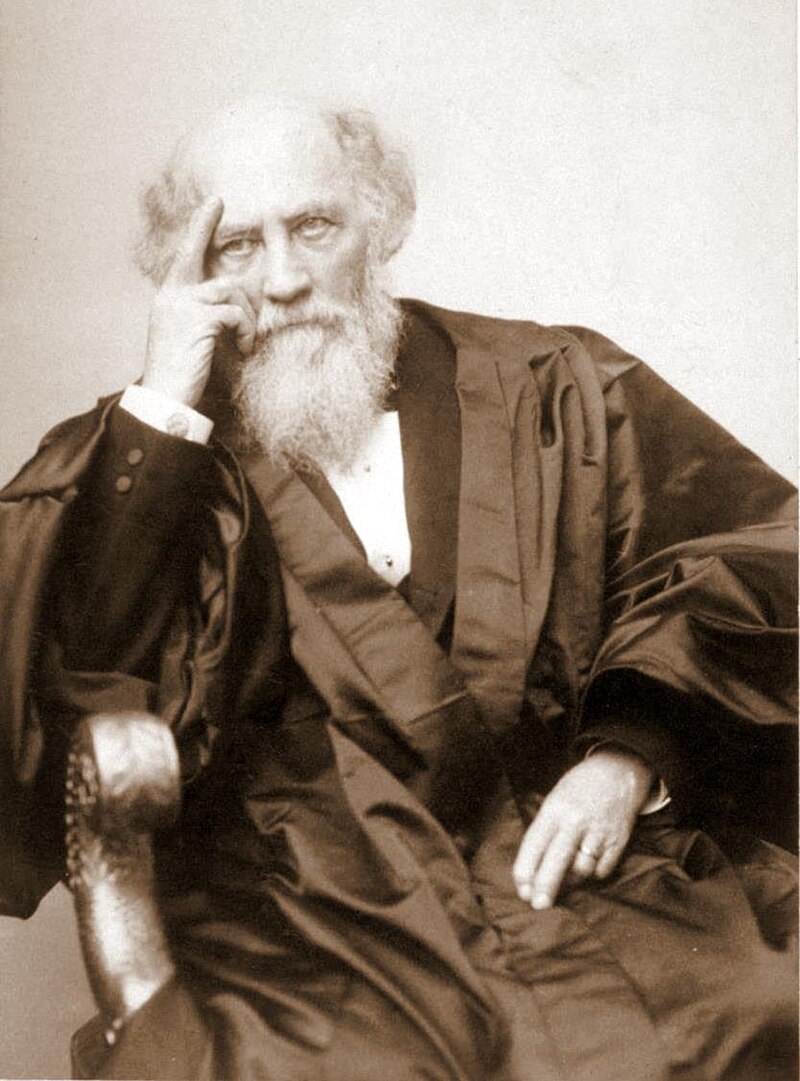
The majority decision, however, did not go unchallenged by a court minority.  In a dissenting opinion, Justice Steven Johnson Field, joined by two other justices, took strong objection to the majority opinion.  Shown here, Field wrote:  “The punishment imposed was one exceeding in severity, considering the offenses of which the defendant was convicted, anything which I have been able to find in the records of our courts for the present century…. Had he been found guilty of burglary or highway robbery, he would have received less punishment than for the offenses of which he was convicted. It was six times as great as any court in Vermont could have imposed for manslaughter, forgery, or perjury. It was Field which, in its severity, considering the offenses of which he was convicted, may justly be termed both ‘unusual and cruel.’


Field continued: “The state has the power to inflict personal chastisement, by directing whipping for petty offenses,—repulsive as such mode of punishment is,—and should it, for each offense, inflict 20 stripes, it might not be considered, as applied to a single offense, a severe punishment, but yet, if there had been 307 offenses committed, the number of which the defendant was convicted in this case, and 6,140 stripes were to be inflicted for these accumulated offenses, the judgment of mankind would be that the punishment was not only an unusual, but a cruel one, and a cry of horror would rise from every civilized and Christian community of the country against it.”


In reality, O’Neil’s chances of appeal having been exhausted, he faced an order in 1894 committing him to the House of Correction in Rutland for one month (some accounts say two) and ordered to pay more than $6,000 in fines and court costs.  Because the prison records subsequently were destroyed by fire, there is no way of knowing how much time O’Neil actually served.  It can be assumed he paid the heavy fine.  During ensuing  years Vermont’s liquor laws themselves loosened.   After another referendum, the state in 1903 restored “local option.”


As proclaimed by Alan Westin above, John O’Neil indeed had written his name in American judicial history — to his personal peril.  He subsequently returned to a more normal life in Whitehall, residing at 21 Canal Street.  The 1900 census found him there, 48 years old, with wife Annie.  His occupation was given as owner of a “combination store,” perhaps indicating some expansion of his inventory beyond liquor and beer. 

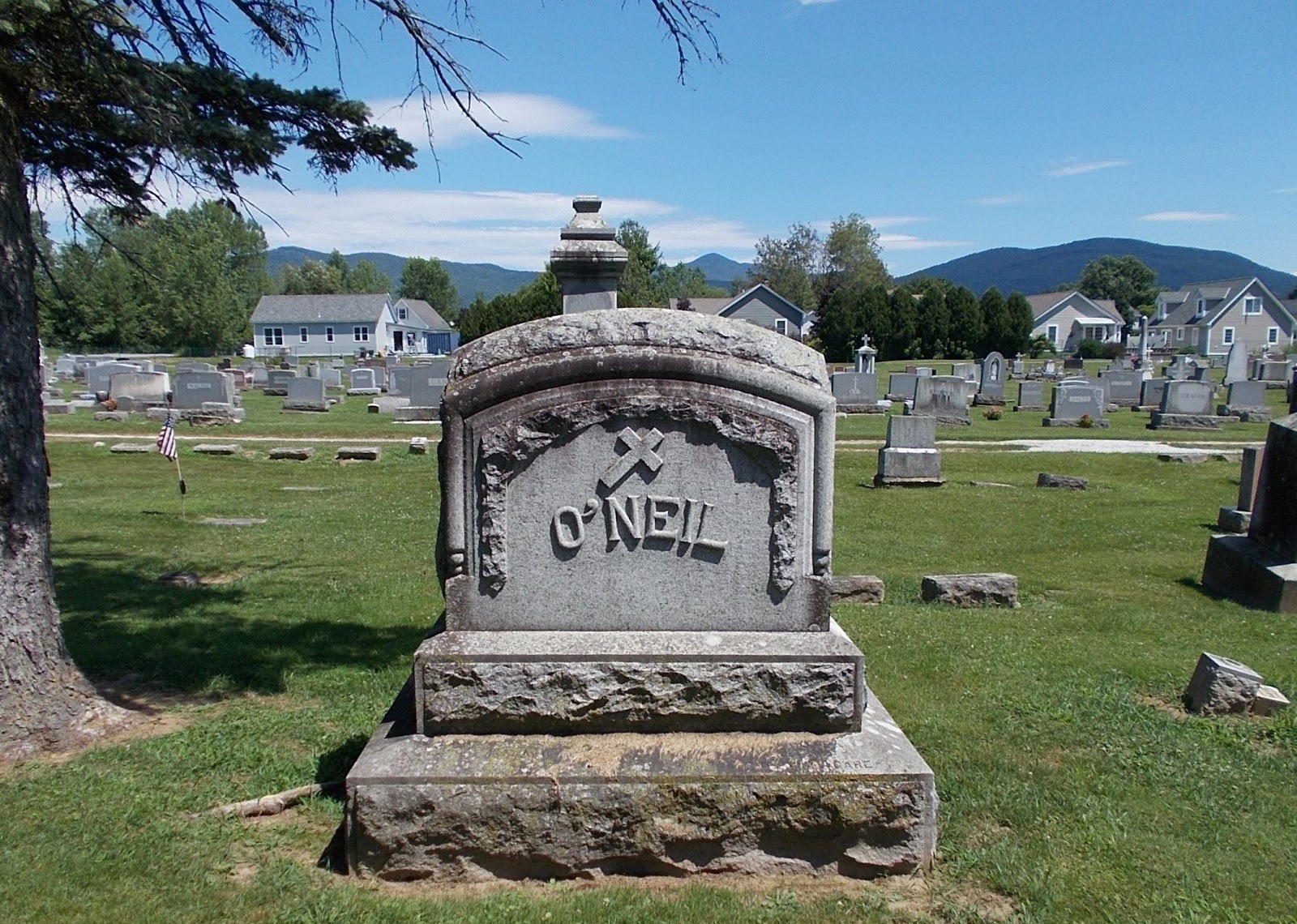
By the time of the 1915 New York State census, O’Neil had retired.  The much persecuted liquor dealer lived to be 77 years old, long enough to see National Prohibition imposed, prove to be a disaster, and repealed.   Having sufffered a fatal stroke in 1935, O’Neil was buried in the family plot in Calvary Cemetery.  Ironically the site was in Rutland, Vermont — focal point of all the whiskey man’s troubles.  Wife Annie had preceded him there by 22 years, dying in 1913.

Note:  Much has been written about the case of O’Neil vs. State of Vermont, leaving an almost decade long record of trials and judicial opinions ranging from a Rutland justice of the peace to United States Supreme Court Justices, followed by multiple opinions from Constitutional scholars.  It continues to be an excellent example of judicial overreach.  The post, however, lacks a photo O’Neil.  I am hoping that some alert descendant will remedy that omission.


John O’Neil and Vermont’s “Dry” Laws

John O’Neil was a liquor dealer in Whitehall, New York, doing a thriving mail trade into neighboring Vermont. In December 1882,in what is often referred to as “The Jug Case,” O’Neil was convicted in Vermont on 307 counts of selling whiskey by mai and shipping it from New York to Vermont, contrary to Vermont’s prohibition law.  He was given a severe fine and sentenced to hard labor for 19,914 days (54 Years) if the fine was not paid by a specific date.  

The case went all the way to the U.S. Supreme Court and dragged on for almost ten years.  In the end O’Neil paid a smaller fine and may have spent some time behind bars.   Writing about O’Neil’s legal woes in Vermont courts, the distinguished American legal scholar Alan Westin wrote:  “In any event, whether he broke Vermont granite for decades or became a pioneer father of California, O’Neil’s place in American constitutional history is secure.”


The story begins in Maine where Portland mayor and Prohibition zealot Neil Dow had engineered the first statewide “dry” law. (See post on Dow September 14, 2021.)  Shown here, Dow came to Vermont’s Statehouse to lobby for a similar alcohol ban in 1852.  The Women’s Christian Union and other groups joined to vote Vermont “dry” the following year.  Although the total ban eventually was lifted, it was in force long enough to embroil John O’Neil — severely.


Born in Vermont, O’Neil was the son of Irish immigrants, Edward and Mary O’Neil.  According to 1870 census data, his father was a laborer as was John at age 18.  Three years later the youth wed Anna M. Conline, both 21. They would have two children, John James and Louis. His new role as a family man likely triggered O’Neil’s changing occupations, moving a few miles south across the Vermont border to own and operate a liquor store in Whitehall, New York.

O’Neil had a sense of the artistic for his liquor containers.  Buying his whiskey by the barrel, he decanted it into ceramic jugs of varying sizes for sale.  As many Eastern dealers, he preferred to market containers that bore labels in cobalt hand applied script, bearing his name and often the city. (One, top left, recently sold for $475.)  O’Neil also offered a line of beers, advertising as a bottler of Schlitz and employing clear blob-top bottles as containers. 


Meanwhile Vermont legislators, taking their lead from Dow and the WCTU, voted to make the entire state “dry,” banning the production and sale of all alcohol, except for Communion wine and medicinal purposes.  Subsequently put to a public vote the ban prevailed  22,315 to 21,794, a margin of only 521 votes statewide.  Meanwhile in Whitehall, O’Neil was neither making or selling whiskey in Vermont, but his sales there were booming, protected, he apparently believed, by the process.  It worked this way:  O’Neil would receive orders from Vermont through the railroad.  The orders came on cards with a Vermont address and the order attached to a jug.  In Whitehall, O’Neil would fill the jug, pack it, and send it back to the addressee by rail with a bill for “cash on delivery”  The money was collected by railroad personnel and returned to the O’Neil in New York.

In Vermont, however, customs officials and state police were on alert. It had been noted that liquor supplies coming from New York had increased substantially despite all efforts to control them.  In 1882 a complaint was lodged against O’Neil  fueling an investigation.  He was charged with 475 offenses in trafficking liquor and wine into Rutland, Vermont.  A trial was held at the Rutland Courthouse, a supreme irony:  Rutland was the place of O’Neil’s birth, he considered it his home town, and many years later he would be buried there.


Rutland Courthouse

Although O’Neil essentially had only been charged with a single count of a jug being sent into Rutland, a local judge and jury through some dubious reasoning and fanciful mathematics sentenced him on 307 counts of violating Vermont’s prohibition law.   O’Neil was fined $6,140 dollars (more than $200,000 in today’s dollar) and sentenced to 19,914 days of hard labor (54 years) if the fine was not paid by a given date.  The threatened punishment was in excess of sentences for much more serious crimes including armed robbery, forgery and manslaughter.


Chief Justice Blatchford

Over the next six years O’Neil appealed his case through the Vermont court system all the way to the United State Supreme Court.  Although the matter reached the High Court in 1889, the justices did not rule until almost another three years had elapsed.  Then, in an opinion written by Chief Justice Samuel Blatchford, the Court majority decided that it lacked jurisdiction to rule against Vermont and in effect let the draconian verdict stand.


Justice Field

The majority decision, however, did not go unchallenged by a court minority.  In a dissenting opinion, Justice Steven Johnson Field, joined by two other justices, took strong objection to the majority opinion.  Shown here, Field wrote:  “The punishment imposed was one exceeding in severity, considering the offenses of which the defendant was convicted, anything which I have been able to find in the records of our courts for the present century…. Had he been found guilty of burglary or highway robbery, he would have received less punishment than for the offenses of which he was convicted. It was six times as great as any court in Vermont could have imposed for manslaughter, forgery, or perjury. It was Field which, in its severity, considering the offenses of which he was convicted, may justly be termed both ‘unusual and cruel.’


Field continued: “The state has the power to inflict personal chastisement, by directing whipping for petty offenses,—repulsive as such mode of punishment is,—and should it, for each offense, inflict 20 stripes, it might not be considered, as applied to a single offense, a severe punishment, but yet, if there had been 307 offenses committed, the number of which the defendant was convicted in this case, and 6,140 stripes were to be inflicted for these accumulated offenses, the judgment of mankind would be that the punishment was not only an unusual, but a cruel one, and a cry of horror would rise from every civilized and Christian community of the country against it.”


In reality, O’Neil’s chances of appeal having been exhausted, he faced an order in 1894 committing him to the House of Correction in Rutland for one month (some accounts say two) and ordered to pay more than $6,000 in fines and court costs.  Because the prison records subsequently were destroyed by fire, there is no way of knowing how much time O’Neil actually served.  It can be assumed he paid the heavy fine.  During ensuing  years Vermont’s liquor laws themselves loosened.   After another referendum, the state in 1903 restored “local option.”


As proclaimed by Alan Westin above, John O’Neil indeed had written his name in American judicial history — to his personal peril.  He subsequently returned to a more normal life in Whitehall, residing at 21 Canal Street.  The 1900 census found him there, 48 years old, with wife Annie.  His occupation was given as owner of a “combination store,” perhaps indicating some expansion of his inventory beyond liquor and beer. 

By the time of the 1915 New York State census, O’Neil had retired.  The much persecuted liquor dealer lived to be 77 years old, long enough to see National Prohibition imposed, prove to be a disaster, and repealed.   Having sufffered a fatal stroke in 1935, O’Neil was buried in the family plot in Calvary Cemetery.  Ironically the site was in Rutland, Vermont — focal point of all the whiskey man’s troubles.  Wife Annie had preceded him there by 22 years, dying in 1913.

Note:  Much has been written about the case of O’Neil vs. State of Vermont, leaving an almost decade long record of trials and judicial opinions ranging from a Rutland justice of the peace to United States Supreme Court Justices, followed by multiple opinions from Constitutional scholars.  It continues to be an excellent example of judicial overreach.  The post, however, lacks a photo O’Neil.  I am hoping that some alert descendant will remedy that omission.


Mannie Hyman — Leadville’s Premier Saloonkeeper


The first saloon opened in Leadville, Colorado, in 1877, followed by hundreds more of varying character.  The city’s most notable “watering hole” was Hyman’s on Harrison Avenue.  Hugely popular, the Leadville saloon became famous for occasional gun play, celebrity visitors and general hi-jinx.  Overseeing the totality of those “attractions” — and reaping the profits — was its immigrant proprietor, Mannie (sometimes given as Manny) Hyman.

Hyman was born in May 1851 in Schwersenz, then part of the Prussian Empire, now part of Poland (Swarzedz), the town shown here.  Possibly to avoid conscription into the Prussian Army where many died in basic training, at the age of about 15 he exited Germany and sailed to America, landing in New York about 1866.  From there his trail grows cold.  Hyman next surfaced in 1879, age 18, living in the Colorado mountains at Kokomo, Summit County.  Once a gold and silver mining community of 10,000, today it is a ghost town.


 Hyman had gained experience in the liquor trade and sufficent funds to start a saloon and liquor store in the boom town.  His enterprise ended in October 1881 when a fire broke out, reportedly caused by a faulty lamp. Kokomo had no way to fight the flames.  Most of the town was destroyed, including Hyman’s saloon, a $3,500 loss.  While he may have rebuilt temporarily, he did not stay long in Kokomo.


The German immigrant turned his interests toward mining.  By March, 1880, Hyman owned the Grand View Mine and, according to the Leadville Weekly Democrat, the site was in in great demand from investors and speculators. “Mr. Hyman is constantly receiving letters and telegrams from parties wishing to purchase the property…”  By the following year Hyman also had mining interest at a location near Kokomo called “Gold Hill.”  Unsatisfied by his mining returns, however, Hyman yearned to return to the liquor trade.  


He found it in nearby Leadville, shown above.  By 1880, this town was one of the world’s largest and richest silver camps, with a population of more than 15,000, Income from more than thirty mines and ten large smelting works producing gold, silver, and lead amounting to $15,000,000 annually.  In the early autumn of 1882  Hyman purchased the Leadville saloon license held by two locals at 314 Harrison Avenue, and later bought the adjoining storefront at 316 Harrison.  Those addresses would become central to his Leadville “watering hole” for years to come, as shown on the fire map below.

Happenings at Hyman’s’s.  Mannie’s drinking establishment rapidly became the most popular venue in Leadville.  Located on a major downtown street, it adjoined the city’s prime theater, the Tabor Opera House, property of Colorado millionaire, Horace Tabor. (See post on the Tabors, April 14, 2018.)  An 1880s photo shows the theatre right of Hyman’s saloon.  Across the street from the Opera House was the Clarendon Hotel, Leadville’s premier hostelry.  It housed celebrities and actors who performed at the theater.  As the result of these attractions, Hyman’s bar, below, was a popular hangout.


Among them was Oscar Wilde, the famed British author, playwright and wit, who was on a lecture tour of the United States, apparently not fearing to appear in the “Wild West.”  Shown here he appeared at the Tabor Opera House on April 14, 1882. Speaking on the topic “The Decorative Arts,” Wilde is reported to have drawn a large Leadville audience.  After his lecture he  found time to visit Hyman’s Place for drinks.  Wilde later commented: “Where I saw the only rational method of art criticism.  I have come across, over the piano, printed a notice: Please do not shoot the pianist. He is doing his best.”


Other prominent visitors were “Unsinkable” Molly Brown, survivor of the Titanic disaster, and her considerably older husband, James J. Brown, a millionaire Colorado mine owner and engineer.  The Browns had acquired  great wealth in 1893 when Brown was instrumental in the discovery of a substantial gold ore seam at the Little Jonny Mine. They are shown here with their children.   A popular motion picture later would be made about the couple.  


Brown wrote his name in the history of Hyman’s saloon, the result of a tussle he had with another patron after accidentally bumping into him.  They exchanged insults.  Then matters got physical.  A reporter for the local newspaper told the story:  “The result was that Brown seized a chair and was about to resolve it into its original elements over Chamberlain’s head, but instead of the intended object getting it, an innocent and unsuspecting chandelier that was looking down on the fight, received the full benefit of the blow.”   And fell.  According to witnesses, Hyman’s chandelier knocked out Brown and his opponent was left unhurt.  Both men were arrested, fined $5 and court costs. 


A more serious altercation occurred at Hyram’s two years later involving the Western gunman, “Doc” Holiday, the dentist turned gunslinger and participant in the famous Gunfight at OK Corral.  Now sick and impoverished, Holiday was working for Hyman dealing cards when confronted by Billy Allen to whom he owed $5.   Although witnesses claimed Allen was unarmed and simply wanted to talk, Holiday testified he thought he was being attacked. He drew his gun and fired.  As proof of Holiday’s infirmity, the first bullet was wild, lodging in the front door.  A second  bullet hit Allen in the arm, a wound from which he later recovered.  Holiday was incarcerated.  After lengthy court procedures that received wide press attention, the dentist turned gunfighter was acquitted of attempted murder and released.  He left Leadville and died of tuberculosis two years later.


Hi-jinks at Hyman’s involved the proprietor himself. When two customers ordered a bottle of German white wine, the men bet Mannie $50 that the bottle was a not a genuine import.  Mannie took the bet and offered to double the amount.  The men agreed. Three Denver liquor importers were recruited to taste the wine and determine its authenticity.  They confirmed it.  Mannie collected $100 dollars.


In late 1883, A man approached Mannie with the story that the body of a “petrified” man had been located 50 miles south of Leadville.  He suggested the stone corpse could be displayed as an attraction at the saloon. Mannie agreed to finance an elaborate effort to recover the oddity.  Further investigation found that instead of a calcinated corpse, the body was a frozen stiff dead man. The deal fell apart. Mannie reportedly lost $1,000 in the escapade.


Mannie’s Business Philosophy.  In December of 1883, a reporter stopped at Hyman’s Place to ask about the proprietor’s success over the past year.   Gold and silver deposits were dwindling, the population of Leadville was declining, and many businesses, including saloons, were feeling the pinch.  Despite such concerns, Hyman’s establishment was always crowded and the owner continued to be a genial host.  Why, the reporter asked, was this so?


Normally reticent, Mannie opened up to the inquiry: “‘I never like to talk about myself or my business to a newspaper man… but if a discovery of a ‘secret’ as you call it, will relieve your anxiety, I shall be happy to unfold it to you.  One prime reason of my success is found in the fact that my patrons are treated alike, without discrimination as to wealth, worldly position or the clothes they wear. As a caterer to the public, I depend upon the public for success, and do not extend any more favors to the mining prince than I give to his humble employee. In my opinion all men are alike so long as they conduct themselves as gentlemen, and my employees have instructions to insult nobody until they are insulted. That is one of the reasons of my success, and, I believe the principal one.


Ask by the journalist to suggest other positive attributes, Mannie continued by saying:  ‘Well, I sell the best goods in the market at prices which rob neither my patrons or myself. I do not claim to sell better goods than my competitors. I merely claim to keep as good a stock as anyone else, and sell it as cheaply as anyone else….I have done an extensive business during the past year, for which I am very thankful to the public of Leadville.”


Mannie In and After Leadville.  As a leading businessman, Hyman was frequently solicited to make contributions to Leadville charitable causes.  In addition to being a generous donor, he had his own causes.  A staunch Republican, he financed a private poll of Leadville’s voting population.  An avid fan of baseball,  he was a director and major funder of the “moderately successful” Leadville Baseball Club.  Mannie also raised funds for a medallion honoring George W. Cook; a Rio Grand Western Railroad employee who orchestrated rescue efforts following an avalanche at the Homestake Mine. 


During this period Mannie fell in love. Her name was Fannie Goldman.  Originally from Chicago, Fannie came to Leadville in 1866 to visit her aunt and uncle, a local merchant.  The couple met during a fishing trip that included a number of prominent local businessmen.  Mannie, a 35-year old bachelor, was immediately taken with the younger Fannie. The couple announced their engagement to Leadville newspapers in September of that year and married in Chicago on February 1, 1887.  The marriage seemingly spurred Hyman’s disengagement from both his saloon and Leadville.

As Mannie sold off his assets, including Hyman’s Place on Harrison Street,  above, the Leadville Herald Democrat commented:   “The revenues that have been derived from this property since it was purchased by Hyman a few years ago, have been something enormous, and to-day it is regarded as one of the most valuable of the avenue possessions.  Taking his profits and Fanny with him, Hyman moved to Denver.  There he opened up a tobacco shop, advertising as “State agent for Palacios, Rodriquez & Co.’s celebrated Aurcliae clear Havana cigars, at wholesale. A full fine stock.”


The following years seemingly proved difficult for Hyman.  The tobacco business in Denver seemingly did not go well.  Moreover Mannie and Florence’s marriage hit the rocks and in 1911 the couple divorced.  There were no children.  Mannie moved out of Denver to live in New York City, his occupation, if any, unknown.  He is recorded living in a boarding house until his death in May 1924 at the age of 73.  In Leadville Hyman had been an important personage; in New York he was just another elderly man walking the streets of Manhattan.


Notes:  This post would not have been possible without information provided by  Temple Beth Israel and its website JewishLeadville.org.  Their article about Mannie Hyman and his saloon was invaluable.  Although the website also provides many photos of Leadville residents, unfortunately Hyman’s picture is not among them.


Scroll to Top