Author name: Jack Sullivan

Cato Alexander: America’s 1st Celebrity Bartender


Cato Alexander was born a slave, remained illiterate all his life, and is said to have known George Washington.  By dint of inherent intelligence and hard work, he rose to become the owner of a highly popular early New York City tavern and has been hailed as “America’s first celebrity bartender.”  Unfortunately there are no known images of Alexander, described as “dark-complected, broad-shouldered and sturdy… hospitable and dignified.”


While Alexander’s birth year is generally agreed as 1790, the place variously is given by historians as New York, Virginia or South Carolina.  My inclination is to the Southern states where it was illegal to teach a slave to read and write.  Early in life the boy Cato fetched up in New york City.   That is where he apparently encountered George Washington known for stopping at inns for rest and refreshment.  Because Washington died in 1799, Alexander at most would have been a groom, a young boy helping the former President from his horse and tending to the animal.


As he matured Alexander, by dint of his demonstrated abilities, found work in several New York City inns and hotels, learning both to cook and work behind the bar.  He became free in 1799 through provisions of the Act For the Gradual Abolition of Slavery, opening new opportunities for the former slave.  After a decade of working for others Alexander was able to muster sufficient resources to purchase the two-story building, shown below,  and open it as “Cato’s Tavern.”


It was an almost immediate success, favored by the local New York elites.  Among his customer base he could count the young people of  wealthy families such as the Beekmans and Van Courtlands.  Members of the Belvedere Hunting Club, a prestigious sporting organization, met there regularly, another lucrative source of revenue.  Alexander had located his watering hole strategically on what was called “The Harlem Road,” today East 54th St. and 2nd Avenue.  For young bucks with fast horses, it was ten minutes from the then city limits, then confined to the southern tip of Manhattan.  The 1800’s print below features two sporty horse traps racing up the road to Harlem, possibly competing to arrive first at Cato’s.


Once there they would have been treated with topnotch food and drink.  Alexander’s signature dishes included roast duck, fried chicken, curried oysters, and terrapin (turtle).  His food was widely hailed but took second place to his mixed drinks, among the first to be referenced as “cocktails.”  Among his most famous concoctions were his South Carolina Punch, Gin Toddy, below left, and Virginia Eggnog, right. 


Power

The quality of his drinks led the Irish actor Tyrone Power (father of the 1950s movie star of the same name) to declare:  “Cato is a great man.  Foremost among cullers of mint…for julep” and “Second to no man as a compounder of cock-tail.”  In 1835, the New York Mirror opined:  “Who has not heard of Cato Alexander? Not to know Cato’s is not to know the world.”  When Alexander married Eliza Jackson in 1828, the New York Evening Post printed this verse for the occasion:


                            Cato the great has changed his state,

                          From single to that of double;

May a long life with a Jackson wife

Attend him void of trouble.


Another writer, noting the frequent mention of Alexander in the press claims that: “Cato’s name became known all over the U.S….Word of mouth about his legendary [tavern] was spread as far as the tongue could wag.”


Not all New Yorkers were enthusiastic about Alexander’s success. He sometimes was harassed and threatened by whites who could not tolerate a formerly enslaved black man coming so far and rising so high in public attention and esteem.  “Trouble” resulted in the shape of brothers George and Andrew Luke who plotted to bring down Alexander.  Local tavern owners themselves, they were fiercely jealous of Cato’s success.  In January 1831 with others they headed to his tavern on the Harlem Road. They brought with them chains, clubs and other weapons.


Their plans relied on Alexander’s soft heart.  The tavern was shut tight.  Cato and Eliza were both in bed, when a loud knock was heard at the door.  Cato got up to see who it was.  Through the door a woman pleaded to him to let her in to get out of the January cold.  She said she had lost her way.  He obliged and went back to bed.  When she was assured the couple was asleep, the woman unlocked the door and let the Luke brothers and their accomplices inside.  


The intruders proceeded to wreck the interior of the tavern, smashing mirrors, bottle of liquor, and furniture.  Not content with damaging property, they attacked Cato and his wife, who was pregnant and almost beat them to death.  It took months for the couple to recover from their wounds and similar time to repair the damage to the tavern.  Eventually Alexander was able to recover and be back with a thriving business for at least 30 years.


It was not prejudice against blacks that led to Alexander’s downfall, rather it was the same generous nature that impelled him to give a warm place to a pleading woman. One of his biographers explained his downfall:  “A significant amount of Cato’s clientele were young, wealthy whites. He became friends with a lot of them, and he was known for giving out loans to those who were down on their luck in hopes of nestling his way into high society.  But also, as a man who himself started from the bottom, he knew what it was to struggle and wanted to help if he could.”


Whatever his motive, Alexander accrued considerable debt.  Whether his illiteracy prevented him from keeping accurate records or for other reasons, he 

often was not paid back by those who borrowed.  In the process, he accrued at least $100,000 in debts, equivalent to $3,000,000 today.  Alexander was ruined financially and forced to close down Cato’s Tavern.


Before long Alexander attempted a new start by opening Cato’s Oyster House in Manhattan.  It was not a success, driving the former slave even deeper in debt.

By now approaching 70 years old and in ill health, he shut down the restaurant after one year and retired.  Alexander is believed to have died in poverty in New York in February, 1858.


What made Alexander even more remarkable as a mixologist is that, illiterate, he did not have any written drinks recipes.  What he knew was the result of bar traditions passed down though the black community and his own experience.  Posthumously proclaimed “Father of Mixology,”  Alexander’s recipes have been lost in the mists of history.  


A self-described “spirits savant” named Alexi Fisher, shown here, has attempted to remedy that sad fact by teaching online courses attempting to recreate the cocktails as Cato might have made them.  She includes the well-recognized “Brandy Alexander,” unfortunately not invented by Cato but likely by another New York bartender, Troy Alexander, who held forth at the famed Rector’s restaurant.


Notes:  Resources on Cato Alexander are abundant on the Internet.  Principal among them are online articles by Sierra Lawson and David Wonderich.  The slave turned master mixologist continues to fascinate.  Above is the picture of “Cato’s Tavern made the centerpiece a quilt that recently sold online.


Early Philadelphia Taverns & Inns: Part 2

 Foreword:  In 1908 the Robert Smith Brewery commissioned Philadelphia painter and illustrator James Moore Preston to provide it with a series of works depicting pre-Revolutionary taverns and inns in or near the “City of Brotherly Love.”  Preston created twelve color lithographs.  I find the pictures striking and believe they deserve preservation through this blog, along with some inkling of the histories of each of those early Philadelphia “watering holes.”  Six were presented in Part 1, posted on January 1.  This post completes the series.


The Blue Anchor Inn
on Front Street at Dock Creek was the oldest inn in Philadelphia, built in the decade between 1670 an 1680.  William Penn is said to have supped there upon his first arrival in the city in 1683.  Some believe that the Blue Anchor is the first structure built in Philadelphia.  The lumber is thought to have come over in the first ships to dock there.  The structure was timbered, filled in with small bricks and had the dimensions of twelve by twenty-two feet.  It has been called “the only public building” in the city for a time, a place where ship-masters, merchants and other citizens could gather.


Where Preston got his model for the Blue Anchor is unclear.  A newspaper illustration
 of the tavern shows a somewhat different building, isolated on the shore and approached by row boat.  It depicts Indians with bows and arrow looking on.  The scene in Preston’s 1908 color lithograph shows a building of at least three stories with other structures around it.  Because the contours of both are the same, my guess is that improvements over the years and the growth of Philadelphia around the tavern led to the changes.


The brewery-sponsored picture above entitles it the State House Tavern, because of its location across from the government center.  This Chestnut Street drinking establishment also was known at various times as the Half Moon, the Coach and Horses, and foremost as Clarke’s Inn.  “The table was good, and the inn became one of the chief centers of official activity.”  


Although Preston’s picture gives the structure a jaunty look, including figures bowling on the lawn,  an earlier lithograph shows a much more austere Clarke’s. Brewery founder Robert Smith in his diary related that an apprentice had ruined the malt supply by over-heating:  “I being gone to the Half Moon for dinner.”


An advertisement in the Pennsylvania Packet of March 9, 1772, by owner James Alexander announced the Black Horse Inn, located on Second Street near Callowhill, calling it a “Commodious Inn of Entertainment” and convenient for market people.  He went on describe its livery stable as “good as any in the Province,” able to stable as many as fifty horses at a time and offering “a good yard for coaches, chaises,and wagons.”  Preston has caught much of this in his drawing, with a carriage and horses as major elements.


Although Anderson did not detail the kind of entertainment the Black Horse provided, another source has described it:  “In 1805 two live porpoises were exhibited at the Black Horse and the following year the learned African Horse, “Spotie,” which had a tail like an elephant’s and a knowledge of arithmetic. The same year two royal tigers from Surat in Asia and a living sea-dog, taken on the Delaware River near Trenton, were shown.”  Although the Black Horse did brisk business through the mid-19th Century, by 1917, as shown here, it was badly deteriorated.


Depicted by Preston amid a wintery scene, the Moon and Seven Stars, standing at the southwest corner of Fourth and Chestnut Street, was one of the best known inns of its day.  Standing between the Delaware River wharves and the State House, it served both the maritime and commercial communities.  In addition:  “Several clubs made it their meeting place, and all the leaders of American thought and action enjoyed the hospitality of its tap-room or its ordinary at one time or another.”  On the lithograph, the sign of the Moon and Seven Stars appears very small.  A reproduction captures it much better.


The Three Crowns was a public house famed for the good food provided by its owner, a Mistress Jones.  It was housed in a two-story building adjoining the south end of the City Tavern (see Part 1).  It fronted on both Second Street and Walnut with a spacious courtyard that stretched to Dock Creek.  “At that house Richard Penn and other governors, generals and gentry used to be feasted.”  The sign of the Three Crowns has a distinctive accent of British royalty.


The final lithograph is of the Spread Eagle Inn.  It was located fourteen miles west of Philadelphia on the Lancaster Pike, one of the first turnpikes to be built in America.  The Spread Eagle was the first relay station and stage house west of the city.  Customers traveling on their way west as far as Pittsburgh would leave Philadelphia early in the morning and stop at the Spread Eagle for an ample breakfast.  Preston’s picture captures the moment of such an arrival as the proprietor stands in the doorway to welcome his guests.  The artist apparently took his visual clues from an earlier illustration, adding color and detail.


This building was replaced circa 1800 by a large stone tavern, also called the Spread Eagle.  About 1824, the hostelry triggered controversy when the original signboard, shown here, was altered by a local artist. He added a second neck and head to the representation of the American eagle, leading to considerable “political excitement.”  Neighbors and wagoners could not see why “our glorious bird of freedom” should be altered into a European-looking symbol.  The tavern was derided as the “Split Crow” by dissidents, causing the sign hastily to be repainted — “Americanized” once more.


James Moore Preston’s colorful and engaging 1908 art works allow a brief exploration of Philadelphia’s earliest and most historic inns and taverns, all of them but one long since disappeared.  The exception is City Tavern, seen in Part 1 of this series.  Another City Tavern has been reconstructed on the earlier site.  Said to be a replica of the original, the building appears to be significantly different from Preston’s representation.  In any case we can be grateful to the Robert Smith Brewery that commissioned these colorful images of a bygone day. 

Early Philadelphia Taverns & Inns: Part 1

Foreword:  In 1908 the Robert Smith Brewery commissioned Philadelphia painter and illustrator James Moore Preston to provide it with a series of works depicting pre-Revolutionary taverns and inns in or near the “City of Brotherly Love” as a way to promote its brand of beer.  Although  he has been considered a member of the Ashcan Group and exhibited in the famous 1913 Armory Show, Preston was an artist who worked in many modes.  He created color lithographs that memorialized the founding of the Smith Brewery in 1774 and eleven early Philadelphia “watering holes.”  I find the pictures striking and believe they deserve preservation through this blog, along with some inkling of the histories of each tavern and inn.  Some information was provided by the Smith lithos — and is quoted.  Other illustrations and information are the result of my research.


The first illustration is of the original brewery in Philadelphia, owned by a man named Joseph Potts and later by Henry Pepper.  In 1845 he sold out to  Robert Smith who had come to America in 1837 from England after having served an apprenticeship with the Bass Brewery there.  He died at 86 in 1893 and the business was reorganized as the Robert Smith Ale Brewing Co., owned by Schmidt’s Brewery of Philadelphia.  It is shown here as it looked about 1908.


The London Coffee House was built in 1702 at Front and Market Streets and remained intact until it was torn down in 1883.  Given that Preston drew it a quarter century later, how did he know what it looked like?  The answer lies in earlier lithographs that the artist clearly drew on to create his version.  The one shown here served as a model, right down to the four horse carriage at right.  The caption tells us:  “London Coffee House was…the center of pre-Revolutionary life in Philadelphia…where cargoes were bought and sold, slaves and good were auctioned, and the news of the day discussed.”


Amazingly, the Penny Pot House derived its name from the fact that a customer could buy a container holding about a pint of beer at the tavern for a single cent. Considered the second oldest tavern in Philadelphia, it was a landmark that stood near the docks on the Delaware River.  A Maryland guest was shocked by the revolutionary talk he heard there, retorting: “The Delegates rage windily against the King’s Blessed Majesty, which shall stand as firm as the House that was founded on the Rock.”  Preston’s recreation of the Penny Pot may been taken in part from a 1700 lithograph shown here.  Note that Preston has put the landing point closer to the water than the earlier version.


Completed about 1770, City Tavern was located on Walnut Street above Second. The Continental Congress met there in 1774, two years before the Revolution. “It was early an important place, and after the Revolution succeeded the London Coffee House as the central place of Philadelphia.”  During succeeding years the establishment underwent several name changes until the building was demolished in 1852.  My assumption is that Preston relied on a old lithograph to guide him.  In recent years the City Tavern has been reconstructed at the original site. It is said to be historically accurate.  Shown here, however, the building looks quite different from the brewery drawing.


The Indian Queen was a hotel noted for the importance of its residents.  It was the home of Robert Morris, the financier of the Revolution, and provided lodging for both George Washington and John Adams.  “Jefferson had his study in the south front room of the second story, from which arose the erroneous tradition that in this room he drafted the Declaration of Independence.”  Preston’s depiction echoes a contemporary print of the Indian Queen but features a different sign over the door.


Opened as the Washington Tavern about 1790 at Sixth and Jayne Streets, the name was changed to the Falstaff Inn in 1830.  Owned by William Warren, an actor and former theater manager, he renamed it to commemorate his own stage portrayal of Falstaff.  Not only that, he had himself painted as Shakespeare’s fat rogue on the sign that can be seen at the second floor corner. The accompanying motto reads:  “Shall I not take mine ease at my inn?”  Over the years the hotel deteriorated into little more than a flop house, as shown here, and eventually was torn down.


A second set of James Moore Preston’s illustrations will follow in a separate post tomorrow.


J. G. Philpott: Michigan’s “Hale Fellow Well Met”

If you chanced to meet Jay George Philpott at one of his Michigan enterprises, he almost certainly would become an instant friend and confidant — and have something to sell.  It might be liquor, oysters, insurance, used cars, or even Russian bonds.  In one ad Philpott boasted: “Dealer in Everything Under the Sun except Salt.”  His home town newspaper termed him a “hale fellow well met” perhaps ignorant that the term often refers to a disingenuous, insincere friendliness.  Or maybe not.

The eldest of three sons, Philpott was born in Broome County, New York in November 1866, to Alice (Mosher) and Thomas Philpott, a Civil War veteran and iron worker.  Indicating that the family was not wealthy, the 1870 census recorded the boy Jay working as a clerk at the age of 14, apparently in a Utica, New York, drug store.  In 1885, at age 19,  Philpott passed the state exam to become a licensed pharmacist.


The youth eventually was drawn to other locales and occupations, moving to Detroit, Michigan, to work for the Koppitz-Melcher Brewing Company in sales.  The brewery was the brain child of Konrad F. Koppitz, an immigrant from Austria who was a highly respected brewmaster when he organized and became company president.  From Koppitz Philpott may have learned the value of assertive advertising, e.g. the brewery’s claim to make “Detroit’s Perfect Beer.”


After five years in Detroit, Philpott stuck out on his own.  In a highly unusual move he established himself almost simultaneously in two smaller Michigan cities, Port Huron, the northeastern most point of the state on Lake Huron,  and Adrian, 130 miles southwest of Port Huron, not far from the Ohio border.  In Adrian, left he opened a wine and liquor store on Main Street, shown here.  There Philpott also sold a wide range of non-alcoholic goods, including oysters, engendering this ad in the 1909 Adrian city directory:


In Port Huron, left, his J.G. Philpott liquor house began by operating in a small space in the downtown McMorran-Davidson Office Building, shown below.  By 1910 the organization had expanded to include a mail order business with operations on three floors. 


In a “puff” piece in the Port Huron Times-Herald in June, 1910, a reporter described the storefront on the ground floor as being the most elaborately furnished business in the city, likened to a bank with its “heavy counters” and “fancy brass lattice or wicket work.”  The writer went on to extoll the main stock room as resembling a drug store with liquor kept in “fancy mahogany and cherry finished cases.”  The story continued: “A large number of people are employed in the bottling department, where all kinds of high grade liquors are prepared for shipment. In the labeling department a number of girls find employment.”


Philpott himself was quoted extensively: “No matter how deeply we cut prlce we never cut quality.  All the goods we sell are the highest grade in their respective classes. We give the promptest, most careful and most efficient service that an up-to-date, finely equipped and thoroughly trained organization is capable of.”

The reporter felt constrained to point out that the J.G. Philpott Co. had never been accused of breaking the law.  Perhaps not, but stretching the truth, Philpott claimed his establishment was the “Largest Wholesale Liquor Store and Mail Order House in Michigan.”


As was customary with liquor enterprises like Philpott’s, it featured two house brands, likely mixed up on premises.  They were “Killarney Straight Whiskey” and “King Edward XII Straight Whiskey.”  The owner did not bother to register a trademark for either label.  As was customary for liquor wholesalers, Philpott issued shot glasses for both brands.  They would have been given to customers in saloons, restaurants and hotels for use over the bar.


According to his biography in the 1909 “History of Lewanee County,”  Philpott also was a gentleman farmer .  On the outskirts of Adrian he bought a 20 acre spread on which he raised poultry.  The biographer noted:  “He is a great fancier of finely bred chickens, and his pens of Houdans, Brahmas, and Leghorns [shown below in that order] have won many prizes at different fairs and poultry shows where they have been exhibited.


While his businesses and poultry hobby apparently were going well, Philpott’s marital situation was not.  In June of 1890 he had married 22-year old Gertrude Durham, the daughter of Joseph Durham of Romeo, Michigan.  They wed in Sarnia, Canada, the birth country of Gertrude’s mother’s.  There would be no children.  The stress on their marriage from the outset seems inevitable.  Philpott frequently was absent from their Adrian home for extended periods as he traveled to Port Huron to run his business there.  His wife may have been left behind to feed the chickens.  After nine years, she called it quits.  Charging Philpott with “extreme cruelty” Gertrude obtained a divorce.


Philpott, now 45, married again two years later.  This time his bride was  Ernestine Bowsky, 26, originally from a New York State family.  The couple would have one son.  They named him Jay George Philpott II.   This time Philpott made Port Huron his home base, housing his family at 517 Rawlins Street in a three story residence boasting a white pillared porch.


Philpott’s economic fortunes were about to change abruptly.  With prohibitionist Henry Ford leading the charge, Michigan in 1917 became the first Midwest State to outlaw the making and sales of alcohol.   This development apparently led him to shut down his Adrian company and in Port Huron shift to selling groceries.  When that enterprise proved unsatisfactory, Philpott moved, as many former whiskey men did, into the newly burgeoning automotive field.  He opened a business he called “Auto Sales Co” at 531 Water Street.  References to this company in Port Huron directories indicate that Philpott was selling auto insurance.  Not identified as a dealer for a specific make, Philpott apparently  was selling used cars, a perfect venue for a pitchman.


From the Water Street location, the “hale fellow well met” also was dealing in foreign securities, more specifically, Russian Imperial bonds.  These were highly speculative investments.  After coming to power the Soviet Government of Russia repudiated honoring any securities issued by the Czarist regime.  Given the extraordinary amounts of money involved, European bankers and others desperately kept alive the idea that someday the bonds would be paid off.  From time to time they floated rumors from of progress in negotiating with Russia’s Communist government.  The stories spiked brief inflation of values.  Banks and bond agents cashed in; small investors lost when the rumors proved to be just rumors.


Philpott, always open to opportunity, energetically was peddling Russian bonds to his fellow citizens, promising big returns once things got straighten out in Moscow.  By 1929, the Michigan Securities Commission in Lansing had had enough.  According to press accounts:  “Philpott is said to have disposed of virtually worthless Russian bonds to Michigan investors at a considerable loss to the latter…The Commission is seeking to revoke Philpott’s brokerage license and has ordered him to show cause why this action should not be taken.”  Although I cannot find the outcome of this official action, Russian bonds eventually proved to be all but worthless.


In the interim Philpott, the “hale fellow” died, age 58.  He succumbed at home on May 27, 1930, after a brief illness.  His funeral services were held at the residence, officiated by the Rev. Austin DuPlan, pastor of Grace Episcopal Church.  His remains, accompanied by his widow, Ernestine, and their son, were taken by train to Utica, New York.  Jay George was buried in the Philpott family plot in nearby Oriskany Cemetery.   Ernestine is not buried with him.


Note:  This post was constructed from a wide range of sources.  The most important was Philpott’s biography in “The History of Lenawee County Michigan,” Vol. I; Editor, Richard I. Bonner;  Western Historical Assn., Madison WI, 1909.


The Club Saloon of Choteau, Montana


Foreword:  When a cache of letterheads from Choteau, Montana’s, Club Saloon recently came up  for auction, I was struck by the numerous ownerships of that drinking establishment during just fifteen years.  The rapid turnover is intriguing, a story told in the stationery the proprietors left behind.


The oldest letterhead is dated Oct. 20, 1899.  The saloonkeeper was William E. Jeffrey,  whose stationery featured a fancy backdrop, full of curves and splotches.  He advertised that “The Club”  could provide “wines, whiskeys and cigars.”  Jeffery featured  the whiskey of Bond & Lillard, a Kentucky bourbon.  By 1899 that brand was controlled by Stoll & Co. of Lexington, Kentucky, an arm of the Whiskey Trust. [See post on Stoll, April 23, 2017].


By 1900, ownership had devolved briefly to C. G. Allen who ordered up stationery that proclaimed the the Club Saloon the “Finest Resort in Teton County.”  Allen’s tenure at that “watering hole,” must have been short.  By October 1901, M. Morrison & Co. was declaring itself the proprietor of the Club.


Morrison was followed only seven months later, by W. D. Hagen.  In a note under his letterhead Hagen asked a wholesale dealer for the exclusive rights to sell Perfecto Cigars in Choteau, promising substantial continuing orders in return. In his advertising Hagen claimed exclusivity for Lemp Beer sales.  Later, he added his name to his letterheads and the admonition:  “A prompt settlement desired.” 


William Hagen was a well known figure in Choteau, having served as the Teton County sheriff from 1897 until 1900.  In that role he was instrumental in the first known hanging in the county.  When the decomposing body of Julius Plath aka Robert Davis, a hand on a local sheep ranch, was found in 1898, circumstantial evidence pointed to a drifter named William Pepo, who promptly disappeared.  Sheriff Hagen relentlessly tracked Pepo down to a small town in Washington State and brought him back to Choteau.  On slim proof a local jury found him guilty and sentenced him to death.  Hagen supervised construction of the gallows and Pepo was hanged, protesting his innocence to the end.


The retired sheriff apparently found that running a saloon was not what he had envisioned.  By 1903 new ownership had emerged.  Now Taylor & Butler were a partnership operating The Club.  Their proprietorship was similarly short-lived, replaced by C. H. Davis.  I have seen no letterhead for Davis but in a Choteau newspaper ad of July 1904 he resurrected the slogan about having the “Finest…in Teton County.”  He added his own slogan:  Call and See for Yourself: We”ll Show You.


Fast forward 10 years, during which time no new letterheads emerged.  On December 31,1913, a local newspaper reported:  “The Club Saloon property and licenses were sold to J. H. Peters of Great Falls for $5,800 last Saturday.”

Period.  No indication of who the seller might be.  Peters was already running a saloon in Great Falls but may have moved to Choteau with this purchase.  He wasted no time in having his own letterhead printed, shown above.  He subsequently added H.C. Peters, likely his brother, to Club management.


H.C. Peters was a veteran of the Spanish-American War, probably a member of the 1st Montana Volunteer Infantry.  The unit was mustered in at Helena on May 5-10, 1898, leaving the U.S. for service in the Philippines on July 18, 1898.  They arrived in Manila, Philippines, on August 24, 1898. While the unit was enroute, the city of Manila surrendered to American forces. An armistice was agreed to between the U.S. and Spain effectively ending the fighting.  Nonetheless, the Montana regiment stayed an entire year in the Philippines fighting a Filipino revolt against American rule.  The 1st Montana suffered one officer and 20 men killed in action;  9 officers and 111 men were wounded.  A medal was awarded to veterans like Peters by the State of Montana.


Despite the frequent changes in ownership, The Club Saloon continued to stay in business.  Even National Prohibition and the country-wide ban on selling alcohol apparently could not shut it down.  In September 1932 the Choteau Acantha newspaper reported that George Burrell, the crippled proprietor of The Club, had been murdered in the establishment, apparently in the course of a robbery.  Burrell had been found strangled to death, a telephone wire wrapped twice around his neck.  


Note:  My interest  in the Club Saloon led me to the books of Nancy C. Thornton, a former Choteau Acantha reporter, who has done historical summaries of the events that through the years made local news in Choteau and Teton County.  Her “Tales from Montana’s Rocky Mountain Front” provided the story of Sheriff Hagen and the Pepo hanging. 


Whiskey Men and Mystery Deaths


 Foreword:  Presented here are brief accounts of three whiskey men who died under mysterious circumstances.  Two of their deaths were ruled accidental, although upon reexamination one might well have been suicide and the other a murder.  The third was declared  a suicide, and likely was so, but the rationale behind the act of self-destruction remains murky.  


A Scottish immigrant, David Porter began his San Francisco career as a drayman,  driving a team of horses hauling barrels for a liquor dealer.  Before long Porter owned the liquor house and had expanded his business interests and wealth to become part of the city’s financial elite and owner of one of the city’s finest mansions.   The Porter home at 1414 Folsom Street had a commanding view of San Francisco from atop Nob Hill.  Now the site of the posh Fairmont Hotel, the liquor baron’s Victorian home was two and a half stories high with a wrap-around yard and garden.  


The net worth Porter gave the 1870 census taker was equivalent to over $1,000,000 today.  In ensuing years he operated David Porter Company as an apparently successful liquor house and managed a portfolio of other investments.  One press account called him “one of the most widely known of San Francisco merchants.”  Late on the afternoon of January 17,1893, Porter arrived at the Mills Building, a major financial center, and took the elevator to the seventh floor.  After visiting an office there, the liquor dealer returned to an elevator that stood next to a spiral staircase open to the ground floor lobby.  


Suddenly Porter pitched over the side. He crashed on the second floor, fracturing his skull, and died instantly as his body rolled down the stairs to the lobby.  A coroner’s jury ruled it an accidental death.  A San Francisco Examiner story speculated that when an elevator car was not at hand, Porter walked over to the bannister, looked down the seven stories, had a sudden attack of vertigo, tipped over the railing and plunged fifty feet. The newspaper termed it:  “A fearful descent.”  


Not long after Porter’s death, however, strong speculation arose that his fall might not have been accidental.  Although his obituaries spoke of his wealth, Porter soon was revealed no longer a rich man. He apparently owed large amounts of money and was on the brink of bankruptcy.  Despite appearances, Porter was no millionaire.  In fact, he had died worse than penniless. Was his fall really an accident?  There is reason for doubt.


                                                            *****

On a Sunday afternoon in June 1913, Solomon H. “Sol” Dreyfuss was found dead of gunshot wounds lying in his office at the Paducah, Kentucky, liquor house of Dreyfuss & Weil.  His hand was near a pistol he kept in his desk.  The family claimed an accident; onlookers suspected suicide.  No formal investigation ensued.  Dreyfuss’s death certificate simply gave the cause as “gunshot wounds…manner unknown.”  Questions remained.  Suicide takes one shot, Dreyfuss had been shot twice — each potentially causing instant death.  One shot entered the liquor dealer’s right temple.  The other bullet pierced his skull back of the right ear.  Looking at available evidence years later, Paducah police concluded Dreyfus was victim of a homicide.  But who shot him and why?   


This whiskey man earlier had stirred considerable national controversy.  A popular muckraking American journalist Will Irwin, writing in Collier’s Weekly in May 1908, blamed Dreyfuss  and his partner for suggesting that their “Devil’s Island Endurance Gin” was an aphrodisiac. “The gin was cheap, its labels bore lascivious suggestions and were decorated with highly indecent portraiture of white women.”  Such liquor, Irwin implied, could drive men to rape and murder.  Could someone have decided to avenge this outrage?  Or had Dreyfuss been the victim of a burglary gone violent.  Was a family member involved?


No such speculation seems immediately to have followed Sol’s death. Fingerprints were not lifted from the gun, the liquor dealer’s office was not searched for clues, no interrogations were conducted and no official police report was filed.  The family’s insistence that Sol’s death was an accident was accepted by authorities and the case closed.  That two shots had been fired seemed to concern no one. Years later Paducah police concluded Dreyfus had been murdered.


Solomon Dreyfuss was given a quick funeral and buried in Temple Israel Cemetery in nearby Lone Oak, Kentucky.  His liquor house continued to function under the management of his son until 1919 when National Prohibition shut its doors.  “Devils Island Endurance Gin” went out of existence never to be revived.  With 1934 Repeal came laws that banned suggestive liquor advertising.  What remains today is the unanswered question:  Who shot Sol Dreyfuss?


                                                          *****

After immigrating from Germany in 1868, Max Ullman spent most of the next dozen years traveling over Georgia, changing jobs and cities frequently, looking for a place big enough to achieve his ambitions. Shown here, he eventually found opportunity in the Brunswick, Georgia, liquor trade.   He marketed his own brand of whiskey brought to him in barrels by land and sea, decanted the liquor into ceramic jugs and sold them to area saloons, hotels and restaurants.  


Ullman rapidly  became rich.  He parlayed that success into a handful of enterprises, including owning a bank, shown here.  Having made a fortune, he met his undoing in the national financial panic of 1893, suffering heavy losses and faced bankruptcy.


 On May 18, 1893, Ullman walked to his office with a banker friend named Burbage, “chatting pleasantly,”  He owed the man $15,000 but actually had no ability to pay the debt.   When Burbage asked him for the money, Ullman replied “All right, wait a moment,” and stepped into an adjoining bathroom.  The Atlanta Constitution told the rest of the story:   “Burbage, waiting, heard a report which he thought was a chair falling.  Finally when Ulllman did not return he went for him, and found his body sitting upright on a bench with a bullet hole in the center of his forehead and blood flowing in a rapid stream to a pool that had already formed below.”


The news of the apparent suicide spread rapidly and streets around the site were crowded with anxious citizens.  Ullman’s financial institution was bankrupt, its liabilities hopelessly outweighing assets. Many with accounts, including the City of Brunswick, lost significant amounts of money.  Ullman’s other business enterprises, including his liquor house, closed as the effects rippled through the community.  Yet the mystery remained:  Why had Ullman taken so drastic a step when his indebtedness to a friend seems relatively minor?


Note:  More complete stories on each of these whiskey men can be found elsewhere on this website:   David Porter, October 9, 2019;  Sol Dreyfuss, June 6, 2021, and Max Ullman, November 17, 2020.


Rogers Distillery: 40 Years in Maysville, Part 2

Foreword:  For the first time in the dozen years of this website, the amount of photographic and written material available about a Kentucky distillery, forty years in operation, and about its owners is of sufficient magnitude to suggest that the article be presented in two parts.  The first segment was devoted to the distillery founder James Hampton Rogers.  This vignette features his wife, Lida Clarke Rogers, and their son, the subsequent distillery owners.

With the death of James H. Rogers in 1890, the distillery he had founded about 1879 was now the willed property of his widow, Lida Clarke Rogers, age 38.  Shown here as a girl of 16, Lida had a distinguished ancestry dating from the Revolutionary War.  She was a direct descendant through her mother, of two well recognized war heroes, both with Kentucky roots, Jesse Hord and Francis Triplett.  


Hord was an officer in the Virginia militia during the
 Revolution.  After the end of hostilities he emigrated to Kentucky in 1786 and settled on Mill Creek in Mason County where he gained a reputation as a famous hunter and Indian fighter.  Hord died in 1814.  Triplett commanded the Virginia militia at the 1781 Battle of Cowpens, South Carolina, and for his valor received a sword from the Continental Congress.  After the war Captain Triplett became a wealthy landowner and at his death in 1794 reputedly left 37,000 acres of prime land in Kentucky to his children.  Although eligible for DAR membership, Lida did not join, but her daughter later did.


For Lida’s father, however, military service proved not so salutary.  Young John R. Clarke trained for the law and was received into the bar at the age of 24.  He seemingly was highly successful in the legal profession and in the 1860 census claimed assets approaching $180,000 in today’s dollar.  Despite this wealth, a growing family, and Confederate influence in Kentucky, at 34 years old Clarke chose to join the Union Army.  After serving through most of the conflict, whether the result of wounds or sickness, he died in a military hospital at Camp Nelson, Kentucky, and was buried on the grounds — now a national cemetery.  His wife, Mary, was left to raise Lida and her brother, Frank.


From all indications, Lida’s girlhood without a father found the family relatively well off.  The photo above, taken when she was only 16 years old, shows her wearing a hat with two birds mounted on the top, the fashion rage at the time.  When she was 21, she married James Rogers and settled down to the life of a wife, mother, and homemaker.  In the photo shown here she sits dutifully beside her husband.  No evidence exists that Lida was given any responsibilities for operating the Rogers distillery at Devil’s Backbone, shown below.  Now it was hers.  After what may have been several difficult years she persuaded her brother, Frank H. Clarke, to return to manage the facility.  Frank had left Maysville for Chicago as a young man and was an employee of the Board of Trade in that city.


In agreeing to return as general manager and bookkeeper for the distillery, Frank required that while being willing to take directions from Lida he annually be given one-fourth of the net profits from all whiskey the company sold.  He also was paid a salary, from which his expenses were to be deducted..   The agreement was not a partnership:  Her brother was to act under Lida’s “supervision and control and as she might order and direct in the management of the business.”   Although the duration of this contract was left uncertain, it prevailed for 19 productive years.


During that time, Lida Rogers made a major decision affecting the future of the J.H. Rogers Distillery, shown above:  She put the facility under the aegis of the Bottled in Bond Act of 1897.  As a reaction to widespread adulteration in American whiskey, the Act made the federal government the guarantor of a spirit’s authenticity, gave producers a tax incentive for participating, and helped ensure proper accounting and the eventual collection of the taxes due.  Two Kentuckians had played a prominent role in its passage, John C. Carlisle, Secretary of the Treasury in the Cleveland Administration, and Col. Edmund Taylor, a prominent distiller who lobbied the bill in Congress. 


By enthusiastically endorsing the Act Lida was casting her lot with the quality whiskey makers not only of Kentucky, but of the country.  Company participation was prominently displayed on advertisements and every whiskey label.  Shown above are examples.


During ensuing years Lida became recognized in Kentucky as highly competent business executive — and an increasingly rich one.  Her wealth allowed her to purchase what arguably is the most famous mansion in Maysville, known as “Phillips’ Folly,” shown below.  Begun in 1825 for merchant and community leader, Wiliam B. Phillips, the house was not completed until years later.  As a result, some suggest, it represents no single architectural mode, combining Federal, Greek Revival and Georgian styles.  Phillips lived in the house less than a year before selling to what became a series of short term owners until Lida Rogers bought it in 1904.


She made it a home for herself and for her daughter, also Lida, now Mrs. Darlington Fee.  The household included Lida’s husband, two grandchildren, both girls, and a Filipino nurse.  This must have been a particularly happy time for the matriarch, surrounded by family.  In 1910 Lida turned over ownership of “Phillips Folly” to the Fees.  At the time she was experiencing heart problems that would end her life in April 1911. She died at age 58.


Her death occasioned obituaries in both Maysville newspapers. Said the Daily Public Register:  “She was one of Maysville’s prominent residents, a cultured woman with a strong and bright mind….She was generous and kind, but did not parade her benefactions, and many will miss her generous and kindly help in hours of distress and misfortune.”  The Daily Bulletin termed Lida “a most excellent Christian lady.” Its story noted:  A singular coincidence in the death of Mrs. Rogers was that she died at 4 o’clock, April 24, and her husband died at 4 o’clock on the morning of June 24, twenty-one years ago.”  Neither paper mentioned her success at running a distillery.


Lida Rogers’ funeral service was held in her home, with an Episcopalian priest conducting the service, despite her being identified as “a devout believer in the Christian Science faith.”  She was buried in the Maysville Cemetery next to James Rogers.  Her gravestone is shown here.


Lida’s death resulted in a notable rift in the distilling family.  The agreement she had made with Frank Clarke gave him no right to distillery ownership.  The property was inherited by her son, John Clarke Rogers, known as “Clarke.”  He appears to have worked at the distillery under his uncle and the relationship may have been an uneasy one.  Once he controlled the distillery, nephew Clarke wasted no time in firing Frank Clarke.  The uncle filed suit against the company claiming the was owed a portion of the profits on whiskey distilled under his supervision and aging in the company warehouse but yet unsold. He took his nephew to court.  A Mason County Circuit Court judge, citing the original employment agreement, disagreed.  Not deterred, Frank appealed to a higher Kentucky court and again was turned away.


Now charged with managing the Devil’s Backbone faciity, often called the Limestone Distillery after its flagship brand, John Clarke Rogers proved as able in the ownership role as his father and mother had been.   By that time he was married to Mary Huston January, daughter of Maysville residents Horace and Louisa January.  The couple would have three children in rapid succession, Louise, 1903, James, 1904, and Horace, 1905, who died in infancy.  Clarke Rogers provided his family and a live-in servant with the comfortable home at 400 West Second Street in Maysville shown here.


The young man faced two principal challenges during his tenure.  First, Whiskey Trust executives were pressuring Kentucky distillers to sell out and become part of the monopoly or agree to sell whiskey to them exclusively.  Many smaller distillers had succumbed.  Clarke, however, stood firmly independent, continuing to make and distribute the Limestone Old Fashioned Sour Mash brand created by his father.  A second challenge came from the rising tide of anti-alcohol sentiment, drastically reducing potential markets for whiskey.  Undaunted, Clarke is recorded doing business right into 1920 when National Prohibition was imposed.  He had guided the family distillery through its fourth decade.


Only 46 years old when the distillery closed, Clarke subsequently became storage manager for the Kentucky Burley Tobacco Growers Coop.  As he aged, heart disease, cited for causing the deaths of both his father and mother, began to plague him.  After suffering from chronic myocarditis for a dozen years, John Clarke Rogers died in July 1934.  He lies buried not far from his parents in the Rogers family plot.


Note:  Once again, thanks go to Cay Camness, Marla Toncray, and the Kentucky Gateway Museum Center for their assistance in providing the photos and other materials important to completing this second post on the Rogers distilling family of Maysville, Kentucky.  


Rogers Distillery: 40 Years in Maysville, Part 1

Foreword:  For the first time in the dozen years of this website, the amount of photographic and written material available about a distillery, forty years in operation, and about its owners is of sufficient magnitude to suggest that the article be presented in two parts.  This segment is devoted to the distillery founder James Hampton Rogers.  The next post will deal subsequent owners, James’ wife, Lida Clarke Rogers, and their son, John C. Rogers.

Shown here, James H. Rogers is not generally listed among the “Whiskey Barons” who made Kentucky liquor famous throughout the United States and, indeed the world.  Unlike other distillers he never was dubbed a “Kentucky Colonel” by the governor, indicating an extraordinary contribution to the economy of the Bluegrass State, nor has he been profiled in the many books on Kentucky bourbon.  Despite a foreshortened life, however, Rogers founded a distillery that lasted an astonishing 40 years and might have gone on longer except for National Prohibition.


According to census figures, Rogers was born in 1845 in Fleming County, not far from Maysville, a jurisdiction carved out of Mason County in 1798 and named for Colonel John Fleming, a noted Indian fighter and early settler of the area.  Today Fleming County is known as the “Covered Bridge Capital of Kentucky.  The boy was the son of Lucinda and James M. Rogers, a native of Virginia.  His father was a merchant tailor operating a store that sold apparel and accessories.  The family appears to have been reasonably well off.  Shown here is a photo of the infant James at five months — the first whiskey man for whom I have found a baby picture.


Educated in the local Kentucky schools, Rogers moved to Maysville as he matured. He found work there as a clerk in the wholesale grocery establishment of Hamilton Gray, a prominent local businessman who may have been a mentor to young man.  A photograph from this period shows Rogers right, posing with a friend, John Pearce.   James is dressed as a young sport according to the fashion of the time.  Note the slouch hat, string tie, chest pendant and pointed leather shoes.  Alcohol almost always was a staple commodity of a grocery like Gray’s.  Accounted a bright young “comer,” Rogers likely was  learning about whiskey and its profitability.


Although Mason County was not one of the early distilling centers of Kentucky, the late 1870s and early 1880s saw a flurry of activity in what became the Seventh Revenue District.  Among the whiskey-making facilities created there were the H.E. Pogue Distilllery in 1876 [see post on Pogue, Nov. 1, 2015], John B. Farrow & Son, 1881, and Poyntz Brothers, 1881.  Meanwhile T. W. Wheatley had constructed a distillery in the on Blue Run Pike near the Ohio River. 


Having accumulated sufficient capital, in 1879 Rogers bought Wheatley’s plant and moved it to a site on the Germantown Pike about a mile north of the Maysville Courthouse.  The area was known to locals as “The Devil’s Backbone,” a ridge 764 feet in elevation that offered views of the river as the Ohio made a very sharp bend. Presumably the Devil had extreme curvature of the spine. 


Rogers was about 34 years old when he bought Wheatley’s plant.  By that time at age 28 he had married Lida Clarke, a local Maysville woman, 21.  At the time of the distillery purchase the couple already had three children, John, Florence, Sophia, and a fourth, Lida, on the way.  This suggests that growing family responsibilities may have occasioned Roger’s determination to strike out on his own. 


Rogers wasted no time in expanding the distillery, shown below.  By the mid-1880s the facility had a mashing capacity of 190 bushels a day and a new warehouse capable of holding 5,000 barrels of aging whiskey.  Insurance underwriter records indicate that the distillery was of frame construction with a metal or slate roof.  The property also contained cattle pens 280 feet southeast of the still.  The warehouse stood 50 feet south of the still.


Rogers featured three brands, “Belle of  Maysville,” “Old Time” and “Limestone,” the original name of Maysville.  It was his flagship label.  The owner trademarked only Limestone, registering the name in 1884.  It was renewed in 1913.  For the most part Rogers bottled his whiskey in plain glass containers ranging in size from half pint flasks, below left, to quarts, right.  They bore paper labels of varying designs. 


Unlike distillers who sold their whiskey to liquor dealers for bottling and labeling,  Rogers courted a wholesale trade, selling to saloons, restaurants and hotels in Maysville and beyond.  As was traditional with such distillers, Rogers provided customers with shot glasses that  advertised the brand and his name.  They also carried the slogan:  “Notice the Quality & Age.”  Those glasses also carried marks designating the number of shots, a feature designed to assist bartenders in measuring out the whiskey.


Rogers was active in Maysville’s fraternal organizations, with his primaryfocus on a Masonic affiliate known as the Knights Templar, full name “The United Religious, Military and Masonic Orders of the Temple and of St John of Jerusalem, Palestine, Rhodes and Malta.”  Members addressed each other as “Sir Knight” and wore garb similar to that shown here. Pledged to protect and defend Christianity,  Templars primarily engaged in charitable work in the community.   Considered by the local press among “the successful businessmen of the city” and “a prominent citizen,” Rogers had risen considerably in Maysville by making good whiskey.


Energetic in broadening the customer base for his liquor, Rogers was on a June 1890 trip to Southern cities developing new markets when he was stricken with a case of bloody dysentery, known in those days as “flux.”  In an age without antibiotics the condition could be fatal.  Upon returning home, the doctors sent him to bed immediately but after rallying briefly Rogers steadily worsened.  Said the Maysville Evening Bulletin:  “The disease had gained such a strong hold that the most faithful nursing and the best medical skill failed to check its progress and the patient sank steadily….” 


Rogers died on June 23, 1890, only 47 years old.  He left behind his widow and four minor children.  After ceremonies conducted by his fellow Knights Templar, he was buried in Maysville Cemetery.   His entire estate including the distillery was left to his widow, Lida.  Although he would never be accorded the recognition granted to some of his whiskey-making Kentucky colleagues, as will be described in Part Two,  J.H. Rogers had founded a distillery that would survive four decades.


Note:  Thanks go to Cay Camness, Marla Toncray, and the Kentucky Gateway Museum Center in Maysville for their assistance in providing from their archives  photos and other materials important to completing this post and the post that follows.  The center has a wealth of information regarding the history of Maysville, Mason County, and their inhabitants.


Ellison & Harvey Rode the Bull To Success

In the wake of the Civil War in the former capital of the Confederacy, wounded veteran Lucas “Luke” Harvey met Irish immigrant William Ellison and together they created a successful Richmond, Virginia, liquor house whose flagship whiskey celebrated a Durham bull that collectors today celebrate as “iconic.”

The story began in 1843 when Luke was born in Amherst, a small Virginia town about 100 miles due west of Richmond, the son of Catherine and Joseph L. Harvey.  When the boy was six, his 30-year-old father died leaving Luke’s mother to care for six children ranging in age from eight to infancy.   As the eldest son, Luke appears to have left school at an early age.  The 1860 census found him at 17 in Lynchburg, Virginia, working as a salesman for a merchant named Engledore and living in his home.


After the Civil War broke out,  Harvey was quick to enlist in the 11th Virginia Infantry Regiment.  Unlike most recruits, he entered as a corporal in Company A, indicating leadership skills.  His early service apparently was exemplary. By September 1861 Harvey had advanced to sergeant.  By then, the 11th Virginia Infantry had seen fierce combat at Bull Run, Williamsburg, and other early battles.  In the process the regiment steadily suffered losses.


In May 1862 Harvey sustained a serious wound at Seven Pines, Virginia, the battle shown above.   It kept him out of combat until September 1863 when he returned to his unit.  Apparently still plagued by his injury, Harvey was discharged from further service the following September. The 11th fought to war’s end, suffering many soldiers killed or captured.  At the Appomattox surrender only one officer and 28 men remained of the regiment.


Harvey’s employment after being mustered out of the Confederate army appears to have been in the grocery business, operating a store on South 17th St. between Main and Cary in Richmond.   As with most grocers Harvey almost certainly was selling liquor.  The year 1870 was a pivotal year for him.  He married. The new Mrs. Harvey was born Betty Barbara Hargrove from Hanover, Virginia, a hamlet about 18 miles from Richmond.  She was 17, Luke was 27.  They would have three sons, one of whom died in adolescence. 


The same year, perhaps motivated by his new marital responsibilities, Harvey abandoned selling lettuce and lentils in favor of opening a liquor store.  As shown below left, in a 1870 ad the veteran announced the opening of L. Harvey & Co., Wholesale Liquor Dealers,  at 1512 Main Street in Richmond.  He featured Jos. Robinson’s “Olive Branch Rye.”  Shortly after, an Irish immigrant named William Ellison published an ad, below right, that proclaimed him to be a “wholesale liquor dealer” featuring “wines, liquors and Virginia rye whiskies.”  Ellison’s establishment was located at 1440 Main Street, less than a block away from Harvey’s.  Note that the newspaper used the same stock illustration for both ads.


Apparently it dawned on both men that they would be better off combining their enterprises rather than competing.  Thus in 1871 the liquor house of Ellison & Harvey was born in Richmond.  The partnership proved to be a stable one, existing almost 35 years.   As further proof of the good relations between the men, in 1881 Harvey gave his second son the name “William Ellison.”  


The collaboration resulted in the partners establishing their own brands of whiskey, likely undertaking their own “rectifying,” that is, blending whiskeys to achieve the desired taste, color and smoothness.  Among their labels, as shown here on a shipping crate, was “Virginia Club.”  Although the box proclaims that the partners had trademarked that name, I can find no record of it.  Another label, “Old Bull” was registered with the federal government in 1906 and the company flagship, “Old Durham,” in 1878.


The early trademarking of the name “Old Durham” indicated that Ellison & Harvey knew they had hit on a whiskey and a name that captured public attention.  Bull Durham Smoking Tobacco was a highly popular brand of loose-leaf tobacco manufactured by W.T. Blackwell and Company in Durham, North Carolina originating during the 1850s.  In an era of roll-your-own Bull Durham was a household name.   The partners had struck gold.


They advertised Old Durham aggressively.  An ad that ran in  the Richmond Dispatch on February 24, 1879, read in part:  “Durham Whiskey.—The great  success we have met with thus far in the sale of this whiskey, and the satisfaction given wherever introduced induces us to recommend it to all who wish to get a really pure article of whiskey.  All we ask is a fair trial, and we are satisfied it will compare favorably with any whiskey in the United States.”   A later ad carried a testimonial from an M.D. identified as “state chemist” who found Durham Old Rye “free from adulterations” and “an excellent article of whiskey” with medicinal qualities.


Ellison and Harvey also designed a distinctive quart bottle for Old Durham.  The firm commissioned an amber blog top quart unique among whiskey bottles. As shown above, the back side featured a flat raised disc known as a “foot”.  It served two purposes:  First, as shown above, it allowed the bottle to rest on its side in situations where it might be inclined to roll, as for example aboard ship.


Second, the disc provided a perfect backdrop for the embossed label.  The depiction of a bull — the only one like it on a whiskey bottle — is straightforward and the label a simple “Durham Whiskey.”  Found in shades of amber, the bottle frequently draws comments for its suggestion of bull genitalia.  As one observer has noted: “…There’s no doubt about the sex of the critter when you look at the embossing pattern.”


The bull was similarly displayed prominently on shot glasses made to the partners’ design.  Those would have been given to saloons, restaurants, and hotels selling Old Durham and their other brands.  I am particularly impressed with the acid etching on the glass at left below.  Not only is the bull well realized but has been given something of a personality as it gazes directly outward. 


Over the lifetime of their firm, Ellison & Harvey Company apparently located at only two addresses, 1309 East Carey Street, shown here at it looks today, and later at 1216 East Carey.  Both addresses are in a district of Richmond known as Shockoe Slip.  This area was destroyed by fire at the conclusion of the Civil War when the Confederates torched tobacco warehouses and the conflagration spread.  The district was rebuilt in the 1860s and flourished during ensuing decades. Now considered historic, in recent years Shockoe Slip has been the trendy site of restaurants, shops and high priced apartments.


Ellison & Harvey rode the Durham Bull to success and prosperity in Richmond for more than 30 years.  Prohibition’s vice was tightening in Virginia, however, as towns and counties by local option voted “dry.”  The market for the partners’ whiskey was dwindling steadily.   By the turn of the century both men were aging and possibly experiencing health problems.  Early in the 1900s the partners closed the doors on Ellison & Harvey Wholesale Liquors and retired.


Within the next decade both men would die. The first to succumb was Luke Harvey at age 65 in 1908.  He was buried in Richmond’s Hollywood Cemetery, beneath the Celtic cross monument shown here.  His wife, Betty joined him there in 1928.  William Ellison followed three years later at age 71.  He lies buried with his wife, Allie Hix, under a memorial bearing a Masonic symbol. 


Note:  This post was composed by referencing a wide variety of online sources, including particularly ancestry.com, pre-pro.com, and the FOHBC Virtual Museum.


Whiskey Men With Classic Homes


 Foreword:   Many of the “whiskey men” celebrated on this blog celebrated the wealth their liquor trade engendered by building large houses for their families and themselves.  Although many of those classic homes over the years have fallen victim to the wrecking ball, some are still extant.  Of those a significant number have been included in the National Register of Historic Places.  The documentation accompanying that status often has been been important to my telling the story of the owner.  Shown here are five such residences all with a link to a distiller or liquor dealer.


After serving in the Confederate army, George Shawhan returned to Kentucky, got married, tried farming and quickly decided that making whiskey was a better way of life. It was an easy choice since his family had been involved in distilling for three generations. Unlike his forebears, however, George Shawhan moved out of Kentucky. In 1872 he transplanted his family and mother to Lone Jack, Missouri.


Shawhan bought a farm there and within a year completed his first distillery, Initially it had a capacity of producing two barrels of whiskey a day, each holding 42 gallons.  After a fire there he moved to Weston, a town on the Missouri River where he bought a distillery. It was located near a pure limestone spring and the quality of the water caused Shawhan to enthuse that with his whiskey formula he could “beat those Bourbon County fellows all hollow.”  He prospered.


As his whiskey business continued to grow throughout the late 1890s and early 1900s, Shawhan built a large Victorian home in downtown Weston for his family. Shown here, the house is considered a classic example of “steamboat architecture,” defined as a river town mansion, a big, square, two-story frame house, painted white and porticoed like a Grecian temple. As was typical it also featured a large grassy yard, a surrounding white fence, and a brick walk from gate to door.  Today it serves as a bed and breakfast.


John S. Cooke, an immigrant Irish cobbler’s son, found success and riches in Chicago selling liquor and beer.  An entrepreneur extraordinary,  with the proceeds from his enterprises  Cooke funded the design and construction of a home on Lake Geneva, Wisconsin, shown here, that has been called “a tour de force of the Shingle Style.”  He had become enamored of Lake Geneva, a town where many wealthy Chicago residents made their summer home.  For a time Cooke ran a hotel there.  When it burned, he decided to build a house for his family in Lake Geneva. He commissioned an architect to turn the hotel’s free-standing billiards hall, which had survived the fire, into a summer residence for his family.  


The result was a home of more than usual interest.  It was given Victorian elements such as wide verandas, turrets, and significantly the use of wood — thousands and thousands of shingles.  At the same time the house abandoned the Victorian boxy look in favor of lots of angles that make it stand out architecturally. Cook called it “Ara Glen” after a scenic spot a few miles from his 1837 birthplace in County Cork.  Today it is listed on the National Register of Historical Places.


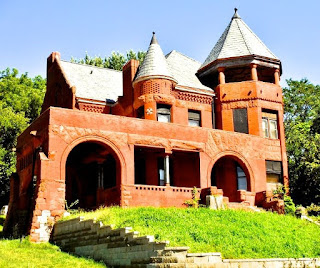
Another Irish immigrant , James McNeely came to the United States as a youth. In 1855 he settled in St. Joseph, Missouri, a “jumping off” place for settlers heading west.  Warned about the unlikely prospect of resupplying along the way,  pioneers often bought their provisions for the entire journey in St. Joseph. Sensing an opportunity, McNeely opened a wholesale grocery and liquor store that provided staples and alcohol to retail grocers and trail suppliers serving the pioneers on their long treks westward.  Business flourished.


His wealth now grown considerably, in 1890 McNeely commissioned a local architectural firm to construct a mansion home for his wife and children.  Situated on a steep slope below the ridge line of the Missouri River bluffs, the house, shown above, was multiple-gabled with a slate roof.  Made largely of red sandstone, it resembled a medieval castle with its towers.  Below the towers is a massive front porch with two entrances, the one at left large enough to allow a horse and carriage to enter.


The interior was equally extravagant, featuring eight elegant fireplaces of unusual designs adorned with polycromed tiles and carved lintels with lions and other motifs.  One can imagine the excitement of the McNeelys as they moved into these palatial surroundings.  Family members would occupy the house for a half century before selling it. Later it functioned as a retirement home.


 The Hergets, two immigrant brothers from Germany and their sons, enhanced the economy of Pekin, Illinois, through their enterprise and investments encompassing eight decades.  At the center of their  business empire was making and selling whiskey. A 1910 history of Illinois described the Hergets this way:   “The members of the family stand high in the social circles of the city, and are universally respected for worth and nobility of character.”   The book failed to mention that the Hergets built mansion homes in Pekin, largely financed by liquor sales.


The emphasis here is on the home of a son, Carl, who managed the several 
Herget family enterprises , including the Globe Distillery and the American Brewing Company, a Pekin brewery founded in 1900.  Carl Herget perhaps is best remembered in Pekin for his mansion built in 1912 at 420 Washington Street.  Now on the Register of Historic Places, the house, shown here, was designed in the Classical Revival style and occupies an entire city block. 


Growing up, Edson Bradley probably could not tell sour mash from sweet corn, but in maturity he turned whiskey-making into abounding wealth. In the process he made possible the rise of Old Crow bourbon — still one of America’s most popular whiskeys.  It also gave him the resources to build one of the largest mansions in America.


When he and his family moved to Washington, D.C. about 1885, Bradley bought a large Victorian home on fashionable DuPont Circle and tore it down to build the grandest mansion the Nation’s Capitol had ever seen.  Bradley’s home was truly his castle, featuring towers, turrets, and stained glass windows. It contained a Gothic chapel,  an art gallery — to hold his extensive collection of ceramics, tapestries and books — and a 500 seat theater he called “Aladdin’s Palace.” Some interior rooms were imported intact from France.


In 1922, 70 years old and enormously wealthy from Old Crow profits, Bradley became restless. Leaving Washington, he moved to fashionable Newport, Rhode Island, and, almost incredibly, decided to take his castle with him.  Brick by brick, tile by tile, the mansion was dismantled and transported to Newport. There Bradley had purchased a existing mansion called Seaview Terrace. He joined the two structures to become one of the largest dwellings in America. Shown here, it featured 54 rooms.  Today Bradley’s Newport “castle” still stands. From 1966 to 1971 it was the setting for a spooky ABC daytime soap opera called “Dark Shadows.” The mansion currently serves as a dormitory for a local college.


Notes:  Longer post on each of the “whiskey men” featured here may be found elsewhere on this website:  George Shawhan, May 13, 2011; John Cook, March 3, 2018;  James McNeeley, May 27, 2018; Carl Herget, June 5, 2018; and Edson Bradley, September 19, 2011.


Scroll to Top