Author name: Jack Sullivan

The Ways and Will of “Doc” Drake, Whiskey Man


He called himself “doctor” but when and how he achieved medical training is something of a mystery.  What we do know of Robert Polk Drake is that by opening saloons and a distillery he openly mocked the prohibitionists of Madisonville , Kentucky, and the “local option” laws they had enacted.  Although “dry” forces eventually shut Drake down, it was not before he had become rich.


Drake’s story was well told by Katherine Gramlin in her 2018 master’s thesis at Florida State University, the primary reference for this post.  Because Kentucky for so long has been considered the prime source of America’s best whiskey, it may be hard to understand that the prohibition movement, because of the state’s predominantly Protestant population, was stronger than in some states with few or no distilleries.


A Prohibitionist Party organized in 1887 in Madisonville was able to push through a number of laws on alcohol.  It was decreed that all saloons or taverns must be located at least a half mile from a church or other place of worship.  Existing “watering holes” would have to move or pay a penalty every three months.  Many relocated to Main Street, shown here.  In addition, judicial approval was required for any new establishment.  Higher performance bonds and taxes also had been imposed.  Saloon proprietors by law were required to maintain a trough for watering their customers’ horses.


Perhaps the most bizarre ordinance stipulated that sales for off-site use be in gallon-sized containers.   While some have seen the requirement as an effort by prohibitionists to encourage drinking at home rather than in a saloon, my instinct is that they believed a heavy gallon ceramic jug would have to be carried home to drink, but half-pint or pint glass flasks could be tippled anywhere, including public places.


“Doc” Drake sized up those restrictions and decided the risk of entering the liquor trade was worth the gamble.  A local boy,  he was born on February 14, 1849, in Hopkins County, of which Madisonville is the seat. He was the second son of Thomas Drake, a Virginia farmer who had moved to Kentucky about 1827 and Antha “Annie” Coleman Drake, born in the state.  Robert’s early learning has been described as “a good English education.”  


Drake’s medical training has not been documented.  In the 1800s one could claim the title of physician without having attended medical school by serving an apprenticeship with a local doctor.  To pay for his training and upkeep, the apprentice would do menial jobs around his mentor’s office.  He also watched procedures performed in the office and  would accompany the doctor on house calls.  In time, an apprentice would be allowed to attempt certain medical procedures and eventually be recognized as a doctor in his own right.  I have located a Madisonville press item about an individual “wounded, was carried to the residence of Dr. R. P. Drake and treated nine weeks, then sent home.”


Nonetheless, in the early 1890s, as he entered middle age, Drake decided that rather than pushing pills for a living, he would make and sell liquor.  In unabashed defiance of Madisonville’s “dry” advocates, he opened a saloon on North Main Street, located an appropriate distance from local churches.  It proved to be so profitable that he decided to prod the prohibitionists further, opening another saloon on Center Street in what had been a ladies’ hat shop.


Drake soon decided that making his own whiskey was more lucrative than just

pushing drinks over the bar for nickels and dimes.  In 1895, he bought land on Onion Hill, named for its strong, lingering scent.  Located just outside the Madisonville city limits, the site included two springs that fed a small watercourse known as Flat Creek.  Those water sources were critical to Drake’s effort to erect a distillery.  Construction was completed by March 1896 and he immediately began production.  


By Kentucky standards, Drake’s was a decidedly small distillery, producing only about 28 gallons a day, the rough equivalent of half a barrel.  Assuming that the distillery produced whiskey every day allowed (never on Sundays), the yearly output was no more than about 165 barrels.  Drake’s equipment included a steam boiler, mentioned in his will.  Also shown here are a doubler and copper pipes used in distillation that are on display at the Hopkins County Historical Society Museum.  The equipment is assumed to be from Drake’s facility.


The reaction of Madisonville’s prohibitionists to a distillery on their border has gone unrecorded, but it must have rankled.  Drake obviously did not care. He produced whiskey for his own saloons and had some to sell others.  Over that period his gallon ceramic jugs bore several names, including “The R.P. Drake Distillery,” “The Twin Springs Distillery,” and “Turner Springs Distillery.”  The one shown here from the Hopkins museum reads “Old Hickory Distillery” on the base.


For reasons yet unexplained, Drake maintained his distillery for only 14 months before shutting it down.  Perhaps he was dissatisfied with the quality of his product.  Making whiskey is a tedious and delicate process.  Many things can go wrong in distilling that render the results undrinkable.  Drake continued to operate his two local saloons and opened a third in Evansville, Indiana, about 50 miles due north of Madisonville.  He may have assumed (correctly) that Evansville would remain reliably “wet” even if his home town banned liquor.


With the wealth from his liquor pursuits, Drake also was investing elsewhere.  Hopkins County was part of the Western Kentucky coal fields.  In 1896 Drake announced he had opened a new mine near the railroad line about a mile and a half from Madisonville.  Claiming the coal seam to be 38 inches thick, he advertised that his “work was done with a view to testing the coal for parties who wish to lease.”   In other words, he was speculating, not mining himself.  At the same time the “Doc” was investing in a local bank and in real estate.  The latter included farmland, office and apartment buildings, a “colored housing” development, and a rooming house available specifically to members of the Presbyterian church.


If Drake thought this outreach toward the Presbyterians would soften prohibitionist sentiments, however, he was mistaken.  In 1912 local “dry” forces were able to enact by “local option” a complete ban on alcohol sales.  Shown above is a marvelous photograph of an event of civil disobedience by prohibitionists in Madisonville as men, women and even small children blocked Main Street demanding that saloons be closed.  The caption reads:   “Streets blockaded by prohibitionist fighting the open saloon, winning victory by big majority.  Madisonville Ky., Jan 24, 1912.”


Although Drake was forced to shutter his two saloons, he remained a major figure in Madisonville.  Ms. Gramlin observes:   “While he never served in office, Drake did use the influence of his wealth and businesses to ensure the future success of his ventures. By strategically locating the majority of his businesses downtown, buying stock in influential banks, gaining the favor of local churches by renting homes and apartment spaces to congregation members, and renting farmland and equipment to county farmers, Drake ensured that he had his thumb in every pot. He was an influential and powerful man in Hopkins County.”


Drake’s personal life, however, was not without its vicissitudes.  At the advanced age of 43, in 1892 he married Willie N. Richardson, 17, in Robertson, Tennessee.  In addition to the age disparity, there was some indication of haste.  The wedding occurred on February 2;  the marriage license was issued after February 21.  The couple’s first child, Lorenzo “Loren”, was born five months later.  Several years later a second son, Owen, died in infancy.  As a doctor, not being able to keep his child from dying must have been extremely painful for Drake.


The relationship between the father and his son Loren appears to have been strained.  The breach is evident in the will “Doc” Drake made on February 2, 1916, just days before his death.  In it he left the bulk of his extensive properties to Loren but only as a caretaker for his grandchildren, Robert, then two years old, and Mary, an infant.  The will stipulated that his son was to have “no power of authority to sell, convey or dispose of said property in any way or manner” but must maintain the property for the children “to be theirs absolutely.”  


His wife Willie, as administrator of the estate, could sell property but the proceeds also were directed to Robert and Mary.  Drake left his son 150 acres of farmland in Hopkins County with a house on it.  That Loren could sell it but none of the proceeds were to be used to pay off the son’s debts “in any manner.” Once again all proceeds were to be passed on to the grandchildren.  Thus was expressed a father’s apparent displeasure with a son.


Drake’s will was completed and filed only two weeks before his death, although he apparently had been under a doctor’s care since the previous March.  The diagnosis on his death certificate was “tuberculosis of throat and lung.”  Dead at 67, Drake was interred in Slaughters Cemetery in Webster County where his parents and other relatives were buried.  Shown here, Drake’s is one of the largest memorials on the grounds, unusual because the statue of Jesus it contains is looking away from the grave.  The monument records the deceased as “Dr. R. P. Drake.”  Wife Willie is not buried with him.


Although the story of Robert Drake and his tussle with prohibition is not unique, it illustrates the “dry” pressures brought against alcohol production and sales in Kentucky,  despite the state being world famous for its whiskey.  By navigating around Madisonville’s “dry” laws for more than 20 years, however, a canny operator like “Doc” Drake was able to a build a fortune. 


Notes:  In researching the story of a medical doctor who owned saloons and, at least for a time, distilled whiskey, I almost immediately became aware of Ms. Gramlin’s dissertation.  My efforts to locate her to for permission to quote her material and use her photos have not been fruitful, although I have emailed to an address she used and called telephone numbers listed to her.  Perhaps a reader will see this post and alert her to my efforts.  


When the Whiskey Trust (Not Really) “Went Bust”

 In August 1918 the monopolistic attempt to corner the market on American whiskey sales known as the Kentucky Distilleries & Warehouse Company came to a crossroads. This expression of a Whiskey Trust held a stranglehold on whiskey manufacturing in Kentucky.  More recently, however, the combine had experienced problems related to increased economic and social pressures. From its headquarters in Louisville’s Stark Building, Trust officials held what at first glance appeared to be a “fire sale” of 17 Kentucky distilleries among the many it owned or controlled.  Hostile press accounts cheered that the auction signaled the demise of the syndicate. But did it?

The Trust distilleries “on the auction block” included producers of well-known Kentucky bourbon brands.  Among them were five, each facility captured in an illustration below. 


Keller Company, Cynthiana, KY:  Established as early as 1840 by Abraham Keller, this distillery, operated under his management for two decades, brought him fame throughout Kentucky and beyond.  Although Keller sold the facility before the out break of the Civil War, subsequent owners kept his name on the company.  Acquired by the Trust in 1902, its executives continued to market A. Keller whiskeys. By 1910 they had expanded the distillery, shown below,  to increase mashing capacity to 450 bushels a day and warehouse capacity to capacity to more than 30,000 barrels.


W.H. McBrayer, Lawrenceville, Ky.  William Harrison McBrayer, called Judge McBrayer, is credited with being among the handful of Kentucky distillers who raised the quality and image of the state’s whiskey to international renown.  His Cedar Creek brand was called:  “The whiskey that made the crowned heads of Europe turn from Scotch to bourbon.”  In 1900 McBrayer heirs sold the distillery to the Trust.  By then, as shown below, it had three ironclad warehouses and a number of outbuildings.


J. M. Atherton Co., Knob Creek, Ky. After the conclusion of the Civil War, John Atherton, 26 years old, built a new distillery on the bank of Knob Creek and gave it his own name. Shown below, this plant was capable of processing one hundred bushels a day to make about seven barrels of what was known as “sweet mash” whiskey.  In 1869 he purchased an interest in a small distillery owned by a man named Thompson and the next year bought him out entirely.  Atherton moved this facility to the east bank of Knob Creek, across from his first distillery, calling it the Mayfield Distillery.  As a harbinger of the philanthropic efforts in his future, Atherton created homes, a school and a church for his workers at both plants, calling the complex “Athertonville.”


T. J. McGibben, Cynthiana, Ky.  During the 1850s, McGibben brought a distillery he called “Edgewater” and named his flagship brands “Edgewater Sour Mash Whiskey” and “Edgewater Rye.” As sole owner, Megibben lost no time in improving and enlarging the distillery.   It was expanded over time into a large complex, featuring five warehouses with the capacity to hold 25,000 barrels of aging whiskey.   McGibben’s whiskey was one of the Kentucky brands featured at the 1893 Columbian World’s Fair in Chicago.  Subsequently a Kentucky publication boasted that Edgewater Whiskey “is to be found in nearly every first-class hotel and bar in this country.”


Wiley Searcy, Anderson County Ky.  In 1886 Searcy is recorded as having purchased a distillery that had been established in Anderson County in 1818   When Searcy bought it, according to insurance records,  the distillery was of frame construction with a metal or slate roof. The property included two bonded warehouses.  The Captain wasted no time in advertising his “Old Joe” brand of whiskey.    His product contained “no jug yeast,” he claimed and was “The best whisky that can be made.”


These were just five of the many Kentucky distilleries acquired by the Trust over time and shut down, leaving scores of distillery workers without jobs, in the syndicate’s effort to corner American whiskey production.  By 1918, however, the Trust had suffered a number of setbacks.  Its efforts at gobbling up the rye distilleries of Pennsylvania and Maryland failed.  A strong backlash among distillers and whiskey blenders led to new competition.  The WWI ban on alcohol sales for beverages threatened production.  Last, but by no means least, prohibitionary forces had dried up markets in many states and localities.   


The “fire sale” approach by the Trust, however, was deceptive.  As the terms of sale advertised in the Louisville Courier Journal clearly stated:  ”There will be reserved from sale all distilled spirits now in bond on any of said premises.”  In addition to continuing to owning that whiskey the Trust retained the right to bottle and market it under established brand names, apparently in perpetuity.  In effect, the Trust was selling its liabilities — shuttered distilleries — while keeping the assets — the stored whiskey — for itself.  Moreover, the longer that whiskey aged, the more valuable it became.   


The Eastern financiers behind the effort to monopolize the whiskey market further refocused their efforts in March 1919 by incorporating the Kentucky Distilling and Warehouse Company and other holdings into the Distillers Security Corporation.  That entity owned or controlled 13 active plants located in Peoria and Pekin, Illinois; Louisville, Baltimore and New Orleans.  Other distilleries were converted to manufacture “cereal products, food and feed products, syrups, alcohol, yeast, vinegar, glace fruits, fruit butters, malt, etc.”    Management was under the aegis of another new entity, the U.S. Food Products Corporation.   


Yet another Trust subsidiary was organized explicitly to sell whiskey abroad called  the “Trans-Oceanic Commercial Corporation” with offices at 25 Broadway, New York City.  It was incorporated at $1,000,000 to “carry on an export business in whiskies, spirits, alcohol and other products.”  The canny “money men” guiding the fortunes of the Trust believed that impending National Prohibition might offer them better opportunities by selling liquor overseas.  


Those machinations have been described in detail by Laura Field, a Philadelphia-based whiskey specialist, who has reviewed the tangled story of the Trust in detail.  She notes:  “The Kentucky Distillers and Warehouse Co. was well positioned after Prohibition as the largest holder of aged whiskey stocks in Kentucky. The Whiskey Trust created their own consolidation warehouses to bring as much of their assets into nine warehouse locations in Kentucky.”  


The U.S. Food Products Company and the Kentucky Distilleries and Warehouse Company were merged in 1924 by the New York money men to become National Distillers.  Field relates:  “In 1933, when Repeal became imminent, National Distillers began to buy up any remaining/available aged whiskey stocks in the United States. Two Pennsylvania distillery locations with large rye whiskey stocks remaining were purchased….”  Rye supplies earlier denied the syndicate now had come under control of this Trust clone.  By 1934,  National Distillers had cornered about half of all the Nation’s aged whiskey just as National Prohibition ended.


Field believes that the history of the Whiskey Trust’s was “riddled with corruption.”  Its tortured history bears her out.  The 1918 sale that shut many of the most prestigious Kentucky distilleries resulted in attracting only a single bid, one submitted by a Trust “insider” group of investors.  Reviewing that outcome the New York World  commented:   “The Whiskey Trust’s plan of reorganization is as unlawful as a burglary.”  Indeed!


Notes:  To learn more about Laura Field, shown here, check out her personal blog, Dram Devotees.  She has done excellent research into areas of whiskey production both historical and contemporary.  Earlier posts on each of the five distillers featured above may be found elsewhere on this website:    Keller, Aug. 1, 2017; McBrayer, Oct. 2, 2011;  Atherton, Feb. 12, 2015; McGibben, Sept. 26, 2015; and Searcy, June 22, 2013.


Leon Kuhn’s Long Road to Mexico — and Back


Born into a well-off family in the waning days of the Austro-Hungarian Empire,  Leon Kuhn, shown here, found his way from Hungary to America, working in the whiskey trade in several Midwestern cities before seizing the opportunity to open a distillery near Mexico City.  That enterprise would make him rich, but later was destroyed in brutal civil conflict.  Kuhn’s story is the stuff of which novels are made.


According to their own lore,  the Kuhn family originally was Swiss, involved in the shipbuilding industry.  Possibly because Switzerland is landlocked, the ancestors “for better business prospects” moved to the city of Arad, shown below, a major city in the Austro-Hungarian Empire with a Jewish population of more than 10,000.  There Leon was born in 1854.


Of the boy Leon, little is known.  He was given a good education, including a period at the prestigious Technical University of Dresden where he studied chemistry, a subject directly related to his career.  Meanwhile, in the early 1870s his two brothers, seeking to avoid conscription in the army of Emperor Franz Joseph, left for America, settling in Texas.  At the age of 19, Leon followed, sailing from Bremen in August 1873 aboard the Kronprince Wilhelm.  


Kuhn’s early residence and occupation has gone unrecorded but it appears that at least for a time he was living in Pennsylvania and possibly using his chemistry background to good effect in distilling.  A sole clue is his having obtained American citizenship in Meadville, Pennsylvania, a notable center for the production of rye whiskey.  Kuhn then seemingly moved to Cleveland, Ohio.


In 1881, Kuhn made a return trip to Europe.  His passport description recorded his height at 5’ 11” and his eyes blue.  On a visit to Budapest he met Theresa Edmunda de Prorok, a young woman from a wealthy family, who was spending the summer there. They fell in love and in on May 1, 1881, the couple were married in England.  Leon was 26; Theresa, 21.  


After their honeymoon, the couple lived in Cleveland where their daughter Alice May was born.  Soon after Kuhn saw better opportunities in the Cincinnati area, at the time the center of the American liquor industry.  The couple settled in Covington, Kentucky, just across the Ohio River.  Their sons were born there,  Alfred in 1884 and Leonard in 1888.  A Covington business directory in 1886 listed Kuhn as “distiller,” likely working for one of the sixty organizations listed as distilleries in the Cincinnati area.


Kuhn’s reputation in the liquor industry was growing, becoming known for his ability as a yeastmaker.  Whiskey guru Michael Veach has emphasized the importance of well-prepared yeast to the final product.  Even if the contribution of yeast is only 5%, he says:  “…It is a vital component to the whiskey.  Think of it this way — adding salt to a dish is a small part of the overall taste, but if there is too little or too much it is noticed in the taste.  The same can be said for yeast in whiskey — the wrong yeast will be noticed.”


That is what the American Spirits Manufacturing Co., an arm of the “Whiskey Trust,” apparently was thinking in 1888 when it reached out from Peoria, Illinois, to ask Kuhn to join its distilling team.  ASM recently had purchased from John H. Francis several properties, including the Monarch Distilling Company, below, a facility Francis personally had built in Peoria.  Not related to the Monarch distilleries of Kentucky, the Illinois Monarch has been described as “operating at certain times of the year for the manufacture of whiskies, gins and spirits.”  The Wine and Spirits Bulletin of February 1903 included the Monarch, shown below, with other Trust properties in declaring:  “These distilleries will eventually furnish the trade throughout the United States with cheap Bourbons that heretofore have been manufactured in Kentucky but of late years in Peoria.”


Over the next dozen years, with the Monarch Distillery as his headquarters Kuhn built a reputation in Peoria as a leading yeastmaker and distiller for the Whiskey Trust.  Increasing affluence allowed him to house his family in the large frame home.    It also brought him into the inner workings of the Trust itself during the years 1888 to 1895, its heyday.  The syndicate produced 300.4 million gallons of alcohol — 75 percent of that produced in the United States.   With a seeming stranglehold on American whiskey production the Trust responded by raising prices, in part to help pay off extravagant bonuses they earlier had promised to distillers who joined.  It backfired. The combine slowly slid into bankruptcy.


By 1894 Kuhn apparently could see the impending demise of the Trust.  He began to look around for other opportunities.  His brothers earlier had left Texas and gone to Mexico.  As he looked “South of the Border” Kuhn saw a possible opportunity.  In September he made an exploratory visit to Mexico City.  After several weeks of investigation, he concluded that the possibilities were great in Mexico for the distilling business.


Kuhn’s next step was to get assured financial backing from East Coast “money men.”  He may have had an advantage there from his earlier stint in Pennsylvania where he possibly had met Francis V. Strauss, a capitalist who operated from Philadelphia and New York City.  Strauss, assuming the role of senior partner, assembled a group of investors who agreed to back Kuhn’s initiative in Mexico.


Armed with those assurances and his own reputation as a distiller, Kuhn was afforded an interview with Mexican president, General Porfirio Diaz.  His timing was propitious.  Díaz’s regime had ended years of political instability and was attempting to achieve growth after decades of economic stagnation. The President fostered a group of technocrats known as científicos (“scientists”), whose economic policies were tailored to benefit his allies and foreign investors.  The latter were offered Industrias Nuevas contracts, part of a program by Diaz to encourage investment from abroad.


Diaz was willing to give the Strauss, Kuhn Compania a monopoly on manufacturing and sales of whiskey and other alcohol products in Mexico so long as the Presidente was given a fifth of the firm for himself and his son.  The partners agreed.  By August, 1895, the Chicago Chronicle newspaper reported that Kuhn was in Mexico supervising construction of a distillery capable of producing 5,000 gallons of spirits daily.  It was located on the right bank of the Viga Canal on the outskirts of Mexico City near the Indian village of Santa Anita.  The distillery was named “Le Grande Union.”


Kuhn shipped material for the building and equipment from Peoria on 26 train cars.  A correspondent for the Chronicle visited the site, described as “a busy scene”:  “Boilers, pumps, iron tanks, lumber, etc., are piled around and are conveyed to the site by the natives.  Gangs of men are busy erecting buildings of solid masonry, the machine shops, warehouses, and a malthouse over 100 feet long being nearly completed.   The foundations of a large mill building four stories high are now in progress.”


The newspaper reported that  the property contained barns to accommodate as many as 800 to 1,000 head of cattle.  As was common with distilleries in the United States the cows would be fed from the spent grain mash.  The owners expected the distillery to be finished and in operation by October, 1895. Below is an illustration of the completed complex.  The Strauss, Kuhn distillery was a most impressive facility.


The enterprise was a family affair.  Gustave Strauss, likely a brother of Francis, born in Switzerland and educated in Germany, was an officer of the distillery while keeping a New York City address.  Francis Strauss visited frequently but also resided in the States.  At least one of Kuhn’s brothers, Fred, was on the scene in Mexico to assist and the Kuhn sons were enlisted when they completed their schooling.   Kuhn was so keen that his children should get excellent European educations that he bought a house in Paris for them to live.  From passport records he seems to have visited them frequently.  After graduation his eldest son Alfred dutifully moved to Mexico to assist at the distillery. 


The second son, Leonard (“Leo”), at the direction of his father had been sent  to England for postgraduate training in business.  The expectation was that he too would join the distillery management team.  Although Leo went to Mexico in 1907, his daughter related,  he determined “…He was not cut out for business, preferring the arts instead.”  Shown here, Leo painted pictures he never sold, avoided the liquor business, and lived off family money.


For the next 18 years the Strauss, Kuhn “Grande Union,” the only distillery of its kind in Mexico and holding a monopoly on whiskey and alcohol production, proved to be a highly lucrative enterprise.  It also proved a boon to Squire Turner Willis and the whiskey he was producing at his Glen Springs Distillery in Woodford County, Kentucky.  Although the Mexican populace favored tequila as its liquor of choice, whiskey was making inroads, particularly among the wealthy.  Through trade cards and other forms of advertising, Kuhn featured the S.T. Willis brand, bottled at the Mexican plant.


As the years passed, Mexico increasingly was driven by unrest, resulting from civil repression, regional conflicts, strikes and other uprisings from labor and the peasantry.  Both had been left behind economically.  The year 1910 marked the beginning of “The Mexican Revolution,” a conflict between government and rebel groups, struggling among themselves for power.  In 1913, the revolution came to the Strauss, Kuhn distillery.  Likely seen as a symbol of the hated Porfirio Diaz or “Yankee imperialism,” rebels attacked and destroyed the plant.


Leaving his brother Fred to watch over the ruins, Leon Kuhn left Mexico and returned to the United States.  After order had been restored by the Carranza government, Kuhn returned to Mexico in 1916.  The purpose he said on his passport application was “looking after investments.”   Kuhn may have been seeking compensation from the new government for the destruction of his distillery.  There is no indication he was successful.


Two years later, on Christmas Day 1918, Kuhn died in Boston, perhaps on a visit to his daughter, Alice May, who was living there.  His will, written on New York’s Waldorf-Astoria Hotel stationary, listed assets of $500,000 (equivalent to almost $10 million today) in a New York bank, bank accounts in Europe, the house in Paris, and properties in Mexico.  Perhaps wishfully, Kuhn also counted as assets 378,500 pesos worth of shares in the now defunct and destroyed Distillery Grande Union.


Although Leon Kuhn’s long road to Mexico ended badly, his role as a pioneer in whiskey history cannot be denied.  He was the first American distiller to venture “south of the Border” and for almost two decades prospered.  He showed the way to other whiskey-makers like Mary Dowling, Peter McGowan, and John Casper who moved their operations to Mexico in response to America’s National Prohibition of the 1920s and early 1930s.


Note:  This post owes its origin from information sent me by Michael Tarabulski, an archivist working for the National Archives in St. Louis.  He also graciously provided me with the pictures of Leon Kuhn and his distillery.  Thanks also are due Aileen Blomgren, who is steeped in all whiskey matters connected with the name “Monarch.”  She sent me materials crucial to this post, including the Chicago Chronicle article.

Three Who Helped Make Jack Daniel


 Foreword:  President John F. Kennedy once noted that: “Success has many fathers, but failure is an orphan.”  Such it has been for the success of Jack Daniel in creating his famous whiskey in Lynchburg. Tennessee.  Multiple individuals have come forward claiming to have been his mentor.  Two with dubious claims, Hop Lee [April 7, 2014]  and Billy Pearson [Dec. 4, 2015] have been profiled here.  Three others deserve mention for their enabling of this iconic brand of Tennessee whiskey.  Their contributions briefly are recorded here.


 A Civil War soldier, farmer,s store keeper, and lay preacher of the conservative Union Lutheran Church in Lois, Tennessee, Daniel Houston Call, shown here,  might have fallen into the obscurity that history accords most of us, except for one decision.  Faced with the question of hiring and harboring a 16-year-old orphan boy of uncommonly small stature, Dan Call said yes and the rest is history.  The boy was Jack Daniel.


Described as a “sinewy, long-legged fellow with a scarecrow figure who walked with a hint of a strut,”  Call was adept on horseback and knew how to shoot.  That made him eligible to join an elite marauder unit of the Confederate army called Forrest’s Escorts, numbering about 100 men over the course of the war.  Their leader was the charismatic and bold Gen. Nathan Bedford Forrest. 


Although Call was not among the original members of Forrest’s Escort, most of them recruited in Tennessee, he joined early in the conflict.  He bid good-bye to his wife, Mary Jane (nee Nelson), whom he had married when she was 16 years old, and rode off to the fighting.   Call served throughout the conflict and is recorded with the unit at the time of Forrest’s surrender in Gainesville, Alabama, at the end of the war. 


Arriving back in Tennessee, Call found that Mary, shown here, had added a new face to the dinner table.  His name was Jasper but he preferred to be called “Jack” Daniel.  The five foot, two inch, local boy had been recommended to Mary as someone to help her in Call’s absence with the general store and other chores.  Although small, Jack was of sturdy build and energetic.  With three youngsters to look after, Mary jumped at the chance for help and brought the boy into the Call home.  But what would her husband say when he returned?  Mary and Jack need not have worried.  Although conservative in his views, Dan Call was a strong Christian and believed in helping his neighbor.  Moreover, he was cognizant of having been an orphan himself.  He accepted Jack into their home and understood the boy’s interest in operating the distillery out back.  


Enter “Uncle Nearest” Green, shown here in an artist’s depiction.  Call commended the young Daniel to the slave, his master distiller.  The preacher is quoted saying to Green, “I want [Jack] to become the world’s best whiskey distiller — if he wants to be. You help me teach him.”   Nearest Green apparently was enthusiastic about the assignment.  He is known to have loved children, siring eleven of his own with wife Harriet, nine sons and two daughters.  When slavery ended at the end of the Civil War in 1865, the Green family stayed with Call.  


A year later the now mature Jack Daniel opened his own distillery, employing two of Green’s son, George and Eli.  Speculation is that they include the black man shown here, sitting in a gathering of the distillery workforce.  Immediately next to one of the brothers is Daniel wearing a white fedora and beard.  Yet another of Nearest’s sons, Edde, also was employed by Daniel. 


At least four of Nearest’s grandchildren joined the Jack Daniel Distillery:  Ott, Charlie, Otis and Jesse Green. In all, seven generations of Nearest Green descendants have worked for the distillery , with three direct descendants continuing to work there in contemporary times.   As shown below, the larger distillery staff was an integrated group.  


Since August 2017, the Brown-Forman Corporation that owns the Jack Daniel’s Distillery and brand name officially recognized Green as their first head distiller, adding his story to their website.  In October 2017, the company also added a narrative about Nearest Green’s contribution to their distillery tours. 


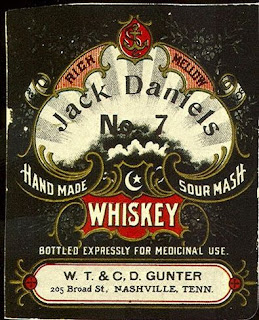
The Gunters.  When Jack Daniel in Lynchburg, Tennessee, needed assistance in developing a market for his whiskey,  brothers in Nashville, William Thomas and Charles David Gunter, recognizing the quality and appeal of Daniel’s product, helped make the distiller’s “No. 7” a widely recognized brand.  Relatively isolated in Lynchburg, a small town with one traffic light and located about seventy miles south of Nashville, Daniel needed the “big city” resources the Gunters could provide from their wholesale liquor house.


The Gunter brothers bottled whiskey for Daniel. They had the staff and equipment to decant the barrels from his distillery into ceramic jugs that they ordered from area potteries and glass bottles bought from local glass houses.   Early jugs have a primitive look to them with the labels in cobalt and black.  In time the presentation improved with more legible and professional-looking stenciled labels.  These jugs varied from quart size to one and two gallons. 


The Gunters advertised for Daniel.  In Nashville the brothers had access to a number of publications to run newspaper ads for “Jack Daniel No. 7” and his Old Time Distillery.  The ads proclaimed the brothers “sole agents” for the Lynchburg whiskey.  The Gunters also had access to modern printing techniques and specialists to design attractive labels for the glass bottles and flasks they merchandised under Daniels’ name.


The Gunters assisted marketing and distribution for Daniel. Nashville was a hub for roads and, more important, rail lines.  Shipment of Jack Daniels whiskey was possible to all parts of the Nation.  Assistance from the Nashville brothers became particularly important after 1904 when Daniel’s No. 7 received a surge in popularity after receiving a gold medal for whiskey at the 1904 St. Louis World’s Fair.  The resulting demand required marketing efforts considerably beyond the capacity of the Lynchburg distillery — and over the next few years the Gunter brothers did their best to provide it.


Many have claimed to be “fathers” of Jack Daniel’s success but only Dan Call, Nearest Green and the Gunthers truly deserve that recognition.


Note:  Fuller vignettes on each of these men may be found elsewhere on this site:  Dan Call, November 14, 2021;  Nearest Green, August 21, 2018; and the Gunther Brothers, September 19, 2017.


Dick Francis — Black Bartender to Congress


An Afro-American born free in the slave state of Virginia but never taught to read or write, Richard “Uncle Dick” Francis became a celebrity bartender in Washington, D.C.  He could count among his admirers top political leaders of the day and eventually was appointed manager of the U.S. Senate’s private restaurant and bar in the Capitol.  In death Francis left his family a fortune in local real estate.


Francis was born in 1826 in Surry County into a family of free blacks.  At a time when slavery was rampant in the South, he was offered no educational opportunities but early on showed unusual intelligence and ambition.  At the age of 21 in 1848 he began working at a Washington, D.C. saloon opened by Andrew Hancock eight years earlier on Pennsylvania Avenue.  Hancock’s has been described as “small, ramshackle and filled with curios.”  


Now enjoying steady employment, Francis in 1854 found it possible to marry at age 28.  His bride was Mary Elizabeth Connor, 26.  They would go on to have a family of four.  As a family man, Francis began to plan for a financial future.  Washington, D.C. at the time was beginning to develop and grow as a city.  Land was still relatively inexpensive, much of it swampy.  As a bartender, Francis was hearing conversations about potential areas for development.  With characteristic canny intelligence, Francis began investing in D.C. real estate.


The black bartender’s effect on Hancock’s trade after taking over the drinks making was described in his Washington Post obituary:  “…It was soon one of the prominent places of the city, the resort of statesmen and of fashion alike.  With them all Francis was on terms of friendly intimacy and distinguished statesmen bowed humbly before his superior intelligence in the matter of adjusting to a nicety the various ingredients that went to make up a whiskey punch or a mint julep.” Hancock’s, with Francis mixing, specialized in cocktails, labeled “Hell and Blazes” served in sugared glasses, hot toddies, and butter rum.


These drinks were served up to some of the most powerful men in Washington, including a trio of American political giants of the times known as “The Great Triumvirate”:   John Calhoun, Henry Clay and Daniel Webster.  All three were known to be frequent patrons of Francis’ bar.  His Post obituary noted:  “With all of them Francis was a person of consequence.  Good natured…Francis took and gave jokes with the best of them.  He heard Clay discuss his Compromise bill with his Senatorial colleagues…; knew Webster’s preculiarities; was familiar with Calhoun and could judge accurately what amount of each kind of liquor each wanted the moment he entered the door.”


Calhoun

Clay

Webster


Undoubtedly Francis was well aware of the racial views of the Triumvirate.  Calhoun of South Carolina, a slaveholder himself, was a fierce defender of slavery and fought to defend the interests of the white South.  Clay of Kentucky also held slaves, but was for the gradual abolition of the practice and favored resettling blacks in Africa.  Webster’s public position was for abolishing slavery.  One of his “peculiarities,” however, was to buy blacks out of enslavement and then require them to work for him to pay off the cost. 


Francis worked for Hancock and his heirs for thirty-six years,  eventually serving the Washington political figures who replaced the Triumvirate.  Apparently among regular visitors was John Wilkes Booth.  In his 1896 memoir “Recollections of Lincoln’s Assassination,” Author Seaton Monroe wrote: “During this period [Booth] seemed to have been occasionally absent from town, but we frequently met and strolled on the Avenue, usually dropping into Hancock’s….”Dick” was justly celebrated for his ministrations to the convivial frequenters of this old curiousity shop.”


All through the tumult of the Civil War and Reconstruction, “Uncle Dick” Francis continued his stellar work behind the bar.  In the post-war period Hancock heirs decided to spruce up their shabby saloon.  The brick core of the building remained but the owners added a mansard roof, decorative iron work,  prominent outside sign, and second floor window casings.  What remained most important, however, was location of the saloon near the U.S. Senate.


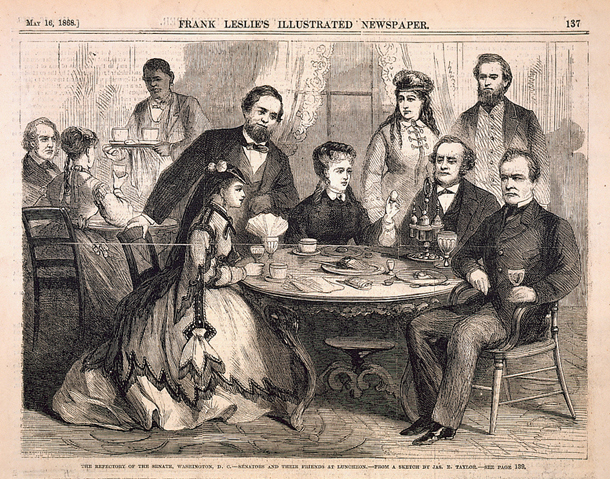
In 1884, another friend of the black bartender, Senator George F. Edmunds of Vermont, shown here, at the time “president pro tem” of the U.S. Senate, made sure that when the well-paying post of managing that institution’s private restaurant and bar came available, Francis would be selected for the job.  A sketch from Leslie’s Illustrated Newspaper illustrates a scene set at that establishment while senators, whose faces would have been familiar to Leslie’s readers are having libations and lunch with what appear to be considerably younger women.  (Having lunched there myself, those diners are much more interesting than my experience.)


Severing his ties to the Hancock Saloon, Francis served at the Senate for about three years.  Sometime during that tenure, he bought the saloon and installed his own management, possibly anticipating returning there someday.  But his health was faltering.  At the end of the Congressional session Francis took leave of the Senate restaurant and retired.


On November 5, 1888, Francis suffered a paralytic stroke at his home at 1113 Thirteenth Street and at age 62, died.  His services were held at the Fifteenth Street Presbyterian Church where the Francis family for years had been dedicated worshipers.  He was buried in Graceland Cemetery in the District of Columbia.  When that burial grounds later was vacated, Francis was moved to Woodland Cemetery across the Anacostia River.  His wife would join him there in 1906.  A large monument, shown here, marks the site of their adjacent graves.  


A final word on this remarkable American comes from his Washington Post obituary:  “The deceased…during his life had probably known more of the men famous in American history and had a  better opportunity of observing them than any colored man in America.”  If Richard Francis had not been illiterate we might be reading his memoirs even into the 21st Century.


Addendum:  Richard Francis had the resources to put his John through medical school.  Dr. Francis, shown here, conducted a medical practice in Washington and developed a sanitarium to care for African Americans who lacked proper health care and sanitation in their homes.  He also worked to educate the black population to become self-reliant and self-supporting, serving on several school boards and as a professor at Howard University.  Despite the color barriers in his time, Dr. Francis was a prominent figure in Washington, participating actively in organizations that worked to improve the lives of African Americans.  Ironically, he was president of the Graceland Cemetery board when the facility went bankrupt and his father’s body had to be moved. 


Notes:  Assembled from a number of sources, this post relies most heavily on the extensive obituary on Francis that appeared in the Washington Post on November 6, 1888.  The item carried no byline.  Unfortunately no photo or other depiction of the bartender apparently exists.


The Three Crisis Life of William Hildebrandt

Immigrating from Germany at the age of fifteen, William Hildebrandt settled in San Francisco for the remainder of his life.  His years there were marked by three crises that might have undone a lesser man.  Blessed with strong character, Hildebrandt overcame each to carve out a forty year career as a successful and respected liquor merchant. 

Born in Hanover, Germany in 1845, William was the son of Frederick Hildebrandt, shown here, and an unidentified mother.  Educated in the excellent German schools, he left his homeland in 1860 and apparently headed straight to San Francisco.  A year later an older sister, Georgina, joined him there. Not long after, she married another German immigrant, Ernst Pestner. The couple had four children over the next dozen years and also made a home for William.

Meanwhile, the young Hildebrandt was making his way in San Francisco commerce.  After spending several years working for one of the many San Francisco liquor houses, at the age of 23 in 1869 he opened his own whiskey business with a partner named Kitz.  He hired Pestner as a clerk.  It was a short-lived enterprise, followed shortly by another liquor business with a partner named Altschul.  That company lasted just two years.


In 1877, moving to 411-413 Battery, William made his brother-in-law his partner and the firm became Pestner & Hildebrandt.  Shortly after, however, Pestner died, leaving his children fatherless.  Resident in the house, William seems to have stepped into the breach.  He made Georgina a partner in the business.  With her untimely death two years later, however, Hildebrant was faced with his first life crisis:  What to do with his orphaned nephews and nieces?  


The 1880 census told the story.  Rather than disbursing the children to foster homes or an orphanage, William determined to care for them himself.  A single man of 35, he now was parenting Antonia, 17;  Ernst, 13; Emma, 11, and Georgina, 5.  How long that situation continued is unclear.  He continued to keep Pestner’s name on his firm until about 1890 when he took a new partner, Max Posner, into the business.


That move seemingly generated new vigor into the liquor house.  The company featured a number of whiskey brands, including “Cameron Gin”, “Cedar Valley Whiskey”, “J H Miles”, “O.B.G.”, “Old Blue Grass”, “Old Club House”, “Sherman Rye”, and “Silver Crown.”  The company flagship brand was “Mazeppa Bourbon,” a reference to a poem by Alfred Lord Byron about a Ukrainian military leader, Mazeppa, who has a love affair with a Polish countess married to a much older, jealous man.  When the Count found out he punished Mazeppa by tying him naked to a wild horse and setting the animal loose.  The whiskey label replicated the scene.


The story of a highly dangerous ride would resonate in Hildebrandt’s own life.  About 1884, about the age of 40 he married a 25 year old local woman named Hulda.  They soon would have a son.  Hulda again was pregnant in 1887 when the couple and Hulda’s brother were all seated together in a San Francisco cable car.  An explosion occurred under the tram, likely an expression of the labor unrest then occurring in the city.


Sitting next to the front seat, the three were blown to the pavement.  Hulda was the most seriously hurt.  She somersaulted and struck the back of her head and spine, suffering a severe scalp wound.  Rendered unconscious by the blow, she took 15 minutes to regain her senses.  Her brother and William suffered bruises in the fall but no one broke bones.  They were transported by emergency wagon to their home where it later was discovered Hulda had suffered a miscarriage.  Their next child would not be born until 10 years later.


Despite this horrendous accident, once again Hildebrandt weathered the crisis.  His liquor house with Max Posner continued to thrive and grow.  Needing more space the partners moved to 610-612 Front Street in 1892.  As many wholesale liquor establishment did, they issued shot glasses for their major brands.  These would be presented to San Francisco and vicinity saloons, hotels and restaurants for advertising purposes.   A selection of their shots is shown throughout this post.


Fire on Market Street

In 1904 Hildebrandt & Posner moved again to 118 Market Street.  Two years later in April William would experience his third major crisis — the great San Francisco earthquake and fire.  The conflagration, as shown here, struck hard at Market Street, burning out the partners’ liquor business.  Large stocks of whiskey and other beverages were destroyed in a matter of minutes.  Undaunted, Hildebrandt and Posner, rather than rebuilding on site, moved their business to 26-30 California Street.  Once again the liquor house prospered.


Despite setbacks, Hildebrandt was gaining a reputation as a prominent figure in San Francisco commerce and society.  Active as a member of the Fidelity Lodge of the Free and Associated Masons and the Odd Fellows, he was a contributor to a range of philanthropic causes.  His obituary in the San Francisco Call recounted that Hildebrandt “was known for his wide charities and his standing in the business world.”


As he aged, Hildebrandt’s health faltered and he died in November 1910.  He was buried from B’nai Israel Hall after services conducted under a Masonic ritual. He was cremated and his remains interred at the San Francisco Old Fellows cemetery, adjacent to his sister and brother-in-law.  Their joint marker is shown here.  Under the guidance of Max Posner the liquor house Hildebrandt had founded continued in his name, until closed permanently by National Prohibition in 1919.


In his later days, William Hildebrandt must have thought back on the major events of his life — responsible for four minor children after the death of their parents,  the explosion on the cable car, and the fire that burned out his liquor house.  He could take satisfaction knowing that he had dealt with fortitude and courage in each crisis — and had prevailed.


Note:  This post was devised from a range of sources, the most important of them San Francisco newspaper accounts of the cable car explosion, the 1906 earthquake and fire, and Hildebrandt’s obituary in the San Francisco Call.  Unfortunately no photo exists of the whiskey man himself, just one of his German father.


Dr. Charles Hazeltine: His Prescription Was Alcohol

After earning an education from the prestigious University of Michigan Medical School, Dr. Charles Storm Hazeltine  upon moving to Grand Rapids, Michigan, abandoned his practice in favor of operating a wholesale drug business with a full line of liquor as well as highly alcoholic remedies of his own concoction.  If you had stomach problems or difficulties urinating, Dr. Hazeltine, shown here, had just the right answer.

For example, his “Fluid Extract Rhubarb” show below, was recommended as a “Laxative, purgative, stomachic…and corrective in diarrhea.”  The dose indicated was 1 to 2 “fluidrachims,” an archaic term for fluid ounces.   One had only to turn to the front of the medicinal bottle to discover that this rhubarb packed a punch.  It was 50 percent alcohol.  Measured as “proof” in liquor, it was 100 proof, higher than most whiskey (80), vodka (80), gin (80) and brandy (70 to 120). 


Shown below is Hazeltine’s “Fluid Extract Dwarf Elder” (e.g., sassafras). This remedy was touted as a diuretic “much employed in dropsy, suppression of urine, and other urinary diseases.”  The dose was the same as for rhubarb extract but the alcoholic content was 40 percent or 80 proof.  Of what use this woody extract might be against “dropsy,” a severe heart condition, went unexplained.


In addition, Dr. Hazeltine offered “A full line of whiskey, brandies, gins,  wines, rums.”  Moreover the drug company claimed to be “…Sole agents in Michigan for W.D. & Co. [Withers, Dade] Henderson County Hand made Sour Mash Whiskey and Druggists’ Favorite Rye Whiskey.”   Moreover the doctor had his own proprietary liquor brands, among them, “Canada 1890 Finest Malt Whiskey” and “Canmalt Finest Blended Whiskey.”


The journey of Dr. Hazelton from the medical profession to huckstering alcohol began in Jamestown, New York, where he was born in October 1844. His parents were Caroline Boss and Dr. Gilbert W. Hazeltine, an eminent East Coast physician and surgeon, who taught anatomy in Philadelphia and New York medical schools.  As the eldest of four children, perhaps it was pre-ordained that Charles would be a doctor. 


With his father affluent enough to give Charles excellent schooling opportunities, he was educated at the Jamestown Academy, founded by a Hazeltine relative.  From there he entered the medical school at the University of Michigan, Ann Arbor.  From the beginning this institution was known as a leader in cutting edge medical education, with emphasis on basic clinical research and patient care.  After a subsequent internship at an Albany, New York, hospital,  Hazeltine returned to Jamestown and conducted a medical practice for 18 months.


Despite his family pedigree, the life of a doctor seems to have held little interest for Hazeltine.  He jettisoned the profession and opened a retail drug business in Jamestown.  A biographer chronicled:  “…But his native town proved to be too limited a field for a person of the doctor’s ambition and he sought the advantages afforded by the city of Grand Rapids, Michigan.”   Why Grand Rapids?  The city is 132 miles from Ann Arbor, but it is possible Hazeltine may have visited there as a med student.   A national center for furniture manufacturing, Grand Rapids was one of the fastest growing cities in America.  With a population of only 2,600 in 1850, by 1900 it boasted 87,500 residents.  About 1872 the doctor moved there.


By this time the Hazeltine was married to Ella Burwell of Jamestown and the couple had two children.  How his wife reacted to the move 445 miles west has gone unrecorded.  Hazeltine initially had a difficult time establishing himself in the new environment and went to work for a local hardware and saddle store.  Not long after arriving in Grand Rapids, Ella, only 25 years old, died, leaving him with their young children.  Two years later Hazeltine married again.  This time his wife was Anna Fox, the daughter  of a wealthy Massachusetts manufacturer.  Charles and Anna would go on to have two children of their own.


The marriage may have opened up a new financial avenue Hazeltine.  That same year, with a partner, Charles N. Shepard, he achieved sufficient resources to open a wholesale drug company.  The business was recorded as “prosperous from the start.”  Shepard had been the first Grand Rapids druggist to feature cure-all “medicines” of his own concoction.  Chief among them was Shepard’s Compound Wahoo Bitters, touted as “A Universal Tonic for Everybody.”  It was highly alcoholic and set the direction of the new drug enterprise.


When Shepard died, Hazeltine reorganized the business as a stock company, capitalizing it at $150,000, and, with a partner named Perkins, became its president.  From that position he built the Hazeltine, Perkins Drug Company into “the most extensive concern in its line in Michigan,” selling his products in Detroit and other Midwest population centers.


Dr. Hazeltine’s success was noted as far away as the Nation’s Capital.  Active in the Democratic Party and supporting the gold standard, he caught the attention of the similarly inclined Cleveland Administration and in 1893 was appointed U.S. consul in Milan, Italy.   As U.S. Consul Hazeltine was popular with Americans and Italians for hosting dances in the consulate’s third floor ball room.  Although the doctor had agreed to serve only a year, he was induced by the State Department to serve a second term.


Returning to Grand Rapids, Dr. Hazelton resumed his roles as president of the drug company and vice president of the Grand Rapids National Bank. In addition, he was on the Board of Trustees of Butterworth Hospital where his efforts were hailed as instrumental in the development of that medical institution.  Hazeltine also served as a trustee of St. Mark’s Episcopal Church and was active in the Masons and Grand Rapids social and literary clubs.


His wealth allowed Dr. Hazeltine to own successively two of the most attractive homes in Grand Rapids.  Seen below left is his house on Heritage Hill and right, the final family residence on St. John Hill.  Both structures have considerable architectural interest.


As he aged, Dr. Hazeltine continued to manage the giant drug wholesale house.  The 1910 Census found him living with wife Anna, a 23-year old daughter, and two female live-in servants.  At 65 his health was already beginning to falter.  He developed gastric ulcers and a kidney condition known as nephritis.  After three years under a doctor’s care, Charles Hazeltine died on December 17, 1912, at the age of 68.  He was buried in the Oak Hill Cemetery of Grand Rapids.  The family monument is shown here.


The wholesale drug company that Dr. Hazeltine had created and nurtured into Michigan’s largest continued in operation into the 1920s.  With liquor distilling and sales cut off by National Prohibition, remedies high in alcohol such as those the doctor created became ever more in demand.  They treated to general satisfaction the sharp increase in digestive and other issues that apparently plagued an alcohol-starved America.  With whiskey unavailable, rhubarb fluid extract would suffice.


Note:  This post was drawn from multiple sources, the most important of which was “Cyclopedia of Michigan, Historical and Biographical, General History of the State and Biographical Sketches of Men, Who Have in their Various Spheres contributed toward its Development,” by John Bersey, Western Publishing Co., 1903.


Whiskey Men and Their Medicinal Remedies

 Foreword:  Presented here are brief stories of three liquor dealers who invented or claimed alcohol-rich “medicines” that were advertised as remedies or cures for a wide range of maladies.  None of these potion purveyors were scientists or doctors or even druggists.   In a time when American medicine was still in its infancy, the cause of diseases like diabetes, tuberculosis, and malaria was still unknown.  Thus anyone could claim a curative — and those whiskey men did.

Simon Hirsch, shown here in caricature sporting a large handlebar mustache, got his start in a rowdy Colorado town called Leadville that had boomed with the greatest silver strike in U.S. history. He left town as the bubble burst and found riches and prominence in Kansas City, Missouri, working at the whiskey trade.

During the early 1900s and up to World War One, the Hirsch firm continued to thrive.  Worried that the growing national fervor for National Prohibition would spell an end to his business, Hirsch shut down his liquor house and created a patent medicine firm whose principal product was a nostrum he called “Lyko.” 


The company originally was incorporated under Missouri laws with a capitalization of $10,000. Hirsch advertised Lyko widely, even using full page ads to tout it as “The Great General Tonic” and offering a free bottle upon request. Newspapers from the Pacific Coast to the South and Midwest carried Hirsch’s ads.  The tonic was an immediate success. By December 1919, Simon was reincorporating his company as the Lyko Medicine Company under Delaware laws, capitalized at a cool $1 million.


Simon installed his son Clarence as president of Lyko Medicine while he himself was listed as vice president. Their ads claimed that Lyko “relieves brain fag and physical exhaustion; builds up the nerves; strengthens the muscles; corrects digestive disorders and rehabilitates generally the weak, irritable and worn out.” Because of the 1906 Food and Drug Act, the ingredients were required to be listed. The principal one was something Simon knew a lot about: Lyko was 23% alcohol.


At 46 proof, this so-called medicine was stronger than beer, wine or even some liquor — at the time nationally prohibited. A member of the medical staff at Fort Sam Houston, Texas, wrote the American Medical Association (AMA), worried that some soldiers were drinking copious amounts of Lyko. He inquired: “Can it be used in larger quantities than the dose shown on the bottle, and thus become a beverage?” After an investigation the AMA responded by dismissing the medicinal effects of Lyko and referring the matter to the IRS, a government agency policing Prohibition.  Despite this , Lyko was marketed through the 1920s. Simon Hirsch died in 1929, even richer than he had been before Prohibition. 


During the 19th and early 20th centuries, Ohio, the state that gave America Thomas Edison and the Wright Brothers, spawned thousands of inventors.   Among  them was Earl Lee.  Growing up in Sidney Ohio, Earl was able to get just a taste of public schooling. Recognized early as a smart youngster, Lee was only 19 years old when he started a liquor business in Wapakoneta, Ohio. Three years later, without closing this outlet, he returned to Sidney. There at age 22 he joined with an older brother, Valentine, to establish the Earl Lee Company.


That business not only sold whiskey, it made and merchandised a line of patent medicines. Despite having no medical education of any kind, Earl Lee invented and produced a series of nostrums under the intriguing brand name “Lee-Cur-U.” Highly alcoholic, they proved very popular. A contemporary account asserted about the Lee-Cur-U remedies: “They have a wide sale and are considered specifics for many diseases.”


When the Tax Act of 1898 was passed to help finance the Spanish American War, the revenue burden fell, in part, on proprietary medicines. Until 1902, each bottle of a remedy had to bear a stamp attesting that a tax had been paid to the Federal government. Lee was very careful to keep on the right side of the law and all his potions bore the necessary U.S. Government tax stamps. My research unfortunately has not turned up any pictures of Lee-Cur-U bottles or labels.


The presence of the Miami-Erie Canal meant that Lee could send his products from Sydney to a wider market via canal boat.  They transported his liquor and proprietary medicines north to Toledo and the Great Lakes area, and south to Cincinnati, the Ohio River and eventually to markets down the Mississippi River. Every indication is that he took full advantage of this good transport system to expand his customer base for both whiskey and cures. In 1913 Lee shut down his liquor house, perhaps as the result of the “local option” prohibition that was sweeping Ohio. The fate of his alcohol-heavy medicines is not recorded.


When saloonkeeper and whiskey dealer James Gorman looked out from his Lynchburg, Virginia, home to the Southern states and localities that had banned the production and sale of alcohol, he saw a vast thirsty audience and an open road to supply it.  But so had many others.  This son of Irish immigrants, however, had inherited a gift of “blarney,” a particularly beneficial quality in the liquor trade.  


Beyond his competition Gorman had the ability to shape the written word to amuse, dazzle and convince readers that his whiskeys not only were the best their money could buy but also had therapeutic qualities.  For example, a Gorman ad in his 18 page catalogue read:  “The World Cannot Beat It….Gorman’s Pure Rye is a brand made from the very best Maryland and Pennsylvania Ryes distilled, always mellow and nice.  The doctors’ best tonic;  good for the sick and doesn’t hurt the well.”


On another page of his brochure the liquor dealer suggested that his “Gorman’s Private Stock was “old, mild and mellow” and enhanced male potency, claiming that it “makes old men young again.”  Note that unlike the other two whiskey men profiled here, Gorman did not think it necessary to create a high-alcohol potion with a distinctive name to represent his remedy.  His trade whiskeys could do the job.


That was evident in perhaps his most egregious assault on credulity. In an ad for “Gorman’s Piney River Corn” whiskey Gorman trumpeted it as “The Greatest Kidney Cure on Earth.”  Another ad claimed his “Piedmont Corn Whiskey”  had “cured more Consumptives than all Doctors.”  With the passage of the Pure Food and Drug Act in 1906 the wrath of the Federal Government soon descended on “cure” claims such as Gorman’s.  In the end, his “blarney” proved to be no match for federal sanctions.


Note:  Longer posts on each of these “whiskey men” may be found elsewhere on this website:  Simon Hirsch, December 10, 2011;  Earl Lee, April 10, 2012; and James Gorman, May 8, 2020.


Capt. Crow and Taming a Bear in Syracuse


Charles M. Crow, was busy operating his wholesale wine and liquor dealership in Syracuse, New York, when a letter from the Canadian North Woods arrived in August of 1879.  In it a friend wrote that he had shipped him a “beautiful black bear” that had been captured 15 days earlier.  Deciding it was no joke, Capt. Crow hastened to a train station west of the city to intercept the animal.  He knew owning a bear would be a challenge but Crow had faced challenges before.

Details of Crow’s early life are sketchy.  According to census records he was born in Ireland in 1835.  That meant that he was just a child when the Great Famine ravaged the Emerald Isle during the 1840s resulting in the deaths of tens of thousands.  The disaster also sent many Irish on disease-ridden ships to America. The boy Crow was among them.  For many the decade of famine was a life changing experience, as we can assume it was for Crow.


Crow’s next challenge would come with the outbreak of the Civil War.  Taking a  cue from his being widely addressed as “Captain” Crow, I checked his name against a roster of six million Civil War soldiers and found a Charles M. Crow — the only one — and assume it was our man.  He was a member of the 42nd Indiana Volunteer Infantry, recruited in Evansville in October 1861 for a three year enlistment but he actually fought throughout the conflict until the Confederates surrendered in April 1865. 


The regiment lost a total of 310 men during service; five officers and 108 enlisted men killed or mortally wounded; one officer and 196 enlisted men died of disease.  Perhaps the 42nd’s most costly battle was in September 1863 at Chicamaugua, fought at the border of Tennessee and Georgia.  Shown here, a memorial in the Chickamauga and Chattanooga National Military Park commemorates the 42nd Indiana Infantry Regiment.  Although Crow entered as an enlisted man, it would not have been unusual for his promotion to officer rank over the course of the war.


As Captain Crow, the young man found his way to Syracuse, New York, where he faced a new set of challenges.  There he went to work for Dr. John M. Wieting, a Syracuse doctor, lecturer, and entrepreneur, who was well known for being difficult.   A biographer attempted to put it gently:  “Dr. Wieting was a man of great force of character….While not tolerant of the opinions and theories of others…to his settled beliefs he adhered unflinchingly.”


Initially Crow lived with Dr. Wieting and his wife, Mary Elizabeth, who was 25 years younger and six inches taller than her diminutive husband.  In the 1875 New York census, Crow was was listed as one of three “servants” in the household.  His real activity was as Wieting’s “agent,” presumably arrangingtenants for the Wieting Office Block and programs for the Wieting Opera House, left.


From Syracuse business directories it appears that after approximately a decade working for the doctor, Crow moved out on his own, opening a wholesale wine and liquor house in downtown Syracuse at the corner of Warren and Genesee Streets, opposite the posh Vanderbilt Hotel.  It was there that he received word about the bear.  Having overcome the Irish Famine, survived the Civil War, and labored successfully for the cantankerous Dr. Wieting, Capt. Crow was not to be intimidated by a bear.  He headed for the railroad station.


According to a local reporter, Crow found the train and shouted up to the American Express agent: “Have you got a bear in that car?” The agent replied “I should think I had, and if he belongs to you, you better come in here and take care of him.  He has tired us all out and we have got enough of him.” Crow mounted into the car to find in one corner an iron-bound cage. In it was chained a large jet-black bear, growling loudly and thrashing up and down the enclosure.


Undaunted by the scene, Crow told the agent:  “I’ll fix him.  Wait till I get him home, and if I don’t tame him in 24 hours you may have my store.” Arriving in Syracuse, the cage (with Crow sitting on top) was transferred to his liquor house.  There ensued a struggle between the owner and the bruin while a phonograph played music in the background.  A crowd, including a reporter, jammed into the liquor store to watch.


The bear continued to roar and several times the crowd panicked and ran out of the store thinking the bear had escaped.  In the end Crow’s strength in pulling a chain around the bear’s neck prevailed. According to the reporter:  “…The bear gave up conquered and lay down peacefully in the bottom of his cage.  Capt. Crow eyed him in triumph and proudly said, ‘There you beast, I told you I’d fetch you.’ The Captain says that in less than 10 days he will lead the bear around the streets like a dog.  Of course he will have him muzzled.”


Notes:  The key source for this vignette was the story in the Syracuse Courier of August 20, as reprinted in the New York Times on August 23 under the headline:  “A Syracuse Man Who Never Gave In to Man or Beast.”  The quote about Dr. Wieting is from “The Memorial History of Syracuse, N.Y.: From Its Settlement to the Present Time,” by Dwight Hall Bruce, 1891.  Genealogical sites furnished other important information.  It appears that Crow never married.


President W. H. Harrison: A Distiller Re-Distilled

 Years earlier having given up distilling whiskey himself on the grounds that his son had become an alcoholic,  William Henry Harrison during the Presidential election of 1840 campaigned by distributing bottles containing an alcoholic beverage with his nickname and home town on them.   Harrison won but died just 31 days after his inauguration as 9th President of the United States.

By the accident of birth, Harrison came in the world in a place where some historians believe whiskey was first made in America, later known as Berkeley Plantation, Virginia.  It was there that George Thorpe, an English gentleman and clergyman set about to turn corn into alcohol.  In December 1620 Thorpe wrote a friend:  “Wee have found a waie to make soe good drink of Indian corn I have divers times refused to drink good stronge English beare and chose to drinke that.”   Those spirits would have been clear in color and more akin to “moonshine” or “white lightening”  than contemporary whiskey. (See post Oct. 23, 2021.)


For his efforts, Thorpe and his fellow colonials were slaughtered by Indians in a raid in 1622, a century and a half before Harrison was born in the spacious 1726 plantation house, shown above, situated on 1,000 acres of land along the James River in Charles County, Virginia.  Perhaps Harrison had this massacre in mind when in 1811 he defeated a coalition of Native American tribes and Chief Tecumseh at the Battle of  Tippecanoe Creek, Indiana.   It earned him the nickname “Old Tippecanoe” and a reputation as a hero in battle.


After his military service Harrison decided to relocate to the Middle West.  By this time he was married to Anna Tuthill Symmes (1775-1864), a well-read, boarding-school educated, daughter of a wealthy western-land speculator named Col. John Cleves Symmes. An excellent horsewoman, Anna was said to be well suited to frontier and military life.  In 1796 she would bear Harrison the first of their ten children.


The Harrisons’ first home was a farm in southern Indiana.  Living in a log cabin while commanding the quiet post of Fort Washington, Harrison invested in a gristmill, whiskey distillery, and sawmill. None of the ventures proved profitable.  That prompted a move to a log-cabin house on a 160 acre farm outside the village of North Bend, Ohio (near Cincinnati), purchased from Anna’s father, likely for a bargain price.  Over the next few years, Harrison would expand the structure, illustrated below, into a much larger dwelling for his growing brood.  


Harrison also would take another venture into distilling.  Neighbor Samuel Burr Jones noted:  “His farm on the Ohio River contains very superior corn ground, and some years since, when corn was low, he established a distillery in order to convert his surplus into an article more portable and profitable.”  While no details exist about the size of the facility, the mashing capacity or daily production, a letter in the Gilder Lehmann Historical Collection records Harrison writing to a B. Tappin asking him to send more lime be used to create an aqueduct for the distillery.  The water would have been used to turn a mill wheel to grind grain for the whiskey mash.


Exactly how many years Harrison operated his distillery is difficult to calculate but it likely was for a decade or perhaps two.  He is said to have ended that activity when one of his sons became an alcoholic.  He seemingly then became a reformer.  Possibly with his eye on a Presidential run he declared his opposition to alcohol in a speech to the Hamilton County Agricultural Society in June 1831,declaring:  “I speak more freely of the practice of converting the material of the “staff of life” (and for which so many human beings yearly perish) into an article which is so destructive of health and happiness, because in that way I have sinned myself;  but in that way I shall sin no more.”


Harrison’s antipathy toward strong drink appears to have been modified significantly nine years later when he became the Whig Party candidate for the Presidency.   He and his party broke new ground in campaigning.   Up to that time it generally was thought vulgar for presidential candidates to make speeches or otherwise campaign on their own behalf.  When Harrison’s Democratic Party opposition characterized him as an elderly country duffer, he broke tradition and began to speak for his candidacy.   Making sure he always had some old veteran of the Tippecanoe battle on the stage next to him, Harrison would break off his oration suddenly to take several ostentatious swigs from a barrel marked “hard cider.”  


His campaign emphasized Harrrison’s having lived for a time in a log cabin, casting it as an icon of the genuine in America. Log cabins engendered great nostalgia for the simple virtues of the Nation’s rustic pioneer past, including neighborliness and fair dealing.  Below are two depictions of many used during the campaign.  The one at left purports to show Harrison shaking hands with a wounded veteran (note the wooden leg).  At the side of the log cabin are two barrels marked “hard cider.”  The picture at right shows a barrel on the roof and claims to be a replica.  


Harrison offered free bottles in the shape of a log cabin to the electorate.  Shown below, the bottles were made in two styles by the Mount Vernon Glass Works of New York. The bottle at left is blown in the shape of a cabin with a four-sided “hip roof.”  The front has the legend “Tippecanoe,” an allusion to Gen. Harrison’s battle success The other side of the bottle reads “North Bend,” his southern Ohio home.


With the originals now worth six figures, the almost universal assumption is that the contents were whiskey.  During the campaign Harrison was quoted saying he would “rather sit on his front porch sipping whiskey than run for President.”   Later Edmund Booz, a Philadelphia distiller,  would issue a series of log cabin shaped bottles, shown below.  Often are mistaken for the originals, Booz’s bottles did hold whiskey.


Although Harrison’s bottles clearly held some kind of alcohol, my speculation is that the contents might well have been hard cider, not whiskey.  Two reasons:  First, the alcohol content of hard cider is only from 4% to 7.5%, just about the same as beer, and clearly not as intoxicating as whiskey at 40% and higher.  Second, cost:  Distilling whiskey from corn or other grains is a lengthy and laborious process, involving time and expense.  Apple squeezings turn into hard cider quite naturally simply by sitting.  Since Harrison’s campaign was giving these bottles away, it might well have chosen cider over whiskey.  In truth, however, we will never know.


The rest of the story is short.  Harrison stood for two hours to give the longest inaugural speech in American history, some 8,000 plus words, despite having been physically worn down by many persistent office seekers and a demanding social schedule.  On March 24, 1841, Harrison took his daily morning walk to local markets, without a coat or hat. Despite being caught in a sudden rainstorm, he did not change his wet clothes upon return to the White House.  He became ill, the doctors of his time made matters worse, and nine days William Henry Harrison died.  His resting place is near his North Bend farm and marked by a memorial tower, shown below.


As one result of his untimely passing, we still do not know what Harrrison’s true feelings were about strong drink.


Notes:  With research from many sources, two stand out.  The chapter on Harrison in “Dead Distillers” by Colin Spoelman and David Haskell, undated, and the chapter on “Running for President:  The Candidates and Their Images (1789-1896),” edited by Arthur M. Schlesinger, 1994.  The photo of the original log cabin bottles is through the courtesy of Ferd Myers.


Scroll to Top