Author name: Jack Sullivan

Whiskey Men as Firefighters


Foreword:  Dedicated to distillers, liquor dealers, saloonkeepers, bartenders and others associated with pre-Prohibition liquor, this website frequently has documented their many contributions to the cities and towns in which they lived.Among those was service on local volunteer fire departments.  This post tells in brief the stories of five firefighting “whiskey men,”  including a father and son, from, as the song goes, “California to the New York Island.”
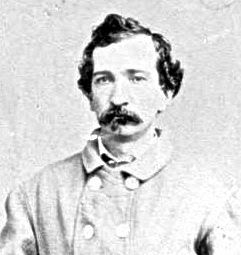

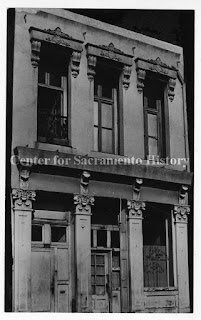
Born about 1831 in Ireland, at the age of 17 or so John Keenan emigrated across the Atlantic, reputedly landing in Mexico about 1848 and working his way to Texas where for a time he was a Texas Ranger.  From there he moved to California, settling in Sacramento.  The energetic Keenan hit town like a tornado.  After a large fire destroyed many of Sacramento’s saloons, the Irishman sensed opportunity. He raced to a nearby settlement where he purchased a prefabricated wooden building on the Sacramento River and had it floated to town.  With the help of his wife, Keenan decorated it, calling it “The Fashion Saloon.”  He soon moved to a more substantial building shown here.

Well aware of the dangers posed to Sacramento by its frequent fires, Keenan decided to assembled a local firefighting force.  It was a canny decision for someone like Keenan who was seeking broad community recognition.  Volunteer fire brigades served several purposes in those times.  Not only did their members provide a level of trained “first responders” to battle conflagrations, but also served as fraternal organizations.  Fire halls not only contained the requisite fire fighting equipment but also large spaces for socializing.  Crew members could be found there at all hours playing cards, throwing darts or just chatting.  The commanders of such units were elected by the members and held in high regard by townsfolk.
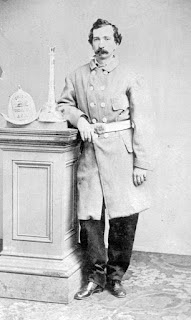

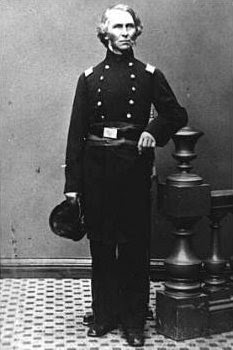
Keenan’s efforts resulted with his being elected its chief.  A photograph exists of the saloonkeeper, dressed in his uniform, standing casually against a pillar on which sits his helmet, identifying J.C. Keenan as chief of the fire unit.  Between them is a large horn, used for alerting the firemen and directing them when fighting a fire.  A downside of this honor was that the chief and other ranking members were expected to pay for equipment.  With Keenan’s wealth gained from the Fashion Saloon such expenditures were easily borne.


******


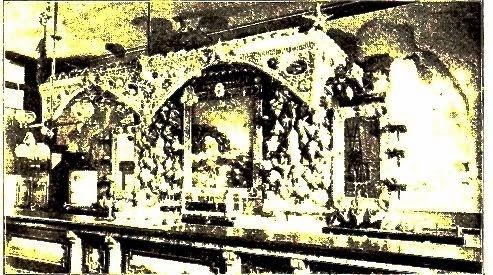
An 1894 directory of Houston, Texas, businesses, advised visitors to the city to pay a call at  the drinking establishment at 1105 Congress Avenue in order to view the bar at the rear, calling it “particularly striking and remarkable” for its decoration of  “sea shells and marine curiosities.”  The Seashell Bar was the creation of C. W. and Charles C. Ruger, father and son saloonkeepers also known to the community for their dedication to firefighting.
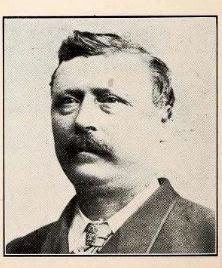

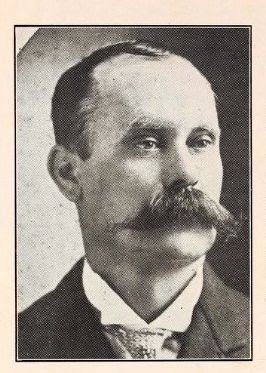
C. W. Rugers, shown right,  was one of Houston’s first volunteer firefighters, attached to Liberty Department No. 2.  He rose to be foreman (commander) of the company and later its representative to the central fireman’s body.  C.W. had sufficient wealth to fund these activities.  An immigrant from Netherlands, he started as a grocer but soon moved to the more lucrative liquor trade and became wealthy.


When his son, Charlie, shown left, grew to maturity, his father took him into the business.  C.W. apparently was a difficult taskmaster, expecting a great deal from his son.  A contemporary biography signaled that Charlie had not had an easy transition from a boy to a businessman:  “At a tender age he had duties thrust upon him that gave him experience that few young men encounter.  He has has had a ‘rough road’ to travel on the highway of life, but out of it he stands today strong and robust, ready to meet any future adversities that may be lying in wait for him.”

Despite whatever his relationship with his father, Charlie followed his father’s example and was an enthusiastic volunteer firefighter.  He was a member of the Siebert No. 19 Company, formed in 1894.  It was the last volunteer group organized in the “Old Department,” before paid fire service in Houston.  The company featured a non-motorized hose wagon that had to be rolled by hand to the fires.  “Strong and robust” as Charlie was said to be, that activity still was a strain and he may not have been displeased when Siebert No. 19 was disbanded.


******


John Stump was a native-born American, coming into life in Cumberland, Maryland, shown below, in 1874 to parents both of whom had been born in that state.  He appears to have entered the liquor trade at an early age, recorded as a 21-year-old saloonkeeper.    By 1900,  according to census data,  Stump had disposed of the saloon and was concentrating his energies as a wholesale liquor dealer. 
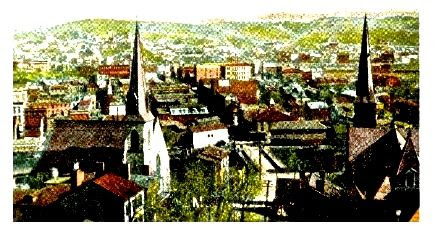


He soon embarked on an active political career, using his role as a volunteer fireman as a launching pad.  Because of the many frame buildings in Cumberland and the presence of a number of glass factories, fires were common.  Stump had risen to the position of acting chief of the Cumberland volunteers when a major fire threatened downtown nearby Frostburg, Maryland.  He sent his fire fighters to help extinguished the blaze, gaining praise from the local press.  Subsequently Stump was elected president of the Allegany-Garrett Counties Volunteer & Rescue Association. He also became a prominent member of the Firemen’s Association of Maryland, becoming its state president in 1898.  


Stump, a Republican, then parlayed that post into running and being elected to the Maryland House of Delegates from Allegany County, serving from 1904 to 1906. He also served terms as both the town’s finance commissioner and its street and sewer commissioner.  Despite his Republican connections, National Prohibition came down just as hard on him as on Democrats.  Stump was forced to close up his prosperous liquor business in 1919.  The 1920 Census found him with no occupation listed. 


******


Perhaps the premier “whiskey man” first responder was Philip Engs, a New York City liquor millionaire.  Born in Newport, Rhode Island, in 1789, as a youth he came to New York to work.   His passion, however, was fighting fires.  While still in his teens he joined Fulton Engine Co. No. 21,  a volunteer fire company organized in 1795 that originally met in Crooks Tavern until it acquired a fire house   Engs rose rapidly in the ranks of his fellow firefighters, after three years chosen secretary of the company and by 1815, age 26, elected foreman, a position he held until 1820.  Subsequently he became proprietor of a major liquor business.
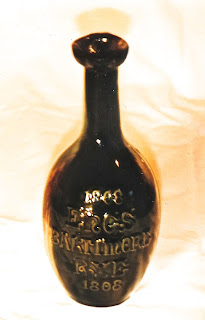

Engs’ headquarters was at 131 Front Street in Manhattan.  From there he not only carried on a vigorous wholesale trade, he also was operating as a “rectifier,” that is, blending raw whiskeys to achieve a particular taste and color.  As he advanced in wealth Engs never forgot his first love — fighting fires.  At the time he had joined the Fulton firefighters, the scene of a blaze often was chaotic.  Volunteers companies often fought among themselves  for prominence while the flames raged on.  Engs soon recognized the need for professionalized fire services in New York.  Accordingly, he became a driving force behind a paid fire department, as one observer ironically put it, “sweeping away the romantic past.”  


In 1865 New York Legislature in 1865 created a professional New York Fire Department was born.  More than 3,800 volunteers were expunged from the rolls.   Among first five fire commissioners appointed by the governor was Philip W. Engs.  He amply had earned the post.  Earlier, with other investors he had incorporated “The Fireman’s Insurance Fund” to insure against loss or damage by fire and to afford charitable funds for firefighters and their families.  He also served a term as president of the Association of Exempt Firemen, a firemen’s social club. 


Those and other Engs’ initiatives figured prominently in an 1887 history of Big Apple firefighting called “Our Firemen.”  The book contained the  portrait of the 76-year-old Commissioner Engs shown above.  The liquor dealer also was a historian of New York’s fire service.  Although he never published it, an Engs’ manuscript has been cited as providing “most of the facts”  about the early days of New York City firefighting for subsequent accounts.


Note:  This website contains longer articles on each of the whiskey men described here:  John Keenan, December 6, 2020;  The Rugers, January 1, 2015;  John Stump, June 14, 1914, and Philip Engs, January 7, 2017.
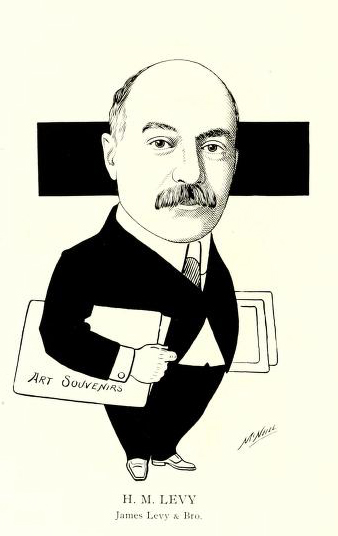


Harry Levy Was Harvard’s Gift to Whiskey


 Looking back at the 900 plus “whiskey men” profiled on this website the vast majority began as indigent immigrants or native-born poor with little education who by hard work and intelligence succeeded in the liquor trade.  Not so Harry Milton Levy, the five foot, four inch, gentleman shown here.  Born to riches in Cincinnati, Levy was sent to Harvard for his college education and stayed to earn a degree from Harvard Law School.  


Harry’s good fortune began when he was born in 1862, the son of Albert and Julia Fries Levy.  His father and a brother had immigrated from Wurtemburg, Germany; settled in Cincinnati, and founded a highly successful wholesale liquor house known as James Levy & Brother.  At the time Cincinnati boasted its centrality east of the Mississippi River, its role as a canal and railroad hub, its access through the Ohio River to the Mississippi Basin and the Atlantic Ocean and, most important, its ability to tap the burgeoning distilling capacities of Kentucky.  “The Queen City,” as it was known, became the center of the liquor trade in America.  The Levys were among the beneficiaries.


After graduating from Harvard Law, above, Harry Levy never practiced for even one day.  He hurried back to Cincinnati and the family liquor house, located at 33 Sycamore Street, to join his father and uncle.  At the time the Levy brothers were selling at wholesale multiple brands that included:  “Belle of Milton,” “Crab Orchard,” “G. W. H.”, “Hazel Nut”, “Madison”, “Maywood”, “Old Pioneer “, “Pilgrimage,” “Richwood,” “Spring Lake,” “Spring Wood,” “Susquehanna,” “Susquemac,”  “Treubrook,”  and “Teakettle.”


Like other wholesalers the Levys were always on the lookout for sources of whiskey supplies for their house brands.  An opportunity arose in 1880 with the availability of The Tea Kettle Distillery about 70 miles downriver in Trimble County.  Established about 1840, this distillery had been destroyed by fire in July 1879.  Rebuilt, the facility was contracted to James Levy & Bro. to handle its entire output.  


Insurance records from 1892 describe the property as containing a stone still-house with a boiler house. A shed located 16 feet from the still housed cattle to be fattened by the slops. The property also included three bonded warehouses: Warehouse “A” — brick with a metal or slate roof, 210 feet south of the still house. Warehouse “B” — brick with a metal or slate roof, 125 feet SE of the still house.  Warehouse “C” — iron-clad, 150 feet north of the still.  In 1892 Harry Levy was recorded as the “proprietor” of this complex.


Beginning with the Trimble County distillery Harry took the family liquor business in a new direction.  Instead of seeking whiskey from a host of suppliers, James Levy & Bro. now contracted for the entire output of a handful of Kentucky distilleries with reputations for quality products and as “jobbers” marketing their whiskeys nationally to wholesalers and retailers.


The 1888 Centennial Review of Cincinnati offered this assessment:   “Twenty years ago Louisville would have considered impossible recognition by the jobbing trade of any city outside of itself as a jobbing market for fine Kentucky whiskey; yet the firm of James Levy & Bro. has not only made Cincinnati recognized as such, but has plucked the laurels from Louisville….”  The article goes on to say that the Levys were not rectifying or compounding liquor but shipping their straight whiskey direct to customer warehouses from the half dozen distilleries they controlled.


The blue ribbon prize of those distilleries had been founded by Judge W. H. McBrayer of Lawrenceburg, Kentucky.  Shown above, McBrayer’s “Cedar Brook” whiskey had won international metals and was, in one report, “the finest handmade sour mash whiskey in the world.”  This “coup” for James Levy & Bro. was engineered by Harvard-educated Harry.  As he aged Judge McBrayer had become increasingly aware of his inability to market his whiskey effectively to a wider audience.  In a visit to the Lawrenceburg distillery, below,  Levy was able to persuade the old gentleman to give him exclusive rights to merchandise Cedar Brook nationwide.  With the help of the Cincinnati organization the brand became synonymous with the best in Kentucky whiskey.


As Harry worked with other family members to build a national and international business for Kentucky whiskey, he was conducting a personal life. In 1896 he married Jeanette Feiss, Ohio-born in 1873 and about ten years younger than Harry.  Jeanette was the daughter of Leopold and Sarah Wyler Feiss;  Her father was a prominent Cincinnati businessman, involved in the tobacco and clothing trades, and known for his civic involvement and philanthropy.  


Although the couple apparently had no children, Harry consistently provided spacious accommodations for the couple.  From about 1904 until 1916 the Levys lived in East Walnut Hills residential district of Cincinnati.  The house, still standing, was a large and impressive pressed-brick residence at 2933 Fairfield Avenue, having the look of a French chateau.  The couple lived there together with one or more servants in attendance.  Harry also bought a summer residence at Tupper Lake in New York’s Adirondack Mountains, a favorite retreat for the well-to-do.  The Harry Levys were among the few Jews recognized in the “exclusive” Mrs. Devereux’s Blue Book of Cincinnati Society.


Wealthy after almost 30 years helping to guide the fortunes of the Levy liquor house,  Harry about 1910 cut his ties with the company.  The reason is not clear.  His father Albert had died in 1905.  Uncle James Levy had sons, his cousins, who may have been slated to manage the business.  Or Harry could have sensed the tightening noose of Prohibition.  Or perhaps he simply wanted a change.  The 1910 census gave his occupation as “capitalist,” someone dealing investments.


His new career coincided with a passion to build Jeanette and himself a new house, one like Cincinnati had never seen before.  The mansion, shown above, has been described thus:  “The design blends elements that were modern for the time, reflecting the approach of the Arts & Crafts a movement, with evocations of the historic past, primarily English architecture of the Tudor and Jacobean periods of the 16th and early-17th century to create a unique amalgam.”  The residence was located in the fashionable Hyde Park district of Cincinnati on six large lots overlooking the Cincinnati Country Club.  The 1920 census records the couple residing there with four live-in servants, a male and three females.


Harry Levy, however was about more than fine houses.  He never forgot Harvard.  In 1892 he personally paid for the attendance of a number of Cincinnati students to Harvard.  Harry also helped finance and administer the local Harvard Club’s annual “scholastic field meet” for local high school students.  Much of his philanthropy went to “beautifying” Cincinnati.  For at least a quarter century he was treasurer of the city’s Municipal Arts Society.  That work explains the “art souvenirs” folders under his arm in the caricature that opens this post.  The Arts Society actively sought to make Cincinnati a more attractive city by promoting open space and public art and by working with schools to advance art appreciation. 


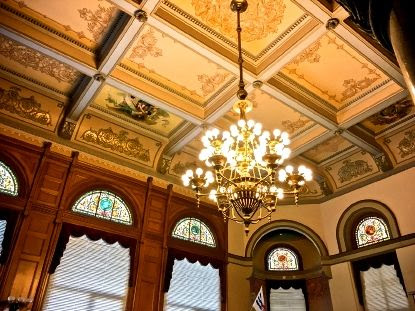
In 1905, for example, the Society, with Harry in the forefront, persuaded city officials to give it a statue of Cincinnatus that had been stored away after being defaced with red paint.  The members paid to restore and place it in a public park for general viewing, as shown here.  When Cincinnati’s City Hall was redecorated, with Harry leading, the Society provided for the internal decoration.  The result were dozens of refurbished stained glass windows and painted ceiling panels that even today have made City Hall a tourist destination.  The building is listed on National Register of Historic Places.


Heavily invested in stock and bonds, Harry Levy faced a significant financial setback at the time of the stock market crash.  He and Jeanette could no longer afford their servants and moved out of their spacious Hyde Park home and rented it for income.  The couple, however, were far from penury.  They moved from the house to the Hotel Alms, shown right, a fashionable residential hotel in nearby Walnut Hills. The couple apparently lived there until Harry died in 1940 at the age of 78.  Jeanette subsequently sold the iconic house.


For a final word on whiskey man Harry Levy it seems appropriate to quote from a Cincinnati Press Club publication.   The article hailed him as “one of Cincinnati’s foremost capitalists, and certainly entitled to the fullest recognition as a philanthropist, for his benefactions for years have been of the most generous nature.”


Notes:  This post has been garnered from multiple sources of which by far the most important was the National Register of Historic Places Registration Form for the Harry Milton Levy House.  It was co-authored by Walter E. Langsam and Beth A. Sullebarger of the Cincinnati Preservation Society in 1997 and provides many cogent details about Harry and Jeanette Levy. 


Gilbert O’Shaugnessy — The Texas Teetotaling Whiskey Taster

Calling himself a professional “rectifier,” i.e. expert blender of whiskey, and frequently employed by his fellow Texans to determine the quality and composition of liquor,  Gilbert Ryan O’Shaugnessy as a youth had taken a pledge never to drink alcohol.  According to family lore, what Gilbert, shown here, tasted he spit out — just one aspect of the unusual life of this Irish immigrant.

Gilbert was born in July 1858 in Slievedooly, County Clare, the son of Patrick and Mary Ryan O’Shaughnessy.  His mother died when Gilbert was only two and the boy received an elementary education in Ireland.  It was in Ireland that he took the temperance pledge that he honored all his life.  His father was a dairy farmer whose properties by custom would go to an elder son.  As a younger son, Gilbert faced a less fortunate future, possibly the impetus for him to immigrate to America.


Sources differ between 1878 and 1883 as the year the youthful Gilbert arrived on these shores.  He seems early to have settled in Galveston, Texas.  There he met Mary Hansbury, born in Texas, the daughter of Irish immigrants, Mary Anne and Michael Hansbury,  At the time of their marriage in February 1887, Gilbert was 29 and Mary 22.  


During Gilbert’s decade or so living in Galveston, he worked for George Schneider & Co., whose letterhead proclaimed the business as “General Commission Merchants and Liquor Dealers.”  The Irishman’s status as a non-drinker might have helped him secure the job.  Gilbert seems to have been a highly useful employee, listed initially in Galveston directories as a “drayman,” that is, driving a horse-drawn wagon, and subsequently employed as a clerk.  Gilbert also had skills in cooperage, making barrels for holding Schneider’s house whiskey blends that included “Lone Star Bourbon” and “J. Martin Rye.”


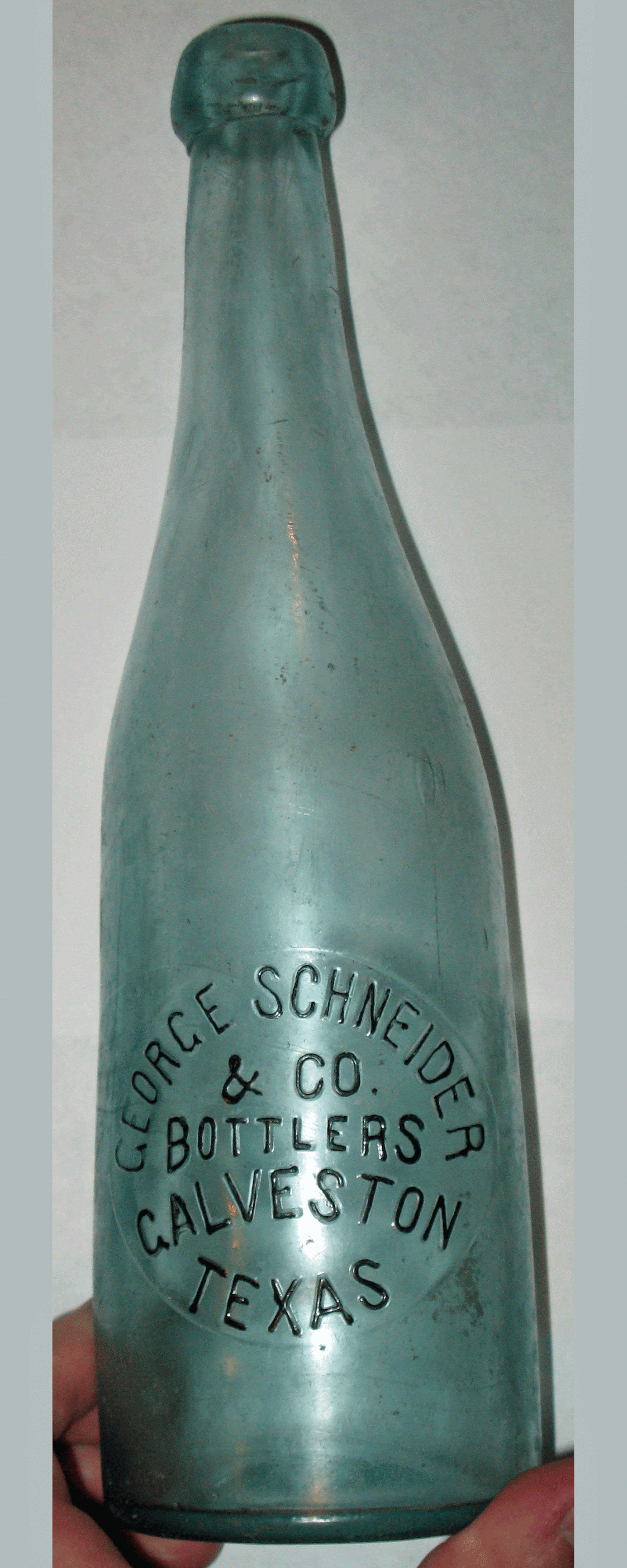
As his employment with Schneider & Co. progressed, Gilbert became increasingly involved in the wholesaling, retailing and finally manufacture of whiskey.  In 1901 he listed his occupation as “rectifier” for the firm.  Rectifying or blending whiskey was and still is a highly valued skill in the liquor industry.  It requires the ability to insure consistency over time in the taste, smoothness and color in a particular brand.  Shown here is a Scheider quart.


Just as Gilbert was reaching the pinnacle of skilled whiskey men, tragedy befell the O’Shaugnessys.  During their decade in Galveston their union had produced five children, Mary Gertrude, Katherine, Patrick, Margaret Eileen, and Antoinette.  On September 8, 1900, a hurricane struck Galveston considered to be the deadliest natural disaster in American history, killing an estimated 8,000 persons.


As Gulf waters inundated the city, a crowd of forty or more displaced residents crowded into the O’Shaughnessy residence, waiting on the second floor for rescue.  When a boat at last arrived, the rush to board caused the craft to overturn temporarily.  Antoinette, 5 years old, was swept away by the flood waters. Fortunately, Gilbert, Mary, and their four remaining children were saved.My grandfather searched for her for two weeks,” related one descendant about Antoinette.  When Gilbert at last found her body amid the acres of wreckage, they buried her in Galveston and shortly after moved 250 miles west to San Antonio.  “I do not believe they ever got over the horror of that storm.”


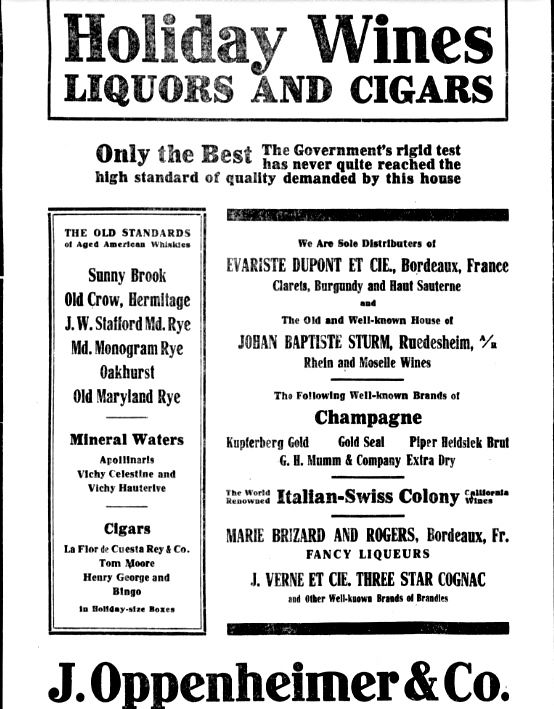
In San Antonio, shown above in 1910, Gilbert soon found employment with J. Oppenheimer & Co., a local grocery and liquor wholesaler and retailer located at 230 West Commerce Street.  “This firm handles the finest wines and liquors to be had anywhere, both imported and domestic,” gushed a puff piece in the San Antonio Light.  A company ad indicates that while Oppenheimer was selling national brands like “Sunny Brook.” “Old Crow,” and “Hermitage,” it also featured house brands like “J.W. Stafford Maryland Rye,”  “Maryland Monogram Rye.” and “Oakhurst Whiskey.”


Oppenheimer’s ads claimed: “The Government’s rigid test has never quite reached the high standard of quality demanded by this house.”  Such a boast suggests that the company required the services of a professional rectifier such as Gilbert.  In order for their house brands to achieve quality desired, his services would be needed at every step to guide the results. For Gilbert it meant tasting and spitting out literally gallons of whiskey over his lifetime.


A skilled rectifier like Gilbert was also called upon by San Antonio liquor dealers and saloonkeepers to test by taste the whiskeys they were purchasing.  Some unscrupulous distillers and wholesalers sold products that were watered down or contained ingredients including grain alcohol, fusel oils, tobacco juice, molasses, and artificial coloring.  A professional taster could detect such contaminants. In the 1900 federal census Gilbert gave his occupation simply as “rectifier,” in the liquor industry.  No specific employer was indicated. 


As time went on, while continuing to work with Oppenheimer, Gilbert was associating closely with several San Antonio drinking establishments, reported among them the Viaduct Bar and the International Saloon.  Shown here are two sides of a bar token from the latter.  Apparently moving from selling whiskey by the bottle to selling it by the glass, Gilbert was obliged to acquire the skills of bartender and saloonkeeper. 


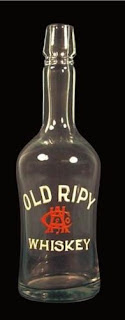
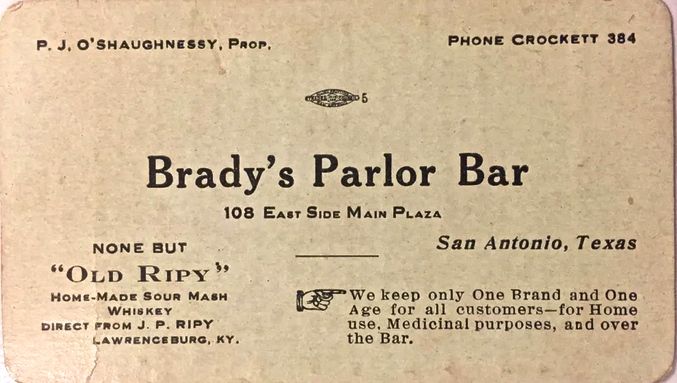
He apparently liked the change. In 1913 the Irishman became proprietor of the Brady Parlor Bar at 106 East Main Plaza,  in the shadow of the city’s Catholic Cathedral, shown above.  It was named for James T. Brady who turned it over to Gilbert’s management in 1913.  This was a high class saloon, known as the sole Texas agent for “Old Ripy,” a quality Kentucky bourbon.  O’Shaughnessy’s business card stated:  “We keep only One Brand and One Brand only for all customers — for Home use, Medicinal Purposes, and over the Bar.”   The “Teetotaler Taster” operated the establishment until shut down by National Prohibition in 1919.


Whiskey, however, was only one aspect of Gilbert O’Shaugnessy’s life.  He became a
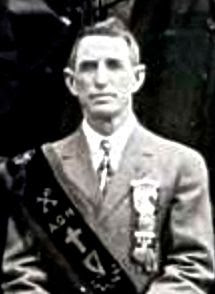
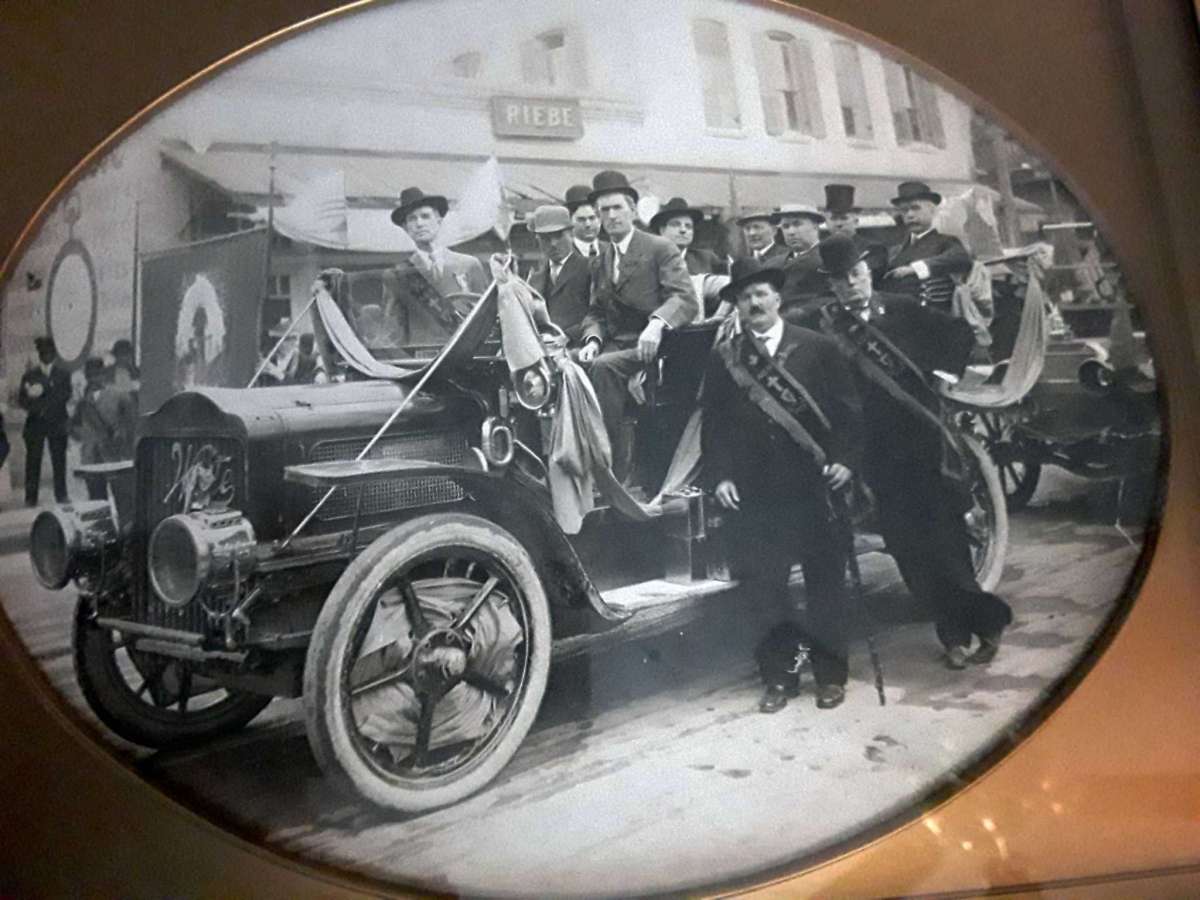
 well known and respected member of the Irish-American community in San Antonio.  In 1908 he was elected president of the local chapter of the Ancient Order of Hibernians, an Irish social organization.  The picture of Gilbert that opens this post is taken from a group photo of the Hibernians arrayed in front of St. Mary’s Catholic Church after the annual St. Patrick’s Day Mass.  The members were wearing their sashes and badges. Gilbert was the only one in a light suit and one of the few who was clean shaven.  He is also visible far left below standing on the running board of an automobile in the ensuing St.Patrick’s parade in downtown San Antonio.  Although Gilbert owned a motor car, the former drayman as yet did not know how to drive.


Typically on St. Patrick’s Day the Hibernian’s planned a daylong celebration for the patron saint of Ireland.  The Mass and parade would be followed by an elaborate dinner in which with the ladies auxiliary, the Daughters of Erin, and others, including the German American Liederkranz,  performed skits and musical numbers.  Says one writer:  “Often the grand finale on the evening’s vaudeville-style was Gilbert O’Shaughnessy, whose Irish dancing brought down the house.”  In contrast to vaunted Irish tenors, Gilbert was reputed to be unable to carry a tune.


O’Shaughnessy was a devoted family man, according to a descendant:  “His children and grandchildren grew up to find good jobs, wore the uniform of this country in wartime, were called to the religious life.”  Gilbert Jr.became a highly successful West Coast jazz musician and another  son was an international golf champion.  The family had realized the promise of America that brought Gilbert to these shores.


With the advent of National Prohibition, Gilbert was forced to shut down his saloon. Now 62, he took a job with the San Antonio Parks Department. As a city employee, he began a 12-year career as an inspector and later, having taught himself to drive, as a chauffeur. Shown here In his later years, Gilbert was diagnosed with stomach cancer in July 1932 and died four months later on October 31— the eve of All Saints’ Day.  As shown here, he was buried in San Antonio’s San Fernando cemetery.


At his funeral the Gilbert O’Shaughnessy was extolled for his generosity to the needy and other good works entitling him, said the priest, “to walk among the princes of the people.”  Little was said about his three decades working in virtually every aspect of the liquor trade, but once sworn having to abstain from alcohol, never having taken a drink himself, demonstrating a strength of character given to very few. 


Notes:  Much of this article was derived from two columns in the San Antonio Express-News in March and April 2021 written by Paula Allen.  The first column was sparked by an inquiry from an O’Shaughnessy descendant who asked whether “rectifier” was  a genuine occupation.  It was followed by a second column that focused on Gilbert’s career.  Family photographs are also from that source.

Frederick Stitzel — “The Thomas Edison” of Whiskey

 An impressive number of pre-Prohibition whiskey men have been inventors, frequently patenting their creations.  Very few, however, were able to see their “brain children” put into production.  An exception was Frederick Stitzel of the famous Stitzel family of Kentucky distillers.  Not only did Stitzel, shown here, register numerous patents, two of his inventions were commercial successes and continue to be in use down to the present day.

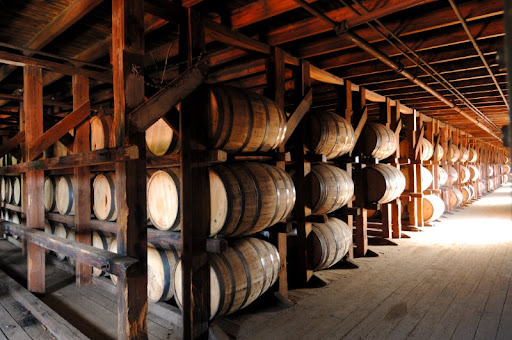
Recently Whiskey Magazine listed the 100 “Greatest Whiskey People,” highlighting individuals worldwide who left a lasting legacy on the whiskey trade over the years.  Frederick Stitzel was among that chosen few.  His claim to fame was based on his patented invention for stacking barrels of whiskey for aging.  Earlier the custom was to stack them directly on top of each other.  This was a highly risky practice.  Each barrels held about 53 gallons of whiskey and filled would weigh around 500 pounds.  Putting one of those behemoths on top of another could cause leakage, outright ruptures and other problems.


As shown here in a drawing, Stitzel’s system consisted of what he called rails, shelves attached to heavy wooden frames to support the weight of individual barrels.  The rails were spaced, so that when a barrel was placed on its side, each end would be supported by a rail.  It also allowed for the barrels to be turned from time to time, assisting the aging process.  Stitzel’s design called for each section to be made separately, allowing easier configuration of tiers in the warehouse.


In his patent application, Stitzel explained: “This my invention relates to a new and useful improvement in racks for tiering barrels containing whisky or other spirituous liquors, the object of which is to provide a portable rack or frame made in sections that will be sufficiently strong to bear the weight of as many barrels as may be tiered between the floors of the house without resting upon each other, thereby avoiding the danger of crushing the staves by the weight, as each tier is made to rest on separate rails projecting on the inside of the frame independent of the others, thereby causing a free circulation of air between the barrels, and at the same time making it easy to remove any of the barrels in the lower tiers without interfering with those above or below.”   The Stitzel rails are in general use even today.


Stitzel did not just exercise his inventive genius on whiskey.  When he died, newspapers across the country carried a notice headlined “Death Takes Inventor of Railroad Signals.”  Called a “semaphore”  Stitzel’s was one of the earliest forms of fixed railway signals. His semaphore system involved electronic signals that display their important information to engineers by changing the angle of inclination of a mechanical pivoted ‘arm’.  During the late 19th Century they became the most widely used form of railway signal.  


Stitzel described the system as “devices along the route for controlling devices in the…train, e.g., to release brake, to operate warning signal at selected places along the route…intermittent control simultaneous mechanical and electrical control….”  Shown here, these semaphore devices are still being used on some railroad lines although generally replaced by signal lights.


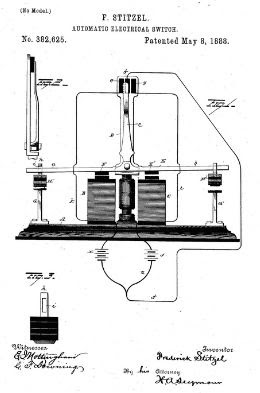
These were just two of perhaps a dozen or more Stitzel inventions.  Shown below left is the drawing for his 1883 improvement for railroads.  Noting that in telegraph, electric signals, and other electronic devices, the batteries operating them steady weakened and required replacement , Stitzel proposed an innovation that would automatically cut out the weakened battery and insert a new one.  Thirty years later in 1923 at 80 years old, Stitzel was still inventing.   Shown right is a “spring wheel” device for automobiles he patented to help smooth out bumps on rough roads.   Stitzel and other family members regularly were in touch with government and industry marketing his ideas for railroads, automobiles and, yes, even airplanes.


Given his passion for invention, it is a wonder Stitzel had time for distilling.  An immigrant from Germany, Frederick, at the age of 14 had arrived in the United States with his father and two brothers, Philip and Jacob.  The family was recorded living in Louisville in 1855.  With Philip in 1875 Frederick founded a distilling company they called Stitzel Brothers.  Frederick was president; Philip was vice-president.  They purchased a small existing plant known as the Glencoe Distillery in Louisville. Shown here, it had only limited mashing capacity.


After this distillery was destroyed by fire in 1883, the brothers rebuilt and expanded the facility as shown here.  Insurance underwriter records from 1892 note that that it was of frame construction, with three warehouses:  A — brick with a metal or slate roof, located 79 feet south of the still;  B — ironclad, 120 feet southwest of the still, and C — ironclad, located 83 feet north of the still. The warehouses were reported capable of holding 22,000 barrels — obviously on Stitzel racks. The partners also maintained cattle pens 79 feet downwind of the complex where the cows were fed spent mash from the whiskey-making. This distillery could mash up to 600 bushels, daily turning out 54 barrels of whiskey. 


The  Stitzel distillery, above, eventually covered an area of two and one half acres.  An 1895 publication entitled “Louisville of Today,” featured the facility:  “Here are a large and splendidly equipped stillhouse, elevator, immense warehouses, cattle sheds, etc.  The plant stands second to none as regards modern high-class machinery and appliances, power being supplied by a thirty horse power engine.”


The expanded capacity allowed the brothers to issue a variety of brands.  At various times they included “Billy Burke,” “Champion,” “Friend of Man,” “Glencoe,” “Lock Horn”, “Merryland Rye,” “Mondamin,” “Parkland,” “Parkwood,” “Pomona Rye,” “S. B. Co.,” and “Old Fred Stitzel.”  Despite Frederick’s frequent contacts with the U.S. Patent Office, the brothers trademarked only one label.  Shown on a shot glass here, the brand was Mondamin, named for a Native American god of corn.


The distillery was listed in Kentucky State tax records as Stitzel Brothers until 1919 and the coming of National Prohibition.  During this period, the plant continued to be expanded.  At Prohibition the company had a large stock of whiskey in its commodious warehouses that it was authorized by authorities to bottle for medicinal spirits.  The distillery itself was dismantled.  The relationship of Frederick to the company during the 1910s is not clear.  Some indications are that he may have left actual distilling with his Stitzel brothers and nephews in favor of operating  a whiskey brokerage in Louisville — and pursuing his inventions.


While exercising these interests, Frederick also was carrying on a personal life with wife and children.  In 1874 he married Emma Laval, a woman born in Kentucky who was twelve younger.  Her father had hailed from the same part of Germany as Frederick.  They would have five daughters over the next nine years — Marguerite, Elizabeth, Winnie, Emma, and Marrie.   The couple would be married for 50 years, until Frederick’s death in 1924.


Stitzel was stricken with bronchial pneumonia in the autumn of that year, lingered only a short period and died on September 18 at the age of 81.  He was buried in Louisville’s Cave Hill Cemetery, where so many Kentucky bourbon barons are interred. His widow Emma would join him there 11 years later.  Stitzel was commended in the press as a Louisville distiller who supported: “All public enterprises of any moment calculated to advance the prosperity of this section”. 


Still receiving patents up to a year before his death,  Stitzel could never approach the record of 1,093 patents Thomas Edison received during his lifetime.  Nonetheless, inventing virtually up until the day he died, Frederick Stitzel richly earned the accolade as “The Thomas Edison” of whiskey men.


Addendum:  Frederick’s nephew, A. Philip Stitzel, later would join with members of the notable Weller Kentucky distilling family to create the famous Stitzel-Weller distillery that survived National Prohibition and brought Julius “Pappy” Van Winkle to the fore. See my post on Pappy, November 22, 2014.


Notes:  This post was gathered from a wide range of sources, of which the more important were records of the U.S. Patent & Trademark Office and “Louisville Today,” issued in 1895 by Consolidated Illustrating Co., Louisville. 


Three Desperadoes of Drink

Foreword:  This post describes of activities of three Western gunslingers with checkered pasts who sought legitimacy in frontier towns by owning saloons and participating in the business life of their communities. When violence almost inevitably intruded, each man faced a different result.  

A member of the notorious Wild Bunch, Lonnie (Logan) Curry was on the lam from a train robbery in Wyoming when he arrived in Harlem, Blaine County, Northeast Montana, in July 1899.  Shown here, Curry immediately rented a house in Harlem, declared the intention of settling down, and reunited with his wife Elfia and their two children.  This sequence likely was a ploy to establish an alibi if arrested for the train robbery.   Four days after he arrived Curry approached its owner about buying a half interest in the Club Saloon.   


Given the gunslinger’s reputation, it clearly was an offer the proprietor could not refuse.  The drinking establishment was renamed the Bowles and Curry Saloon.  Lonnie became active in the Harlem community and made friends of some of its leading citizens.  He began to wear suits and sprouted a mustache. Soon a Curry cousin and fellow outlaw named Bob Lee arrived in Harlem, identifying himself as Lonnie’s brother.  On November 25 the two men concluded a deal making them the sole owners of the saloon.  The cousins called it “The Curry Brothers’ Place.” They immediately began to redecorate the interior in order to attract Harlem’s elite to their drinking establishment, shown below. 


Curry’s high profile in Harlem led to his downfall.  As one author has speculated: “Apparently the saloon wasn’t profitable, perhaps of too many drinks on the house and unpaid tabs.”  Dipping into the loot from the robbery, kept in a Harlem hotel safe, Lonnie tried to cash a $1,000 bank note, arousing suspicion.  Pinkerton detectives were soon on the trail. In January 1890 agents posing as itinerant cowboys came to town looking for the Currys.  


Alerted to their presence Lonnie gathered up Bob Lee and left Harlem.  Late that night the pair roused a local rancher named George Ringwald and sold him the saloon for $1,000 — $300 in cash and a promissory note for the balance.  They then rode south. With them went the proceeds from a community raffle, ending Lonnie’s good reputation with the people of Harlem.  Soon after Elfie and the children departed town.  Following a circuitous route that took him through Colorado, Lonnie eventually reached Dodson, Missouri, possibly the Curry/Logan home town.  There he hid out in a house with assorted aunts and cousins.  In February 1900, Pinkerton detectives tracked him there and surrounded the residence.  When Lonnie tried to escape, they shot him down — dead at 28 years old. His tombstone is shown here.


When a man calling himself Tom Dunn, shown here, about 1893 rode horseback into Saco, Montana, no one in that ramshackle town knew who he was.  He had sufficient money to buy a local drinking eatablishment, calling it “The Valley Saloon.” The newcomer became known as its genial proprietor, and even, some said, got married and settled down.  “At the time of his death,” reported one Montana newspaper: “He had a fairly good reputation among his neighbors and others who knew him.”


“Tom Dunn” was, in truth, Ed Starr, a member of several well known outlaw gangs.  According to Helen Huntington in her book, “War on Powder River,”  Starr was regarded as a “vicious nonentity” and “a killer for killing’s sake.”  When he arrived in Saco, the outlaw was on the lam from Wyoming, wanted as the head of the Hole in the Wall Gang and the outlaw who had killed a United States marshal.


In Saco, as saloonkeeper and livestock broker Starr/Dunn seemed to have turned over a new leaf.  He soon was appointed deputy livestock inspector, reputedly compiling a good record.  Old habits die hard, however, and in 1898, about nine miles from Saco, Starr/Dunn became involved in selling a string of horses, some of them apparently rustled.  In this scheme he had as a partner another notorious Western “bad man” named Henry Thompson, known as “Long Henry.”  When the time came for the two to settle accounts on the stolen animals, they could not agree on a division of the profits.


Angry with Thompson’s demands, Starr/Dunn began telling people in Saco that “Long Henry” had cheated him.  In that small town it did not take long for the word to get back to Thompson himself.  He cocked his gun and went looking for Starr/Dunn. On August 6, 1898, Thompson found the saloon owner and fugitive outlaw saddling a horse at a local ranch. Thompson accosted him with “I understand you say I have been robbing you.”  Starr/Dunn said nothing, grabbed for his gun and fired twice at Thompson.  According to press accounts:  “The first bullet cut a gash in Long Henry’s scalp and the second made a flesh wound in his side.  But neither of them knocked him down.”  Almost simultaneously Thompson, an expert marksman, fired three times.  The first bullet struck Starr/Dunn in the heart, killing him instantly.  


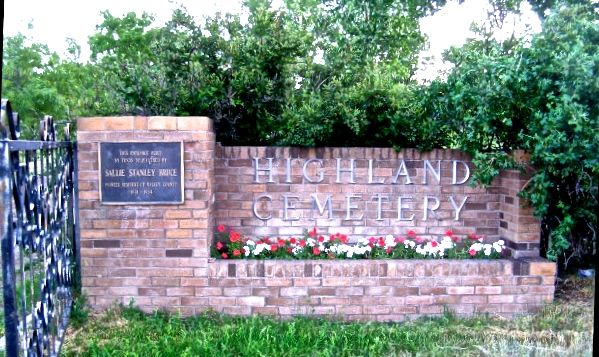
The bullet-ridden Ed “Tom Dunn” Starr was buried in Highland Cemetery in Glasgow, Montana, about 42 miles from Saco.  His funeral was well attended by the friends and acquaintances he had made in Montana.  The Reverend S.W. Russell, an Episcopalian priest from Miles City, conducted the funeral service. 


Violence swirled like dust in a windstorm around Jacob W. Swart’s “Bar Room” in Charleston, Arizona Territory.  Located six miles from infamous Tombstone, Arizona, site of the “Gunfight at the OK Corral,” Swart’s watering hole was a favorite hangout of gunslingers and outlaws.  This photo is believed to be Swart, standing in the doorway of his saloon.


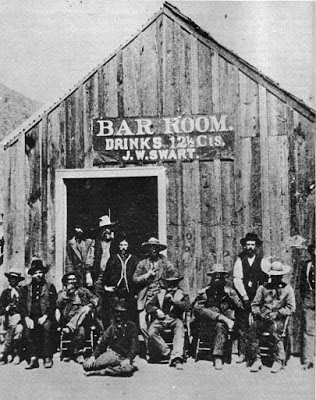
About 1876, the New York-born Swart had moved west. In 1879 the Pima County, Arizona, newspaper reported a payment of $11.44 to him as a quarterly fee for his services as deputy sheriff.  Such jobs often were awarded to those handy with a six-shooter.  Swart subsequently moved on to Charleston, Arizonfounded in 1879 as a milling site for the silver mines around Tombstone.  In 1881 he bought an existing drinking establishment, shown below.  In the years following Swart’s proprietorship of the saloon, it became known as a hangout for a loose group of outlaws known as the “Cowboys.”  The photograph shown here is believed to depict a number of those desperadoes.


 The violence that marked this part of Arizona did not leave Swart untouched. During the mid-1880s, the saloonkeeper had an altercation with a man named Chambers, a manager at one of the Charleston mills.  Swart shot and killed him.  In the West of those days if the dead man was armed and shot in the front, the verdict almost inevitably was “not guilty” and the shooter was not jailed.  In this case Swart found himself facing Justice of the Peace James Burnett, a man known for assessing large fines for infractions and pocketing the money.  Likely reckoning the accused a rich man, Burnett fined Swart $1,000, equivalent to $22,000 today.  Rather than pay up, he hustled out of Charleston just ahead of a posse sent to arrest him.


Swart moved 300 miles west to Yuma, Arizona, on the Colorado River near the California border.   Yuma was a far different place from Charleston and Tombstone.  City Historian Tina Clark has called Yuma a “precious river town.”  It was the first stop in Arizona for trains and steamboats coming from urban centers like Los Angeles and San Francisco.  Tastes in Yuma were more refined and life was calmer.  

There Swart opened a new watering hole he called “The Identical Saloon” at the corner of Main and Second Streets.  In a 1891 advertisement, one that misspelled his name, he boasted of always having on hand “First-class Whiskies, Wines and Brandies” as well as “Choice Key West Cigars.”  Jacob clearly had taken his drinking establishment up a notch on the elegance scale.  His advertising of “Cosy Club-rooms” suggests that he was entertaining gambling or perhaps something more intimate.  At that point the trail goes cold on Jacob Swart.  I have been unable to track his final years or his place of burial. 


Note:  Longer posts on each of these three gunslinging saloonkeepers may be found elsewhere on this blog: Lonnie Curry, May 28, 2020;  Starr/Dunn, March 5, 2020;  Jacob Swart, May 6, 1919;  


Why Did Neal Dow, “Father of Prohibition,” Buy Booze?

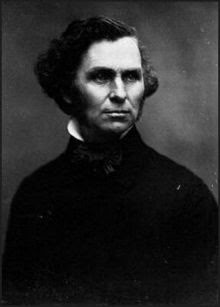
Claiming Neal Dow, shown here, as a “whiskey man’ may seem like a stretch. Dow has been cited as the “Father of Prohibition” and ran for President of the United States as the first Prohibitionist Party candidate. Consider, however, that in 1855 Dow illegally bought a supply of liquor valued at $56,000 in today’s dollar, stashed the supply at city hall in Portland, Maine, and as mayor held the key.  His seeming duplicity incited a riot during which a man was killed.

Dow was born in March 1804 into a prosperous Portland Quaker family.  Although the youth demonstrated exceptional intelligence, his father, a man said to be of lofty morals, refused to send him to college, wary of the influences of college students of that day.  As a result, Dow early joined his father in his tannery business and before long was made a partner.  But hides were not his passion. Drink was.  According to a biographer, even as a boy Dow strongly hated alcohol.  At that time Americans drank three times as much as they do currently.  Portland was a hotbed of legal and illegal drinking establishments, estimated at as many as 300 for a population of 21,000. The young man had found a cause worthy of his ambition. 


After co-founding the Maine Temperance Society in 1827 at the age of 23, Dow became a five foot, two inch, firebrand speaker against the evils of liquor.  His orations were filled with horror stories of drink swilling immigrants, particularly targeting the Irish and their “notorious groggeries.”  Outlawing alcohol, he predicted, would result in  “better public buildings, better ways of living, in multiplied and enlarged industries, and in prosperous, thrifty, happy homes.”


Increasingly Maine residents listened to him.  An 1846 effort by the state legislature to promote liquor sales proved in ineffective.  In 1851, however, Dow was elected mayor of Portland and with Maine Temperance Society members drafted a more stringent law, pushed legislators to pass it and the governor to sign.  The law, earliest in the Nation, made Dow famous with prohibitionists throughout Northern States and he was widely in demand as a speaker.  As mayor he was quick to crack down on drinking in Portland, directing raids against saloons and allowing the booze to flow in the gutters while the thirsty looked on.  Elected again in 1855 by only a slim margin, Dow nevertheless pledged to double down on alcohol suppression.  


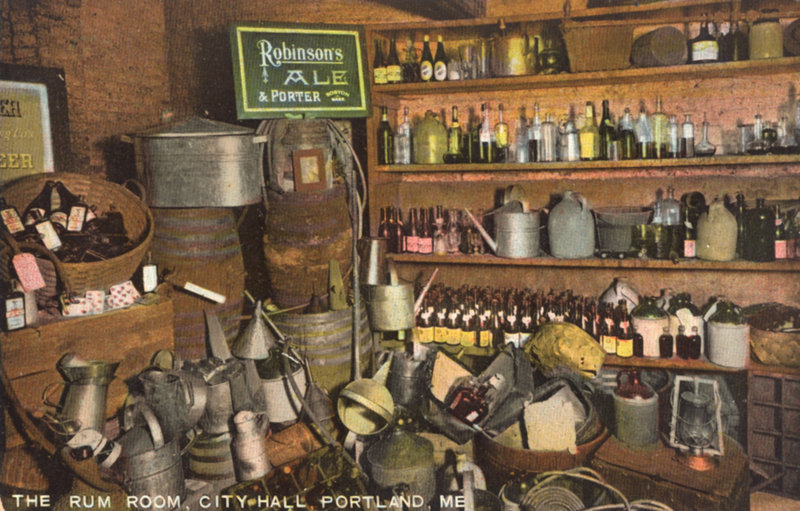
Here things get murky.  Because whiskey was still part of the medical pharmacology, Maine law allowed towns to appoint one government agent, aided by a selection committee, as the sole legal entity to buy and distribute spirits intended for “non-beverage” use.  Apparently not willing to give up personal authority over alcohol, Dow disregarded the law and in his own name bought a stash of booze valued then at $1,600 ($56,000 today).  His purchase probably contained rum, whiskey and grain alcohol. Only when it arrived in Portland did he bother to inform his colleagues.  Dow put the liquor under lock and key in City Hall in what came to be known as “The Rum Room.”  He held the only key.  It is not clear what he had in mind for the stocks.  The situation suggests that he planned to supply it to doctors and druggists upon written requests he alone would approve.  His antagonists, however, saw hypocrisy and wrongdoing.


Because the purchase had not been made under the letter of the law, the liquor theoretically became subject to seizure.  Determined to embarrass Dow, his “wet” opponents drummed the matter into a major issue.  They filed a complaint with the Portland police that the mayor’s purchase had been done illegally and now should be confiscated under the prohibitionary law.  When police seemed slow to act, the protesters went to court.  In Maine, any three citizens could ask a judge for a search warrant if they believed a crime had been committed.  The protestors asked for and on June 2, 1855, were issued a warrant by a friendly local judge.


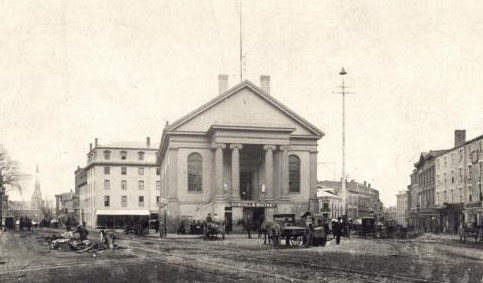
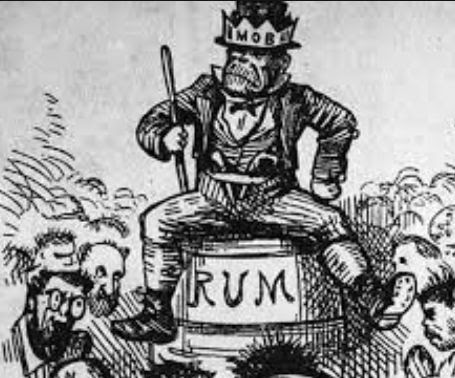
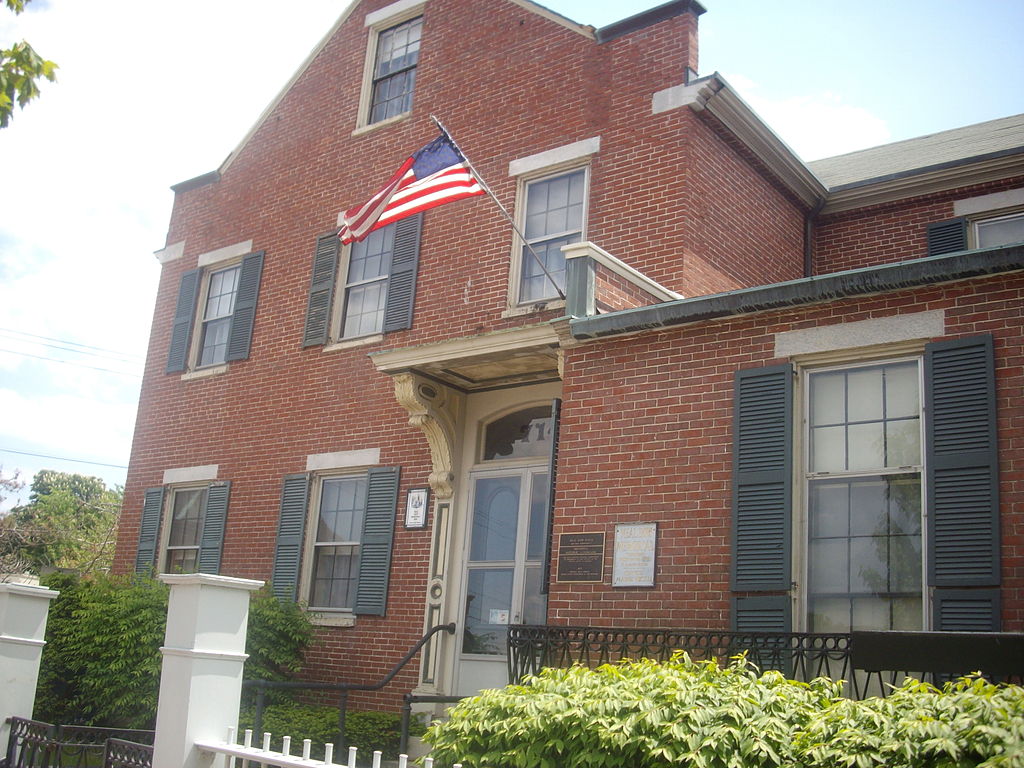
Brandishing the warrant, a small delegation went to City Hall, shown above, demanding entry so they could search the premises.  By this time Dow had caught wind of their gambit and ordered police to bar the door.  When it became evident that the police would not honor the warrant, the crowd grew to some 3,000 men. The mood became increasingly angry at the apparent duplicity of Maine’s leading temperance crusader having his own large supply of booze protected by the police.  Shown here is one cartoonist’s (unfriendly) view of the protest.


In an attempt to avoid violence Portland police officers locked themselves in the Rum Room and refused to disburse the crowd.  An angry Mayor Dow then sent word to local militia companies to come quickly. Sensing impending disaster, one arriving sergeant suggested his men should load blanks. The diminutive Mayor Dow disagreed: “We know what we are about sir. We’ve consulted the law, sir.” 


At ten o’clock that night one militia group of about twenty men formed up in front of City Hall. Now backed by armed troops, Mayor Dow personally ordered the crowd to disperse. They responded with a hail of trash and garbage. Dow ordered the troops to fire to keep the mob at bay.  Their commander, a Captain Green, begged off, said his troops were insufficient, and asked permission to leave to recruit more men.   A reluctant Dow assented. 


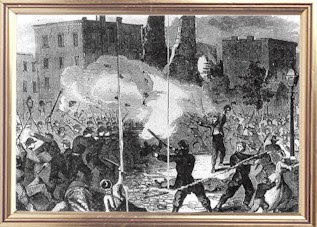
It was a mistake. The sight of the militia marching off encouraged the crowd to become more aggressive. Rocks and bricks were thrown. The rioters discovered that the Rum Room had a door opening to the outside. John Robbins, a 22 year old sailor from nearby Deer Isle, said to have been on the eve of his wedding,  broke a window, crawled inside and unlocked the door. The crowd moved forward.  Just then the strengthened militia returned. At Dow’s command, they opened fire. Robbins was killed instantly.  As the crowd dispersed in panic, the firing continued for twenty minutes. Seven protesters were wounded.  Only because the militiamen were armed with antiquated muskets reputedly prevented the death toll from being higher. To “drys” it became known as the Portland Rum Riot. To “wets” it was the Portland Massacre.


In the days to follow Dow was charged with breaking the law he had helped pass, but was acquitted after a one day trial. The judge was a strong prohibitionist and a Dow supporter who ruled that the city — not Dow — owned the liquor. Considering himself exonerated, the mayor immediately issued a “Message on the Riot” in which he claimed John Robbins was an Irish immigrant who was wanted by the law.  It was a lie. Witnesses under oath testified that Robbins had been born in America, had never been arrested, and was a “steady, honest man, remarkable for his good nature and peaceable disposition.”  Nor was Robbins of Irish descent.


Historian Jack S. Blocker Jr. summed up the effects of the day’s events. The shootings, he says: “Irretrievably tarnished the prohibitionist dream of an orderly world of upwardly mobile abstainers…of Americans who were drawn to the vision of peace and prosperity that the enthusiastic prohibitionists such as Dow himself set before them.”  Dow’s reputation in Maine also took a severe blow.  Anti-prohibition media accused him of murder.  His attempt to be elected to a third term failed.  Opposition to the Maine law was strengthened as public opinion shifted and it was repealed the following year.  Dow’s rush to use lethal force had undone his singular success.


Elsewhere his standing among prohibitionists remained intact, sought as a speaker in the U.S. and England.  Also ardently against slavery, Dow at the age of 57 in 1861 volunteered for service in the Union Army during the Civil War, was made a colonel, and promoted to brigadier general.  Captured by rebels through a fluke, he spent eight months in a Confederate prison before being exchanged.  After the war he returned to his anti-alcohol crusade.  When the Prohibition Party was formed in 1880, Dow became its first candidate for president, receiving a paltry 10,305 votes.


As he aged, Dow curtailed his speaking activities, residing in the family home shown above, with his daughter and married son.  In October 1897, at age, 93, he died.  His body lay in state in Portland’s Second Parish Church prior to burial in the city’s Evergreen Cemetery.  The ardent prohibitionist had begun to write his memoirs but never lived to finish them.  Too bad.  Neal Dow, “Father of Prohibition,” might have revealed in them exactly what he had in mind when he bought all that riot-causing liquor.


Note:  Articles about Neal Dow and the Portland Rum Riot are numerous.  They also vary on some important details.  I have tried to select accounts that have more than one source.  As an addendum to this story, I have added below a postcard issued by a local newspaper during National Prohibition of a 1920s “Rum Room” in Portland’s City Hall. 


John Hill — “Beloved” Saloonkeeper of Davenport


“It is safe to say that no man was more generally beloved in Davenport than Mr. Hill.”   From the Davenport, Iowa, Democrat & Times, February 13, 1924.


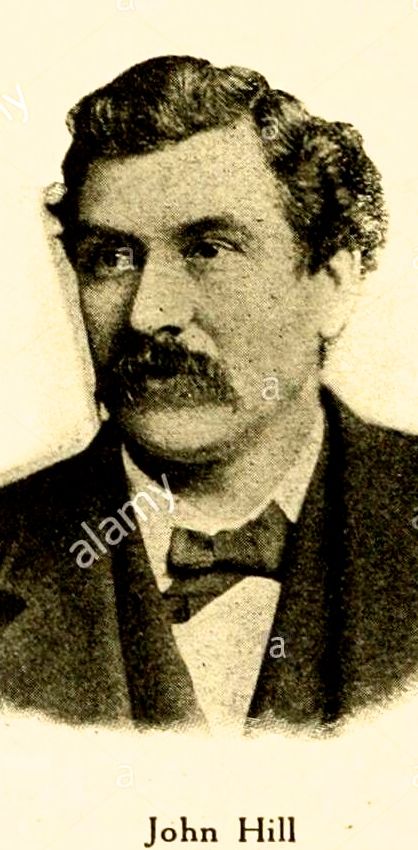
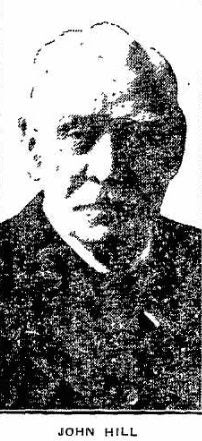
Captured during the Civil War and on the brink of death in a notorious Confederate prison, John Hill, a German immigrant, survived to become a major figure in the liquor trade and community life of Davenport, Iowa.  Shown here, Hill secured his place in Iowa history by his role in litigation that brought down the state’s prohibition law, known by the “wets” as the “Davenport Case” and by “drys” as “The Case from Hell.”


John was born in Frankfort, Germany in April 1840 to Margaret Ditzenberger and Conrad Hill, a government official.   After receiving a quality elementary and secondary education,  Hill left Germany at age 16 for America about 1856, settling in Davenport, a city with a sizable German population.  There he learned the cabinet maker’s trade, before moving to Muscatine, Iowa, until 1861 and the coming of the Civil War.  


The Civil War and Prison


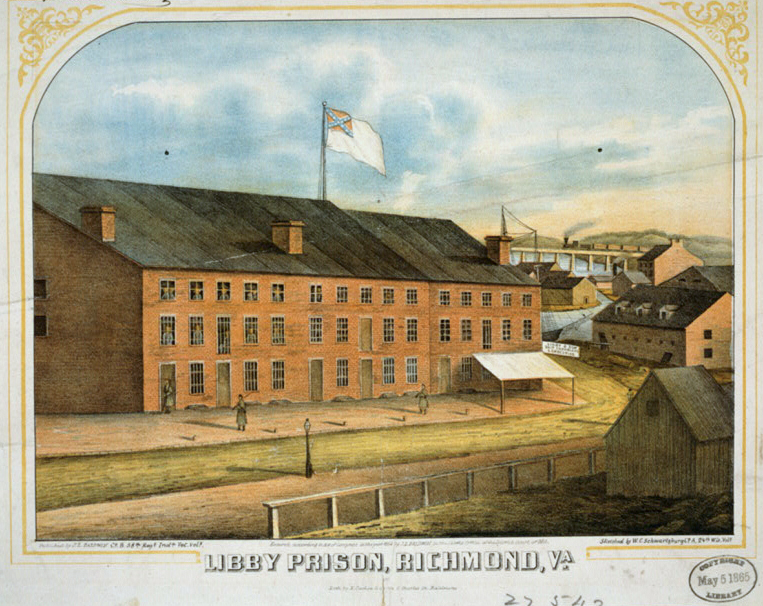
The Roster & Record of Iowa Soldiers in the War of Rebellion records that Hill enlisted in Company C of the Iowa 35th Infantry Regiment in September 1862.  He would rise to the rank of sergeant over the next few months when the 35th saw considerable hot combat as the Union army thrust deep into Mississippi and Louisiana. At some undisclosed point in this campaign Sgt. Hill was captured.  He was sent to the Confederate’s notorious Libby Prison in Richmond, Virginia, known for its overcrowding, lack of sanitation and heavy mortality.  


This is how Libby Prison has been described:  “Prisoners were huddled there like cattle, being so crowded that they could not lie down even to sleep.  There was no heat of any kind and with the chilly dampness and other discomforts, not to mention the lack of food and water…made it a veritable hell-hole….”  Upon arrival, Hill joined in digging an escape tunnel using bare hands and bits of boards.  When the day of escape came, however, he was too sick and feeble to crawl out and was forced to remain behind.   Hill survived Libby Prison, likely released in a prisoner exchange, and returned to the 35th Iowa.  He mustered out in Davenport in June 1865.  This time he stayed in the city, shown here about 1865.


Post War Activities


Honored for his war service by the Germanic population, Hill was made manager of Davenport’s central Turner Hall, shown here.  He proved to be a success as a proprietor.  One account says:  “In the good days, sport, old timers from over the Rhine would gather at the old Turner hall in the afternoon to greet young John Hill with a genial Goondacht!…”


Hill also was having a personal life.  In April 1867, John was married to Maria S. Kaehler, four years younger than he.  Like her husband, Maria  had been born in Germany and immigrated with her parents.  The Hills would have five children, of whom three survived to adulthood.  


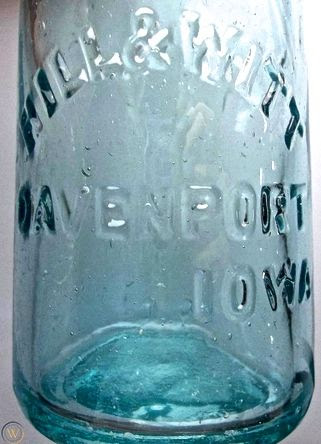
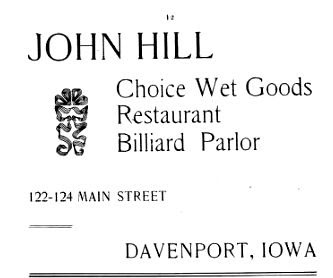
Perhaps it was the impetus of his growing family that persuaded John to leave Turner Hall in 1876 to join local businessman Henning J. Witt in organizing a mineral water factory at 718 W. Second St.  Expanding over time the company added the manufacture of soda water and bottled beer, ale, porter and cider.  Shown below is a blob top bottle and an enlarged label advertising “Hill & Witt.”


By 1879 Hill had left the partnership and returned to managing the Turner Hall.  Again his tenure made him many friends, but after some eight years on the job, he once again grew restless.  His extensive experience with food and liquor led to a logical conclusion and he opened Hill’s Bar and Cafe on Davenport’s Main Street.


As Saloonkeeper


The Davenport Democrat & Leader described this “watering hole”:  “The Hill establishment, by reason of the cordiality and good fellowship of the proprietor, and the excellent service which always characterized its management became one of the most famous stands of its kind in the Middle West.”  The newspaper described the saloon as one that strangers to town would seek out because of its reputation.


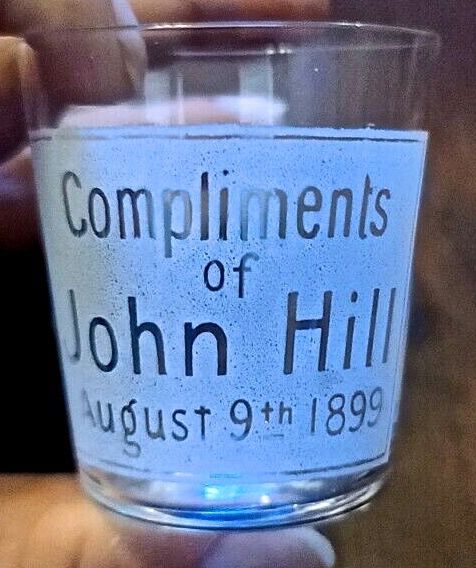
The proprietor made sure that he also was drawing in locals by maintaining memberships in fraternal organizations, including the Masons, Knights of Pythias, Elks and Turner Society. As a Civil War veteran. Hill was particularly active in the Grand Army of the Republic (G.A.R.)  He was a regular at the organization’s national conventions and extended special courtesies to its members, including gifting them with commemorative shot glasses.


At the same time, however, he could see the inroads being made by prohibitionary forces in Iowa.  In 1880 the State Legislature passed a resolution amending the Iowa Constitution to prohibit the manufacture and sale of intoxicating liquors.  It was followed in 1882 by a statewide referendum in which voters concurred.  That year the “drys” met in convention in Des Moines.  There they addressed the saloonkeepers and liquor dealer of Iowa “urging them to discontinue a business that had been outlawed by a vote of the people and the laws and Constitution of the State.”  John Hill’s response:  “Not so fast!”


“The Case from Hell”


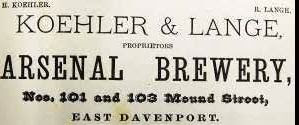
Hill and Henry Koehler, shown here, had hatched a plan.  Along with R. Lange, a partner with Koehler in a Davenport brewery, they thought knew a way to bring down the new prohibitionary laws.  The brewers brought a suit against Hill to recover $100 for a quantity of beer they had sold him and for which he allegedly had never paid.  Hill facetiously argued in his defense that he could not be lawfully compelled to pay for beer sold in violation of the state constitution.


Koehler and Lange then argued that the amendment had not been passed and ratified in the manner stipulated by the Iowa Constitution.  No friend of prohibition, Judge Walter I. Hayes of the County District Court, ruled in favor of  Koehler and Lange, rejected a faux appeal from Hill, and in January 1882 ruled the amendment invalid.


A  shock wave went through the Hawkeye State.  From a case that initially had drawn little attention, now Hill and the brewers were figures of discussion statewide.  Liquor interests hailed them for what came to be known as the “Davenport Case.”  Alarm bells ringing loudly, prohibitionist reviled their effort as “The Case from Hell.”  All parties headed to the Iowa Supreme Court.


As one history of Iowa put it:  “The friends of prohibition were now thoroughly aroused to the danger….”   They brought in as their advocate a distinguished former judge.  The governor, a “dry,” dispatched the Iowa attorney general to appear for the state.  Now funded by the liquor trade statewide,  the other side also mounted a formidable legal team.


After hearing extensive arguments in January 1883, the Iowa Supreme Court with only a single dissent affirmed the decision of Judge Hayes:  the amendment was invalid.  While prohibitionists were left to excoriate the majority judges,  Iowa’s liquor dealers and saloons had been granted a reprieve.  Although the legislature subsequently passed another prohibitionary law, it was simply allowed local option, not a statewide mandate.  Davenport being safely “wet,” its whiskey men enjoyed another 31 years in business.  Only in 1914 did Iowa’s “drys” at last succeeded in a complete state ban on alcohol.


The Later Years


Following his triumph in the Davenport Case, Hill continued operating his high quality saloon and restaurant until about 1900.  Shown here in his elder years, he retired from business, celebrated with Maria their golden wedding anniversary, enjoyed their five grandchildren and was a well-recognized figure around Davenport.


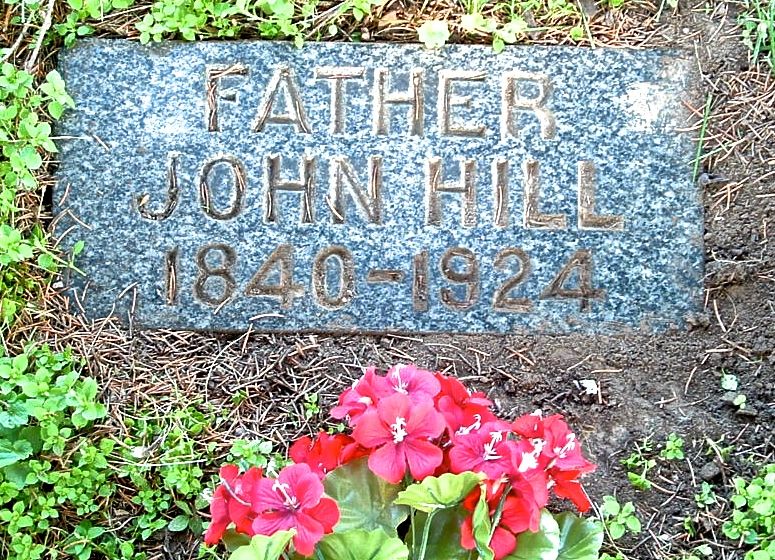
Eventually Hill became afflicted by heart problems and may have shown some signs of dementia.   As his condition worsened in January 1924, he had been confined to bed for only a short time when he died on February 12, 1924.  He was 83.  Hill’s funeral in his home and burial in Davenport’s Fairmont Cemetery were private with only his widow, family, and a few invited guest attending.  His gravestone is shown below.


No final word about this whiskey man could be more eloquent than an excerpt from his obituary in the Davenport Democrat & Leader:  “Mr. Hill was a true gentleman in every sense of the word….He possessed a largeness of mind, generosity, and sympathy which endeared him to all with whom he came in contact.  It is safe to say that no man was more generally beloved in Davenport than Mr. Hill.”


Note:  This post is drawn from a variety of sources, two of which stand out:  John  Hill’s February 13th obituary on the front page of the Davenport Democrat & Leader and documents from “Koehler & Lange vs. Hill.”


George Troug Was a Artist in Barware


 Foreword:  Among individuals labeled as “whiskey men” on this blog are several that through their craftsmanship have provided the pre-1920 liquor trade with distinctive artifacts to advertise and sell alcoholic beverages.  Most were anonymous artisans whose names and accomplishments had never before been recorded or acknowledged.  The vignette that follows is about a possible exception.


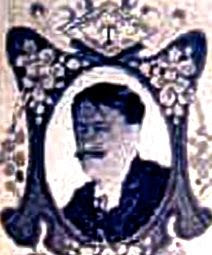
Just as Louis Comfort Tiffany is hailed as the America’s premier artist in crafting glass into lamps and shades, so a Maryland artist in glass should be recognized as the top creator of etched barware, including much-collected pre-Prohibition whiskey shot glasses. His name was George Troug, shown here.

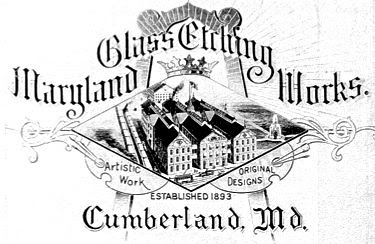
Troug was born in Verona, Italy, in 1861. After attending school in Switzerland, he emigrated to the United States in 1883. He found his way to Cumberland, Maryland, at the time a thriving center for glass production. Troug worked at several glass manufacturing plants, all the time saving his money and planning to own his own factory. In 1893 his dream materialized and he opened the Maryland Glass Etching Works. His letterhead illustration indicated a substantial operation. 

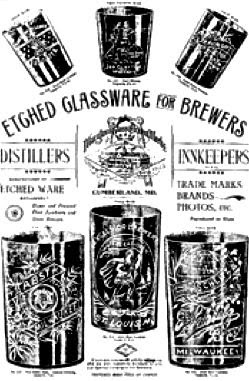
Within a few months Troug was advertising in trade journals as being able to provide fine and fancy etched glassware for brewers, distillers and innkeepers.  He claimed among his customers two prestigious Milwaukee breweries, Pabst and Schlitz.  He was making beer glasses for them etched with their names.

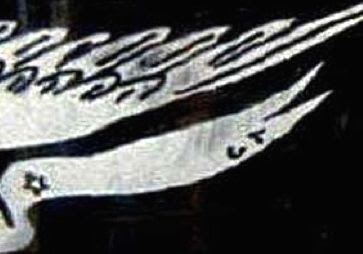
While many Maryland Glass Etching Works products remained unsigned and thus unrecognized as Troug designs, some glassware was graced with his “G T” initials.  His mark frequently is small and hard to find. Yet another way of identifying Troug products is through his sketchbook, parts of which have been salvaged. It also is interesting to see his original drawings as they ultimately took shape on round glass surfaces.


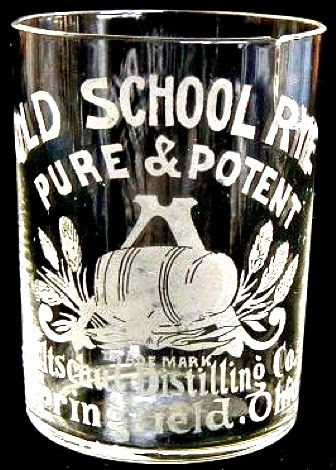
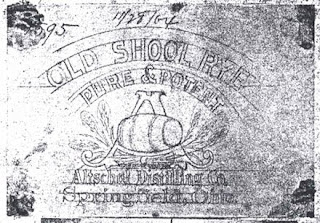
Distiller Sam Alschul of Springfield, Ohio, was a master at merchandising his multiple whiskey brands. [See post of  May 15, 2011.] He turned to Maryland Glass Etching for shot glasses advertising his “Old School Rye.” Troug obliged with a drawing and turned it into a superior etched glass. Notice, however, the misspelling of “school” in the drawing.


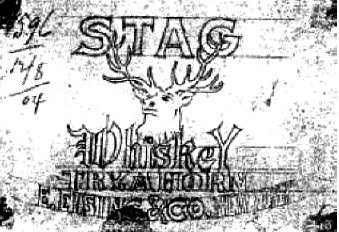
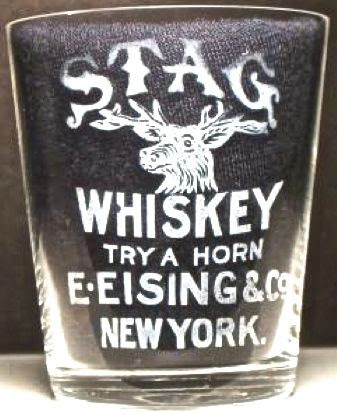
Another example is Troug’s initial design of Stag Whiskey barware for E. Eising Co. of New York (1880-1906).  Although the basic design is similar to the shot, the typography used for the glass is significantly different.  The drawing has “Stag” in plain letters and “Whiskey” in fancy ones. The finished shot glass shows just the opposite typography.

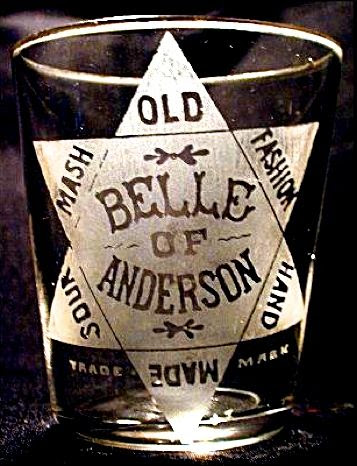
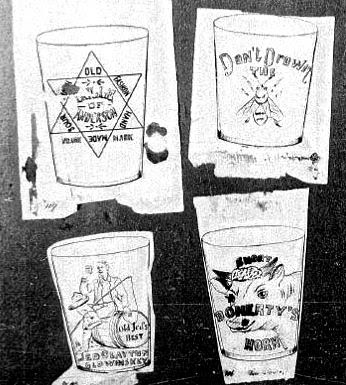
Another clue to Troug inspired glasses are designs copied on tissue paper for later transfer to metal production plates, illustrations that have been conserved by Troug collectors.  Among the images shown on these scraps is one for a “Belle of Anderson” shot glass. The item itself shows the realized design commissioned by Eisen Brothers Co. of Kansas City (1906-1916).

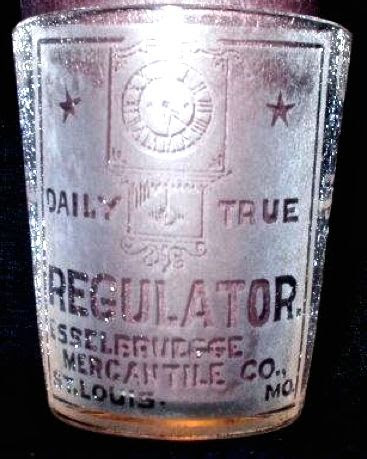
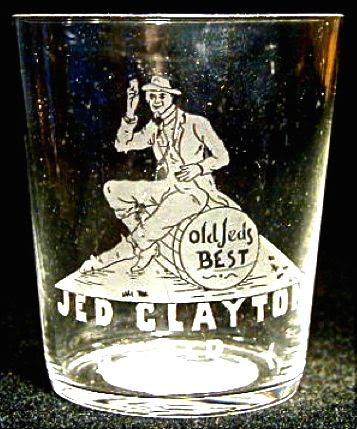
Another sketch depicts Jed Clayton Old Whiskey from Rheimstrom Bros. of Cincinnati (1876-1917). [See post of June 28,2017.] This image too is somewhat altered on the finished shot glass. Other identified Troug “shots” include the “Regulator” from a St. Louis mercantile company and a fanciful pig. 

Details of Troug’s personal life are scant. His energies appear to have been focussed narrowly on his artistry and running his glass etching business.  In 1889 at the age of 28, he married Barbara A. Wegman, a woman seven years younger who had been born in Maryland of a German immigrant family.  Georg and Barbara would have one child, Rita Victoria, born a year after their marriage. 

As Maryland Glass Etching Works reputation grew during the late 1800s and early 1900s, so George Troug became a wealthy man. Known for his spendthrift habits, at the height of his career he purchased a simple late 19th-century residence and in 1903 contracted with a well-known Cumberland architect, Wright Butler, to undertake a extensive and lavish remodeling at the then astonishing cost of $44,000.

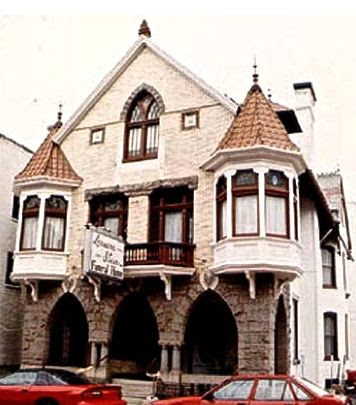
The exterior design featured a recessed entrance with an arcade of Gothic arches, corner bay windows on the second floor and roof cresting.  Inside additions included a ballroom with a pool table that converted into an upholstered sofa and an elaborate self-contained water system. The house exhibited Troug’s artistic skills, featuring etched, engraved, stained, colored and painted glass of his design, as well as other ornate features. The expense may well have been Troug’s downfall. He was forced to sell the house in 1909 and two years later found his company forced into bankruptcy.  When he died in 1931 at the age of seventy, Troug is said to have been destitute. 

Georg Troug’s sad ending cannot dim his achievements in glass.  During the 18 years that the Maryland Glass Etching Works was in business, the German immigrant was responsible for some of America’s most innovative and desirable pre-Prohibition barware.  His legacy is confirmed in the avid way collectors of shot glasses check each item closely with a magnifying glass in the hope of finding a tiny “GT” etched somewhere on the surface.

Notes: The barware shown here is through the courtesy of Robin Preston of the pre-pro.com website, himself a collector of Troug shot glasses. For anyone wishing to know more about this designer, Dale Murschell, a Cumberland historian, has written a book entitled, George Troug and His Art.  Unfortunately the book now is out of print and difficult to find.


Whiskey Men Fighting the Whiskey Trust II


Foreword:  The heyday of attempts at monopolies in the America whiskey trade was relative short.  Two were important:  A Midwest “Trust” organized in 1887 and centered in Illinois that failed by 1898 through bad management and a Kentucky/New York cartel begun in the 1890s that flourished until about 1910, then essentially stalled.  Remnants, however, hung around until 1920 when National Prohibition was imposed.  Among the many problem the Trusts faced was active opposition by distillers and whiskey “rectifiers” (blenders) to their attempts to “corner the market” and drive up liquor prices.  Below are brief stories of whiskey men who opposed the monopolists and helped bring them down.


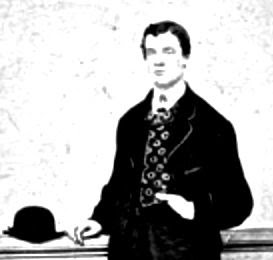
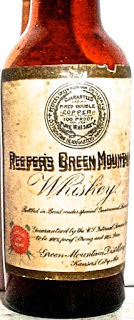
Described by his hometown newspaper as “irrepressible” and “indispensable,” to the Kansas City business community, Max Reefer, shown here, had been in the liquor business for three years when the first Whiskey Trust appeared.  An immigrant from Austria, he began his career in the U.S. as an advertising guru.  After the  birth of his first child in 1863, Reefer with his family moved from St. Louis 250 miles west across Missouri to Kansas City.  There, at the age of 33, he set up a liquor house, calling it “Green Mountain Distillery.”  His business plan was to advertise his whiskey repeatedly in national magazines where he emphasized mail order sales.  The plan worked and Reefer built a large  clientele.


He soon came in conflict with the Whiskey Trust.  Reefer was not a distiller, but a “rectifier,” that is, receiving whiskey by the barrel, blending it on his premises, and bottling it under his own label for shipping.  Rectifiers often found themselves at the mercy of the Whiskey Trust.  The Trust controlled a large percentage of existing whiskey stocks and hiked prices to the blenders.  If they refused to pay, they ultimately ran out of raw product, adding to whiskey shortages — the delight of the Trust.  As Reefer knew, the Trust would have been very happy to put Green Mountain and its owner out of business.  


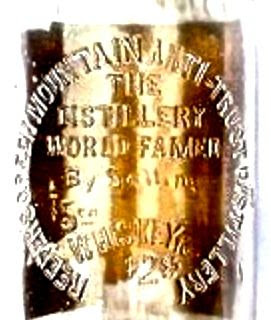
Reefer struck back.  Apparently able to obtain enough liquor for his blends, he advertised vigorously that he could undersell the Trust.  “The whiskey we send is distilled from the purest grain (no seconds), is matured and ripened in wood and will cost you but a few cents over $2.00 per gallon.  We guarantee that no Trust house ever sold the same quality goods for less than $3.00 to $4.00.”   He went a step further by stating his anti-Trust views on his whiskey labels.  To his dying day at age 68 in 1916 Reefer maintained his attack on the Trusts and likely watched with some glee as th declined.


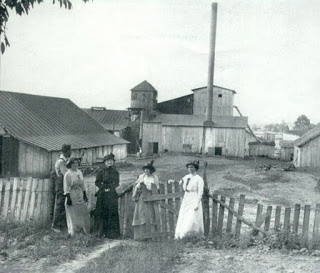
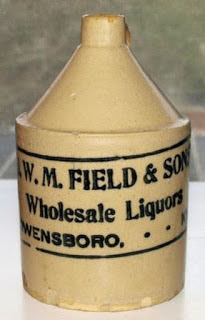
A major target of the monopolists were Kentucky distillers, among them J. W. Morton Field of Owensboro.  His small distillery, shown below, had attracted the attention of the KY/NY Trust.  “Front men” offered to buy 3,000 barrels of whiskey from J. W. M. Field & Sons over five years and then, under specified conditions, an additional 5,000 barrels annually over the next ten years.  Field could produce only 500 barrels for his own use and sale.  If he exceeded that amount, he would pay a penalty of $5 per barrel.  Believing there would be great advantage in having a guaranteed customer for his whiskey for 15 years,  the Owensboro distiller agreed. 


As the Trust’s power grew, some Kentucky distillers had begun to balk at the idea of a whiskey monopoly.  Field was among them.  When the pseudo buyers demanded he agree to transferring his contract to the Trust, he said an emphatic NO. In retaliation for Field’s refusal, they refused to take any more of his production, leaving the Owensboro distiller with unsold stocks.  Seemingly with no other choice, Field sued in 1902.  He had the wisdom to hire as his attorney, William Lindsay, a former chief justice of the Kentucky Supreme Court.   Although the suit was filed in the U.S. Circuit Court in New York, not in Kentucky, Lindsay persuaded the jury to give the distiller a judgment for damages in the amount of $50,000 (equiv. $1.25 million today).  It was a decisive blow against the Trust.  


Although J.W.M. Field & Co had won, the joy of victory was short-lived for Mort Field.  In August of 1903, he died at the age of 58.   Moreover,  family elation at having beaten the monopoly was short-lived when the  “deep pockets” Trust appealed the decision to the U.S. Circuit Court of Appeals.  This time Lindsay was not as effective. That panel decided that the whiskey the Fields could not sell and had stored in his warehouses actually was an asset, gaining value as it aged.  Thus no damage had been done to the Owensboro distiller.  The court nixed the payment and called for a new trial.  There is no evidence that it ever occurred. 


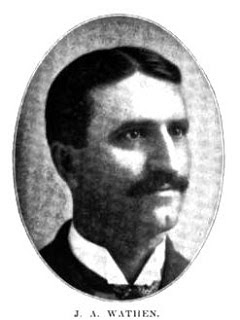
The Wathen family were whiskey pioneers in Kentucky whose interaction with the  KY/NY Trust, known officially as the Kentucky Distilleries and Warehouse Company, were, simply put, “convoluted.”  Three Wathen brothers in 1880 built a large distillery in Louisville.  They experienced great success and reinvested in the company by installing one of the first continuous column stills in Kentucky and steam heat in the warehouses.  J. A. Wathen joined his brothers in 1887 to manage the facility.


In April, 1899, for reason unknown, the Wathens sold the distillery to the Trust.  After the sale J. A. Wathen stayed with organization as an employee.  In a gambit that likely occasioned uncomfortable sibling interactions, his brother J. B. Wathen masterminded the formation of a new distillery for his young sons – called “R. E. Wathen & Co.” named after his eldest boy, only 22 at the time. This facility immediately began to compete with Trust.  The new Wathen distillery used the brand names “Ky. Credential” and “Honeycomb.”  Those labels sounded suspiciously like the brand names “Ky. Criterion” and “Honeymoon,” that the Wathen family had sold to the Trust along with their distillery.


In 1901 the Trust asked for an injunction on the Wathens’ further use of the brands.  During the trial the Trust’s lawyers conceded that the liquor wholesalers and others obtaining these products likely were not confused by the similarity of names used by the new Wathen distillery, but argued that the labels still represented an infringement.  In an expansion of brand name rights, the court agreed, enjoining the Wathens from using “Ky. Credential” and “Honeycomb.”  The ruling held that the brands unfairly impinged on the brands just acquired by the Trust, “even though consumers were not necessarily deceived.”  


Although the Wathens had lost this fight, as author Brian Haraa has expressed it, the family had administered the Trust “a clear “poke in the eye.”


Note:  The Wathen story is adapted from a post by Atty. Brian Haraa on his “Sippin’ Corn” blog.  Brian graciously agreed to my reprinting his piece on this blog where it appeared August 1, 2020.   He treats the Wathen family at greater length in his informative 2018 book, “Bourbon Justice:  How Whiskey Law Shaped America.”   Longer accounts appear at this website on Max Reefer, March 17, 2019, and J.W. Morton Field, January 31, 2016.


The 900th Post — J.J. O’Connor, Model Whiskey Man


This is the milestone 900th post of this Pro-Prohibition Whiskey Men blog.  With the exception of the introductory post on April 6, 2011, each has featured men and a few women who prior to 1920 were distillers, merchants, saloonkeepers and others with close association to American whiskey.  


From modest beginnings, this website now has had more than 1,160,000 views from all over the world.  The blog also has received some 2,150 comments, to most of which I have responded.  Many have assisted me in correcting or enhancing an original post.  The site now has 329 “followers,” to whom I am  grateful for their continuing interest.  


When I began in 2011, I projected a post every couple of weeks.  As the stories multiplied I  soon began adding a new vignette every four days, a practice suggested by the continuing flow of good “whiskey men” yarns.  That flow has encouraged me to attempt to aim for 1,000 posts by 2023.


At 86 years old, it is hard to look beyond that goal.  My plan is to will the entire body of material to the Federation of Historical Bottle Collectors for the digital library connected to its online FOHBC Virtual Museum of Historical Bottles and Glass (https://www.fohbc.org › virtual-museum).  That way the research represented here can be preserved for the future.


For this 900th post I have chosen the story of Jeremiah Joseph O’Connor of Elmira, New York.  Although his story may lack the drama of other whiskey men’s lives,  O’Connor epitomizes those individuals who immigrated to the United States, found a career in the liquor trade and went on to help build their communities — and by doing so, America.  O’Connor was, in other words, a model whiskey man.

*****

 J.J. “Jerry” O’Connor, shown here, was born in Killarney, County Kerry, Ireland, on Christmas Day, 1844, the son of Denis and Mary Reardon O’Connor.  Born during the Irish Famine and British suppression his early days may have been ones of poverty.  In 1850, at the age of three, his parents emigrated from Ireland to Canada where Jerry grew up and was educated.  At age 19, the youth is recorded moving from Whitby, Ontario, to Elmira, New York.


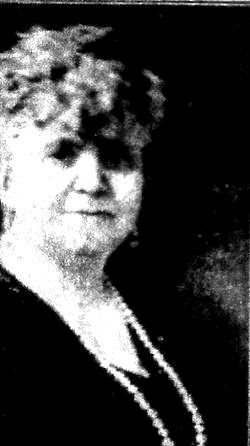
Intelligent and ambitious, O’Conner’s early career included teaching in a Catholic grade school, eventually being raised to principal.  His reputed talent as a educator brought him to the attention of the upwardly mobile Irish-American community and other residents.  He also found a bride in Elmira, wedding Mary Purcell, a woman of Irish immigrant parents, shown here in middle age.   At the time of their 1871 nuptials, according to census data, Jerry was 27 and Mary was 17.  Over the next 17 years the couple would have eight children, all of whom seem to have lived to maturity.


Perhaps it was the demands of his growing family that spurred O’Connor to leave a career in education and by the early 1870s join an older brother, Dennis, in a liquor business they called O’Connor Brothers, located at 108 Water Street.  As an active and articulate Democrat, Jerry also came to the attention of City Hall.  When the position of “city chamberlain” was created in 1876, O’Connor was the first appointee.  The chamberlain was Elmira’s chief fiscal officer, custodian of all city funds and responsible for general accounting functions.  O’Connor proved an inspired choice.  As the initial holder of the office it fell to him to devise systems for accounts payable, payroll, budget monitoring, investing city funds, financial reporting, and collection of real estate taxes.  Accord to a biographer, O’Connor “put the financial system in shape” and his methods were maintained long after he left the post in 1879.
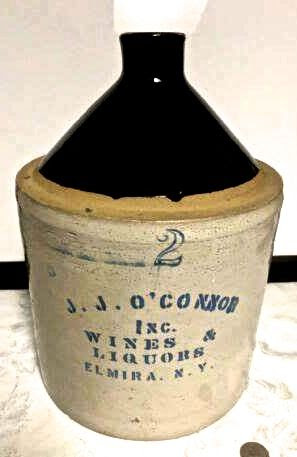

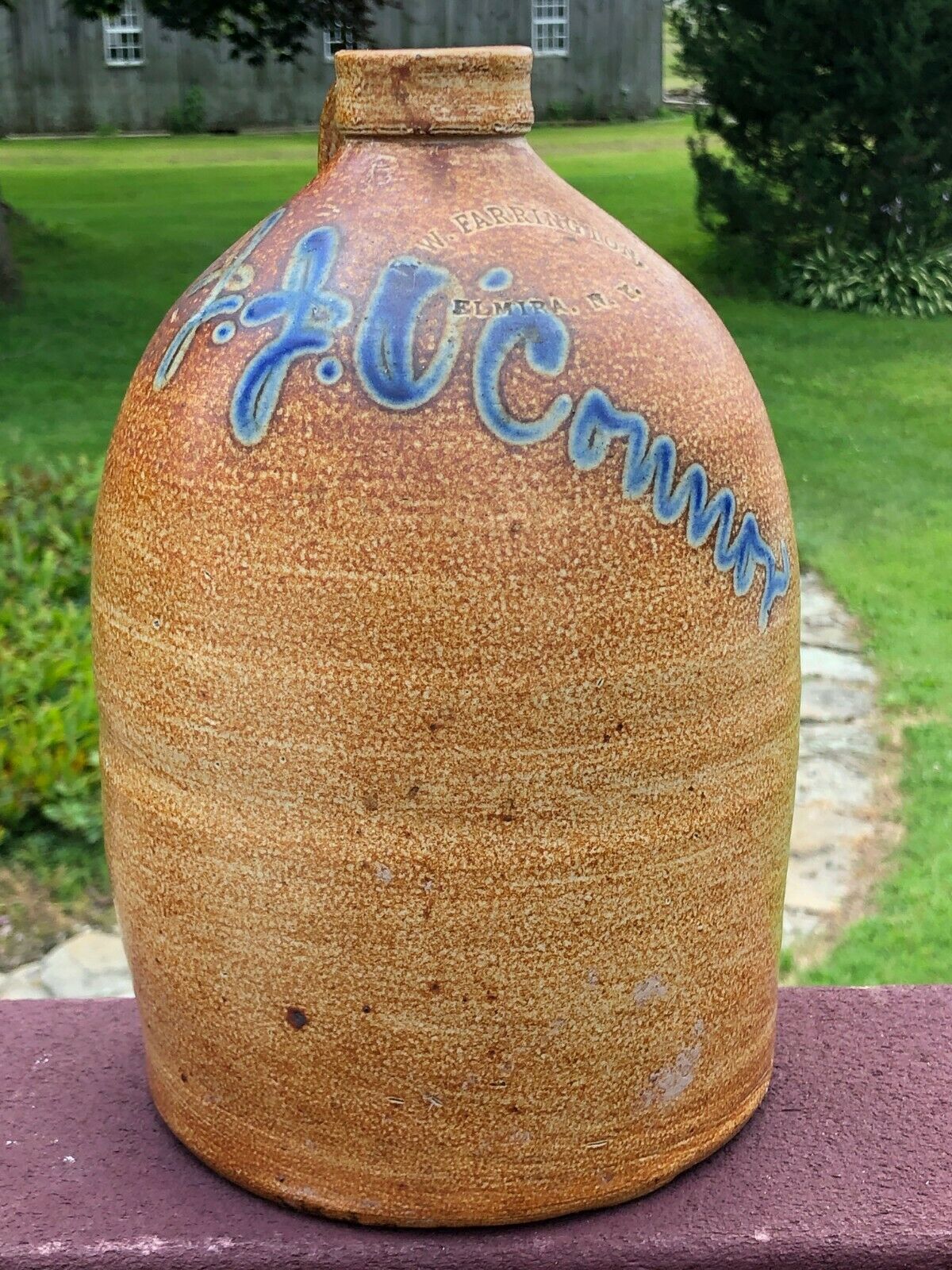
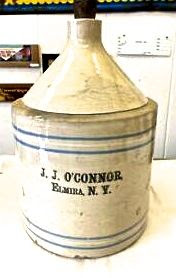
That move almost certainly was occasioned by the sickness and death of his brother, Dennis in February 1879.  Now Jerry had full responsibility for the liquor house.  In time he changed the name to “Jeremiah J. O’Connor – Wholesale Liquor and Wine.”  To customers like saloons, restaurant and hotels, he was providing whiskey obtained by the barrel, decanted on premises and sold in ceramic jugs.  His early containers, obtained from the W. Farrington pottery of Elmira, were graced by attractive decoration, as below.  In time, he moved to more utilitarian jugs, as shown below.


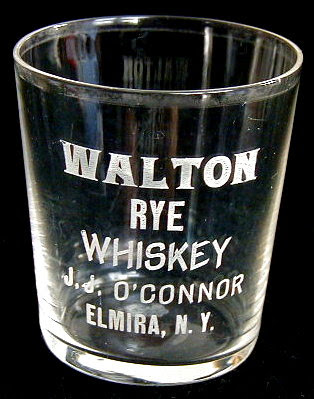
Like many whiskey wholesalers O’Connor marketed his own proprietary brand of whiskey, called “Walton.”  This liquor would have been supplied to him by a nearby distillery to a recipe he dictated or, more likely, blended on his premises.  A practice in the trade was to reward special customers with items such as shot glasses advertising such house brands.  O’Connor’s giveaway was particularly stylish.  As business flourished he relocated to larger quarters at 414-416 Carroll Street.


In the meantime O’Connor’s ability and accomplishments had advanced him to major roles in the Democratic Party.  Following an appointment to the Elmira Board of Heath for two years, he was put forward as the Democratic candidate for the New York General Assembly in 1883.  He won and served two terms, during which his talent as “a public speaker of no mean ability” brought him notice.  At the 1885 state Democrtic convention, O’Connor was chosen to place the party candidate for governor in nomination, a singular tribute to his eloquence.


Much of this whiskey man’s attention was directed toward the Ireland of his heritage, primarily through his role in the U.S. chapter of the Irish Land League, an organization to protect Irish farmers from capricious evictions by British landlords.  Through peaceful means the League sought to establish “three F’s”: fair rent, fixity of tenure, and free sale of the right of occupancy.  O’Connor was a member of the U.S. Executive Committee, and its treasurer who raised the equivalent in today’s dollar of over $400,000 for the poor in Ireland.


O’Connor’s growing wealth from liquor sales also allowed him to make outside investments.  In 1885 he was among the Elmira businessmen who founded the Elmira Daily Free Press, a newspaper that survived for 22 years before being merged with another publication.  He also was president of the Grand Forks North Dakota Land and Investment Co.  Thousands of settlers had been attracted to the Dakota Territory in the 1870s and 1880s for its cheap land. Companies like O’Connor’s helped settlers established small family farms.


Financial interests increasingly called O’Connor to New York City.  There in 1910, he fell down the steps of a Manhattan subway and was severely injured.  When the damage proved permanently disabling, he directed the 1912 incorporation of the Jeremiah J. O’Connor liquor company.  As directors he appointed his wife Mary and one of his sons, 23-year-old Charles Borromeo O’Connor.   Aware that his injuries might lead to complete incapacity or death, Jerry wisely had looked to the future.  It was not long in coming.  He died on November 23, 1913, at the age of 68 and was buried in Elmira’s St. Peter and Paul Cemetery.  His headstone is shown here.


O’Connor’s death merited front page headlines in the Free Press and other Elmira publications.  Hailed as a “notable Elmiran,” his obituaries celebrated the life of an immigrant who had contributed significantly to the development of the city.  His liquor house continued on after his death with the widowed Mary as vice president and treasurer, Charles as secretary, and a non-family member as manager.  After 1917 the O’Connor liquor house disappeared from Elmira directories.


Note:  The major source of this post were from an internet copy of the book, “A History of the Valley and County of Chemung,” by Ausburn Towner, dated 1892. Brief quoted material is from that history.  That resource was supplemented by Elmira newspaper stories and genealogical websites.


Scroll to Top