Author name: Jack Sullivan

Whiskey Men & 19th Century Science

 Foreword:  The concluding years of the 19th Century marked the beginning of the scientific era that stretches into the 21st Century.  They included a number of discoveries that are “old hat” today but initially generated considerable public discussion and speculation.  Some liquor dealers were quick to see the advertising benefit of bestowing a name on a brand of whiskey that reflected a scientific discovery of the time. Below are three examples of those efforts.

X-Ray Whiskey.  In 1895, at his laboratory at the Physical Institute of the University of Würzburg,Wilhelm Röentgen was investigating the external effects from various types of vacuum tube equipment.   At one point while he was assessing the ability of materials to stop the rays, he brought a small piece of lead into position while a discharge was occurring. Röentgen thus saw the first radiographic image: His own bones.    Röentgen’s original paper, “On A New Kind of Rays” was published on 28 December 1895.  It ws only a matter of a few days that an Austrian newspaper reported the scientist’s discovery.  Immediately the word spread worldwide.


The news set off a wave of excitement, perhaps nowhere as intense as in the United States.  For those with an entrepreneurial spirit, the merchandising possibilities of the Roentgen’s discovery seemed endless. In Philadelphia Edward Mulligan, the liquor dealer shown here,, was among the first to climb on the X-ray bandwagon. He trademarked the name, “X-Ray Whiskey” in 1897 just two months after Roentgen’s discovery burst on world.  Shown below are a Mulligan ad that ran in local publications, advertising X-Ray Whiskey as “Scientific, Substantial, Beneficial.” 


Before the year was out, the Philadelphia Times published a “puff” piece for the label saying:  “Edward Mulligan & Sons…have secured the attention of good judges with their X-Ray whiskey.  It has a fine brandy tone and is forging to the front as a brand of whiskey that fascinates an educated taste.”  The firm gifted customers with change purses containing X-Ray brand advertising. The Mulligans’ liquor soon was joined by a plethora of products from prophylactics to stove polish, each claiming the X-Ray imprimatur.


Radium Spirits.  In 1898 radium in the form of radium cloride was discovered by the married French scientists Marie and Pierre Curie.  Like X-rays, radium took the public by storm.  Beginning in the 1910s it was used as a source for luminescent watch faces and in quack medicine for alleged curative powers.  Radium also caught the eye of Edward Beggs, shown here, and his brothers who were running the highly successful Commercial Distillery in Terre Haute, Indiana.  Shown below It was not only the largest distillery in the state but among the largest whiskey-making plants in America.


Taking advertising advantage of the Curies’ discovery of radium the Beggs called their flagship liquors “Radium Spirits.” They appended that name not only to their bourbon and rye whiskeys but extended it to their gin.  As shown below in a Beggs ad, the brothers hailed these libations as “the brightest, purest, sweetest.” In truth the brand name had nothing to do with the content of those alcoholic beverages.  Nonetheless, the Beggs copyrighted the label in 1905.


Today it would be unthinkable to name a drink or food after radium.  Exposure to the element over a period of years has been shown to result in an increased risk of some types of cancer, particularly lung and bone cancer.  Higher doses of radium have been shown to cause anemia, eye cataracts, broken teeth, and reduced bone growth in humans.  The name wisely has been abandoned as a libation.


Electro-Ozonized Bourbon.  X-Rays and radium both had been discovered in the latter years of the 1890s.  Earlier, Christian Friedtrich Schonbein, a German, had succeeded in 1839 in isolating a gaseous material he called “ozone,”  derived from the Greek word “to smell.”  Shown right, Schonbein is generally credited with the discovery of the chemical.


By 1872 George C. Buchanan was accounted the largest distiller in Kentucky, with headquarters in Louisville, operating no fewer than three major plants capable of mashing 4,885 bushels of grain and producing 500 barrels of whiskey a day.  Among them was the Anderson Distillery, below.  Known for his penchant for advertising with a Greek cross, Buchanan may have been drawn to the discovery of the Greek-named gas.


Thus was born the brand of Kentucky bourbon known as Buchanan’s Electro-Ozonized Bourbon Whiskey.  Advertised vigorously by the owner, the whiskey was claimed to be “…In the best shape for use where an alcoholic preparation for the LUNGS is needed.”  Packed in cases containing 24 bottles, the cost was $18.00 per case, a middling charge for Kentucky bourbon.  Buchanan did not copyright the name.


Outcome:  None of these “scientifically” named whiskeys survived the advent of National Prohibition.  Perhaps reflecting the growing sophistication of the public toward science, none of the brands were revived with Repeal.  The day clearly was over when an alcoholic beverage could be marketed by linking it to scientific discoveries.  Today the labels are just collectors’ curiosities.


Note:  Longer posts on each of the whiskey-makers shown here may be found on this website:  Mulligan,  May 9, 2021;  Beggs, October 25, 2017; and Buchanan, October 1, 2014. 


Col. David Colson & “The Tragedy of Frankfort”

David Colson

In January of 1900 the quiet of the Capitol Hotel in Frankfort, Kentucky, was broken by the sounds of gunfire.  Afterward three men were dead, three others seriously wounded and a fourth injured.  One newspaper pronounced:  “The tragedy Is one of the most sensational In the history of the ‘dark and bloody ground.” Arrested was David C. Colson, two-term Democratic congressman, a colonel in the Spanish-American War, and a Kentucky distiller.  

Colson subsequently was charged with three murders, his arrest sending shock waves through the state and much of America.  He was known to be the high achieving scion of a notable Kentucky family. His grandfather, James Madison Colson, was a decorated soldier in the War of 1812.  Shown here, James’ grave is marked with a large American flag.  David Colson’s father, Rev. John Calvin Colson, known as the “Patriarch of Yellow Creek Valley” was a preacher, teacher, lawyer, doctor, farmer, miller, merchant— “being gifted along these lines but not educated for such pursuits.”  


John Calvin built the home, some of it with slave labor, into which David Colson was born on April 1, 1861.  Shown here, still standing as the oldest dwelling in Bell County, Middlesboro, Kentucky, the house is adjacent to a bridge over a railroad line leading to Middlesboro.  The seventh of eleven children, David attended public school and later the academies at Tazewell and Mossy Point, Tennessee.  He studied law at the University of Kentucky at Lexington in 1879 and 1880. Admitted to the bar, he began a law practice in Bell County.


Colson’s interests soon turned to politics.  A Republican, he served in the Kentucky legislature in 1887-1888.  Seen as a political “comer,” he gave up his seat to run on the party candidate for State Treasurer, but lost.  He came back in 1893 to win a term as mayor of Middlesboro.  A popular figure, Colson in 1894 was elected to the U.S. Congress in 1894 and re-elected two years later.  He was named chairman of the Committee on Expenditures on Public Buildings, a “plum” assignment for a relatively junior congressman.


Colson also drew notice in the House of Representatives as a strong advocate for the “Free Cuba” campaign, taking the floor to denounce Spanish activities there.  When the Spanish-American War broke out he left his position, not resigning, but not running again.  A bachelor, he become one of four Representatives volunteering for wartime service and announced his intention on the Floor of the House.  Colson, an infant during the Civil War, may have seen his enlistment as means of advancing the honored military heritage of his grandfather.


Unfortunately, things did not work out that way.  Colson got nowhere near the fighting.  He joined the Kentucky Volunteer Infantry in July 1898 at Lexington.  Only days after the regiment was mustered in an armistice tentatively was reached between the United States and Spain.  The fighting ceased.  This was not the end of the 4th Kentucky, where Colson, likely because of his status, had been given the rank of colonel.  In mid-September the unit was ordered to Camp Shipp in Anniston, Alabama.  A photo below captures the Kentucky 4th in training.  Despite the end of the war, the regiment was not mustered out until late February 1899.  Although not subject to enemy fire, the Kentuckians lost 13 men to disease, 29 discharged for disabilities, 60 deserters, and one man murdered. 


It was an especially cold winter in the South.  Conditions at the camp were primitive. The Army and Navy Journal reported that in February 1898 the temperature at Camp Shipp reached 14 degrees below zero and “life in tents is not what one might call comfortable.”  The conditions were conducive to tension and hostilities among the troops.  There the seeds were sown that culminated in the Capitol Hotel shootout.  Colonel Colson had a run-in with a young lieutenant in the Kentucky 47th named Ethelbert Scott from Somerset, Kentucky, and sought to have him courtmartialed.


Scott was a young lawyer and a nephew of a former Kentucky governor, W.O. Bradley.  Angered by the move, Scott confronted Colson in a local cafe, they argued, and the young man shot Colson.  Although apparently not seriously wounded, the colonel subsequently suffered some paralysis from which he never fully recovered.   Colson declined to press any military charges against Scott who got off free.  The seeds of the Frankfort Shootout were planted.


Having left Congress, Colson turned distiller.  Returning to his home town he joined with two friends to create the Middlesboro Distilling Company, likely the first commercial whiskey-making facility in Bell County.  In early March 1901, the local newspaper reported:  “The Middlesboro Distilling Company has started up their plant and have made their first run of whiskey.  Judges of the article say the quality is good.”


In the meantime Colson had wreaked a bloody revenge, probably planned from the day Scott shot him.  The scene was Frankfort’s elegant Capitol Hotel on January 16, 1900.  The place was crowded with the political elite of Kentucky and onlookers excited by pending contests for the state legislature.  Colson was sitting in the hotel lobby with a friend, Luther Demarree, a local postmaster,  when Ethelbert Scott came up  the stairs from the hotel basement bar with Captain B. B. Golden, his friend and another veteran of the Kentucky 4th.   


Colson who was armed with two sequestered two pistols plainly was waiting.  When Scott and Golden appeared, Colson rose from his chair and began firing.

Scott instantly returned fire.  As the fight escalated and gunsmoke filled the air, Colson moved toward Scott, who, still shooting, retreated, According to a newspaper account: “Colson emptied the chambers of a 38-caliber revolver, and quickly brought a 44-callber into action. Scott by this time had been shot several times, and as he staggered back and fell down the stairway, Colson, who was within a few feet of him, continued the fire until the form of Scott rolled over and showed that life was extinct.”  Shown above is a newspaper artist’s drawing of the scene.


When the smoke cleared and a measure of calm restored, Scott and Demarree were dead. A bystander, Charles Julian, a wealthy farmer from a prominent local family died later from his wounds.  Captain Golden was badly wounded and a second man had been shot in the foot.  Another casualty was a Chicago man who sustain a broken leg when Scott’s lifeless body struck him on the stairway. Colson had been shot by Scott twice in the arm. The bullets splintered his left wrist to the elbow, tearing his cuffs and sleeves to shreds.


Disregarding his wounds, Colson ran out of the hotel and hurried to the home of Chief of Police Williams where he surrendered, saying:   “I am sorry, but he would not let me alone. There were three of them shooting at me.”  A doctor was summoned to dress Colson’s shattered arm and he subsequently was taken to jail, despite asking to allowed to post bail.  He declined to discuss the shootout with reporters and was said to be “…In a highly nervous state and appeared to have been weeping.”


The Grand Jury, meeting the next day, heard Captain Golden claim that Colson had been responsible for all three killings but chose to indict him only on the murders of Scott and Demarree. A number of prominent political figures immediately pledged their support for Colson, including several of his former colleagues in Congress, including the Attorney General of Tennessee.  The story received national attention, one newspaper reporting:  “Colson’s mail from all over the country, as well as from Washington city, Kentucky and Tennessee is very heavy. Many society women have written him words of sympathy. Some are strangers. Brought to trial Colson was acquitted of all charges.


Folllowing his acquittal Colson apparently returned to his investment at the Middlesboro Distilling Company.  The distillery was a success, winning a gold medal, as below, for its Mountain Dew Corn Whiskey at the 1904 St. Louis World’s Fair.  The company issued a trade card to commemorate the award.  The opposite side, shown below, contained a “double entendre” message. The distillery also announced that it was opening a large wholesale liquor store in Frankfort’s Gorman Building.


The Middlesboro distillery, however, could not escape controversy.  In mid-December 1905 the plant and 14,000 gallons of whiskey was seized by U.S. Revenue officers.  An investigation had indicated that the company was disposing  of whiskey without paying taxes.  By this time Colson had died, the cause unrevealed but likely related to his serious woundings.  Death came on September 27, 1904.  He was only 43 years old.


David Colson was buried in the family graveyard in Middlesburo, his large grave marker shown here.  The stone memorializes his service in the 54th and 55th U.S. Congress and as colonel in the 4th Kentucky Voluntary Infantry.  Obviously it does not reference his participation in “The Tragedy of Frankfort” but the people of that city remembered and the story lingered on for decades.


Note:  The account of David Colson recounted on this post is primarily from historical sources and newspaper articles at the time.  I stumbled on the story much by accident while researching the trade card shown here and decided Colonel Colson might be an interesting subject.  Little did I imagine the tragic story that would unfold.


C. E. Roback — The Once and Ever Swedish Charlatan


The man known to Americans as Dr. Charles W. Robeck made a lifelong career out of chicanery.  Forced to flee his native Sweden for his misdeeds, he found a home in Cincinnati, Ohio.  From there he sold liquor and phony nostrums to Americans nationwide.  The drawing left is Roback, as he desired to be seen, a Medieval scholar and savant.


The Roback Imposture Comes to America:  In 1854 Roback self-published in Boston what has been called a “fantastical autobiography,” shown right, in which he fabricated his origins and ability as a seer/scientist to provide “valuable directions and suggestions relative to the casting of nativities, and predictions by geomancy, chiromancy, physiognomy.” The volume purported to tell the story of his life and accomplishments, beginning with his invented origins.


There Roback described his mythical birthplace:  “The building was the ancient castle of Falsters, in Sweden, my ancestral home.  Within its walls, the family of Robak, or as it is spelled in the old Norse records, Robach, had dwelt from time immemorial….I have no recollection of my parents, both of whom died in my infancy….”   By the age of ten. Roback claimed, he had certain prophetic gifts and a special talent for magic, astrology and other occult lore as the “seventh son of a seventh son.”  The purported autobiography spins along extolling the charlatan’s remarkable talents.


The facts tell a somewhat different story.  Roback was born in Sweden in May 1811 and baptised Carl Johan Nilsson.  Later for reasons unclear, he adopted the surname Fallenius, becoming known in some circles as Fabello Gok.  In June 1833 at age 22 he married Greta Nilsdotter, 20, and they had two sons, Nils Johan and Karl Wilhelm.  Roback/Fallenius became a dry goods merchant in the city of Oskarshamn, shown here, and when the business went bankrupt turned to confidence scams involving stock and commodity markets.  Arrested in 1843, he was sentenced to five years in a Swedish prison.


Abandoning his wife and children, he fled to America landing in Baltimore, at first calling himself William Williamson aka Billy the Swede.  About 1847 he moved to Philadelphia where he was transformed into Dr. Charles W. Roback, astrologer.  Ever restless, in 1851 he moved to New York City and two years later on to Boston.  Apparently finding neither city satisfactory, after a brief sojourn in Montreal, he settled in Cincinnati about 1855.


Along the way, now divorced from Greta, Roback married Mary H. Sinnickson, a New Jersey native.  Mary’s mother was from a French Quaker family, her father, Seneca Sinnickson, an American born Swede.  Seneca had a somewhat rocky past, condemned by the Quakers in 1819 “for marrying contrary to discipline” and subsequently dismissed from the congregation “for disunity.”   Mary may have known about Roback’s past and thought him not unlike her father.  In fact, Roback was old enough to be her father.


Chicanery in Cincinnati:  Rok’s occupation in the Eastern cities as astrologer apparently was less lucrative than he might have imagined.  Few Americans had ever heard of a Swedish savant or cared to hire one.  Now married and moved to Cincinnati, he entered the liquor trade as shown in the letterhead above, calling himself a “distiller, rectifier, manufacturer” of domestic wines and liquors.  Roback assuredly was not a distiller, a phony claim made by many dealers.  He possibly was a recifier, mixing up his own brands from whiskey bought from others.  He most assuredly, however, was a manufacturer of alcohol-charged medicinals.


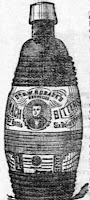
About 1855 in addition to selling whiskey Roback introduced a group of proprietary medicines, calling them “Scandinavian” Remedies.  These included his Scandinavian Blood Purifier,  Blood Pills, and Roback’s Vegetale Dyspepsia Complaint tonic.   Subsequently he issued Roback’s Stomach Bitters featuring a likeness of the faux doctor on the label. 


The highly alcoholic bitters were vigorously advertised nationwide. In one ad he began by asserting that this potion would not remedy all human ailments, but had broad application:  “In the Bilious districts of the West and South there has, for a long time, has been much needed an article of Stomach Bitters which, if taken in proper quantities, and at the proper time, are a sure preventative of Bilious Fever,  Fever and fatigue, Liver Complaints, Dyspepsia, Indigestion, Jaundice, Kidney Complaints and all diseases of a similar nature.”  The nostrum was sold in distinctive ribbed bottles in varying shades of amber, as shown below.


At some point Roback apparently decided that his proprietary medicines, now selling briskly nationwide, were eclipsing his liquor sales.  He created a new corporate name for his nostrums.   Shown here,  the company became the U.S. Proprietary Medicine Company, occupying part of the same building shown on Roback’s letterhead, at 56-62 East Third Street in Cincinnati.  Some writers have assumed this was a different ownership but I can find no evidence  of that. 


Roback’s Enablers and Inheritors:  It appears that virtually from the beginning, Roback outsourced the distribution of his medicinal products.  That fell initially to Demas Barnes, a major figure in his own right as an adventurer, author, one term U.S congressman and subsequently a New York City drug merchant.  Shown left, the young Barnes had left his birthplace in Gorham County, New York, to cross the continent driving a horse and wagon, studying mineral resources in Western states and writing about his experience upon his return.  His publications brought him to the attention of the public and he won a term in the U.S. House of Representatives.  


In 1853, Barnes began a wholesale drug business in New York City.   He rapidly became a prosperous patent medicine manufacturer, developing a national market for his nostrums.  How he and Roback connected is unclear but the Swedish liquor dealer agreed to give control of the national marketing of his pills, potions and bitters to Barnes.  When the law permitted, Barnes early on ordered private die tax stamps for the nostrums. Shown below are stamps for Roback’s bitters in four and six cents, bearing a likeness of the “Doctor’s” Cincinnati headquarters.  


Barnes was just the first of the merchants to see the value in Roback’s medicinals.  The Swedish con man, perhaps in ill health, about 1866 sold out his ownership of the Roback line and was listed in the Cincinnati directory as a manufacturer of “Fine Cut and Smoking Tobacco.” When the Swede died the following year, Cincinnati merchants lined up to claim Roback’s brands.   


From there the story becomes somewhat tangled and hard to reconstruct. It would appear that Prince, Walton & Company was the first to announce ownership of Roback’s Stomach Bitters.  It advertised the potion with an image of a striking nude woman, carrying a bottle and a glass, wrapped in the wings of a large black bird. the company also claimed to occupy the same East Third Street building in Cincinnati that had been Roback’s headquarters.  I can find little about Prince, Walton & Co. In an 1870 Cincinnati directory the company is listed as a liquor dealer located at the northeast corner of Fourth and Walnut Streets.  


By the end of 1871, according to one source, F. E. Suire & Company stepped in to claim ownership of U.S. Proprietary Medicine Company.  A Cincinnati business directory of1867 carried an ad, shown here, that identified this firm as “Importers, Manufacturers and Wholesale Druggists, located at the northwest corner of Cincinnati’s Fourth and Vine Streets.  As the ad shown here indicates, F. E. Suire offered a wide range of products, ranging from glass and glassware, paints and varnishes, snuff and cigars, perfume and druggist sundries, as well as medicine, wines and liquors.


What proprietary medicines F. E. Suire gained from Roback by buying the “medicine company” is not clear.  A clue may lie in the person of Edward S. Wayne, a highly respected druggist and chemist, who had arrived in Cincinnati about 1846.  During the 1850s Wayne had been associated with the Cincinnati College of Pharmacy as a staff member and the Medical College of Ohio as a lecturer in practical pharmacy.  In 1866, he became a partner in the Suire firm and, I believe, instrumental in claiming Roback’s medicine company.


When Suire died in 1874 and his company ceased operations, Wayne joined the wholesale druggist firm of James S. Burdsal & Company.  With Burdsal he created “Wayne’s Diuretic Elixir” and, I believe brought with him the rights to Roback’s products that had come to him through F.E. Suire.  The Burdsal outfit was another pharmacy offering a wide range of products, featuring “medicines, chemicals and liquors” as visible below on its building. Also shown below is a trade card forJ.E. Burdsal that advertises its Dr. Roback’s Scandinavian Blood Pills.  The card also cites association with the U.S. Proprietary Medicine Company.   Finally, the figure at the center of the piece may be that of the self-imagined “legendary” figure, C. W. Roback.


The Passing of the “Fabled” Dr. Roback:   The man who called himself Dr. Charles E. Roback and over time by several other names, died on May 9, 1867, just short of his 56th year.  His body was carried to Mt. Holly, New Jersey, where he was buried in the Sinnickson family plot in Mount Holly Cemetery.   He had been preceded one year by his wife, Mary, who died at 32.  His tombstone is shown below,


The couple, in effect, left no heirs.  They had no children of their own.  Roback’s son, Carl Wilhelm Fallenius is reported to have visited his father in America, seeking money to buy a farm in Sweden.  The “doctor” apparently obliged and also remembered the young man in his will.  After Roback’s death, Carl is said to have declined any inheritance from his run-away father.  


Note:  This post draws heavily, but not exclusively, on a biography of Roback/Fallenius in Wikipedia.  Several of the images shown here are courtesy of Ferdinand Myers V who has devoted two posts on his “Peachridge” website to Roback’s bitters bottles.


Ed Brinkman & Union Distilling — An Addendum

Foreword:   On August 24  of this year, this website featured a post entitled “Ed Brinkman:  From Bookkeeper to Boss and Beyond.”  The item, recounting the   history of Union Distilling of Cincinnati, unfortunately had no photos of Brinkman or other key figures. Fortunately Mike Ashwell, a Cincinnati resident married to a descendant of one of the principals, saw the article and has supplied photos and information that help complete story.  Rather than being added to the earlier post,  I believe Mike’s contribution deserves its own “stand alone” attention,” as shown below.

Edward H. Brinkman spent most of his working life employed by the Union Distilling Company, rising from bookkeeper’s assistant to president of the Cincinnati distillery and liquor house. Demonstrating unique staying power, Brinkman’s imprimatur continued to appear on whiskey even during the years of National Prohibition.  Shown here is his picture as a young “up and comer.”


Mike also has included a photo of the June 18, 1910, laying of the cornerstone for the Union Distilling Company in Cincinnati.  Seen there, the man with the generous mustache to the right of the figure with a mallet is the then President of the United States, William Howard Taft, a Cincinnati native and friend to the distilling industry.  Standing to his immediate left, face obscured, is believed to be Brinkman, then bookkeeper of the distillery.  The bald man to Brinkman’s right is George Dieterle,  secretary-treasurer of the company and Brinkman’s brother-in-law,  The individual holding a trowel to the immediate right of the man with a mallet is believed to be George Gerke, president of Union Distilling.   


The man holding the mallet also deserves notice.  He is Dominic McGowan, the head of a distinguished distilling family and the inventor of a “continuous” whiskey making process.  An immigrant from Northern Ireland, McGowan was famous in the whiskey trade for his innovations and the many distilleries he helped establish in the United States and abroad, among them the Union Distilling plant.  [See a post on the McGowans, May 5, 2021.]


The next image is a letterhead for Union Distilling that includes a representation of the plant as it appeared when fully operating.  Note that the letterhead lists the company as “distillers, compounders, and blenders.”  Although many liquor companies were happy to describe themselves as “distillers” most were actually “compounders and blenders.”  Union Distilling and its management were being unusually honest about its products.


Mike also included the photo of George  Dieterle, below, the ancestor of his wife and Brinkman’s brother-in-law.  Dieterle had a distinguished career in Cincinnati.  Beginning as an officer of Union Distilling, he went on to become president of the Federal Products Company, a manufacturer of industrial alcohol, as well as chairman of the Cincinnati Chamber of Commerce. During World War One, Dieterle served as a member of the War Coal Economy Commission and the War Commission on Municipal Expenditures.  Of him it was written:  “Few men have given longer service or more active aid to community advancement than George Dieterle….”


A closing to this extraordinary set of images features Ed Brinkman about 1898 with his comely wife, Augusta Dieterle Brinkman, and daughter, Hilde, in a family photo of great tenderness and charm.  Hilde
later married (Victor “Holt” Tatum). They had no children, and
thus no direct descendants exist.
“


Note:  My great thanks to Mike Ashwell for sending the above material that help complete the earlier post on Ed Brinkman and Union Distilling.  As an addendum to this website, it deserves special attention for enriching the original story.


Sarah Bowman — Western Saloonkeeper & Much, Much More

Sarah Bowman became a legendary figure for her size, strength, and exploits as a participant in affirming American military control in the Great Southwest.  Reputed to be the first woman commissioned as a U.S. Army officer and buried with military honors, Sarah brought liquor, food, water, “comfort” and, upon occasion, a gun to the task, as shown here in an artist’s view.

Sarah often was called “The Great Western,” a reference to her height, estimated at over six feet tall, at the time taller than most men, and her weight, well over 200 pounds.  The reference was to a famous steamship known as The  S.S.Great Western, shown right, the largest steamship afloat at the time.  One of the soldiers for whom she was cooking, seeing her for the first time is reputed to have exclaimed: “Lordee.   Look at the size of her!  She’s purt’ near as big as The Great Western.”  Others agreed and the name stuck.


Her birth date and origins  are unclear.  One source claims to have seen a birth certificate dated 1813 and the place Clay County, Missouri.  Sarah, however told the census taker in 1850 that she had been born in Tennessee.  The year of her birth varies from 1812 to 1817.  Thus, she likely would have been in her early 30s when, married to a soldier, the first of many men in her life, she became attached to the U.S. Army in the Mexican War as a cook and fan of its commander, future President Gen. Zachary Taylor, shown right.


At the beginning of the conflict with Mexico, Sarah first came to notice when she is reputed to have rushed up to Taylor to say that if he would give her a pair of pants she would wade over the Colorado River “and whip every scoundel that dared show himself.”  At the initiation of hostilities, however, Taylor ordered Sarah and other women cooks to what became known as Fort Brown.  When Mexican forces mounted a siege of the fort, The Great Western came to the fore for her bravery in providing food, drink, and other assistance to the soldiers.


By the time Taylor’s troops relieved the garrison, Sarah’s legend was made. Not long after the battle, Lt. (later General) Braxton Bragg singled her out as the Heroine of Fort Brown attesting:  “…Though the shot and shell were flying on every side, she distained to seek shelter in the bomb-proofs, but labored the whole time cooking  and taking care of the soldiers without the least regard for her own safety.  Her bravery was the admiration of all and were in the fort….”Journalists in the room recorded Bragg’s remarks.  They consequently were reported in newspapers across America.  The legend of Sarah Bowman, “The Great Western,”  was now etched in American history.


As Taylor’s army moved as the Mexican War progressed, Sarah kept in close contact,  in September 1848, a young trooper described her in his diary:  “The Heroine of Fort Brown  or “The Great Western” is in the crowd.  She drives two Mexican Ponies in a light wagon and carries the apparatus and necessaries for her mess which now numbers about a dozen young officers.”  After the occupation of Monterrey by Taylor’s army, she opened a saloon and brothel that provided food, drink and “comfort” for the soldiers.


When the war ended in 1848, one detachment of soldiers was ordered to California.  Sarah wanted badly to accompany them. She was told, however, that only wives were allowed to go.  As shown here in an artist’s depiction, she mounted her mule and rode along the line of soldiers reputedly bellowing:  “Who wants a wife with $15,000 and the biggest leg in Mexico! Come, my beauties, don’t all speak at once — who is the lucky man?”  Most of the troops were dumfounded but at last one, a soldier named David Davis, perhaps intrigued by the cash, agreed to marry her and she was enlisted as a laundress.  Did her $15,000, equivalent to $300,000 in current dollars, come from Sarah’s other “personal services”?


Subsequently she met a newly discharged soldier named Paddy Graydon, an Irish immigrant, who was running a hotel and bar on the banks of the Sonora River. [See my post on Graydon, August 9, 2024.] Calling it the United States Boundary Hotel, he located it in a small settlement close to Fort Buchanan with its drinking population of soldiers.  His establishment was a success, particularly after forging a business relationship with Sarah, by now most famous woman on the desert frontier.  She brought a reputation for her attention to the needs of dragoons.  Wrote one trooper:  “They called her old Great Western. She packed two six-shooters, and they all said she shore could use ’em, that she had killed a couple of men in her time. She was a hell of a good woman.”   


Sarah seemingly took over running the saloon and hotel, able keep order among thetough gun-toting clientele that mixed desperadoes with soldiers — and women.  Under her watchful eye: “Señoritas sang songs, waited tables and cooked, sometimes dealt cards, and always smiled at the rough patrons, laughed at their crude jokes and helped them to forget just how very far from home they were.”


“The Great Western” particularly caught rhe eye of Sam Chamberlain, an officer, writer and artist assigned to Taylor’s army.  Shown left, Chamberlain described Sarah throwing Davis “out of her affections” in favor of a soldier of remarkable size and strength the writer called “Samson.”  She professed her love for him, the giant capitulated and they moved in together.  Fascinated by this Western “Delilah,” Chamberlain made the only known full portrait of Sarah.  Shown below, it depicts her in front of the bar, drawing a pistol from her belt, and preparing to order a hostile Mexican out of her saloon.


By 1850 Sarah was in Sorocco, New Mexico, sharing a household with five orphaned children, ages two to sixteen, acting as a mother figure and showing a more nurturing side to her personality.  In Sorocco she met a 24-year-old Danish-born soldier named Albert Bowman.  Although there may have been no marriage ceremony, Sarah took his last name and was known as his wife.  For the next 16 years they shared life together in the harsh environment of the now American Southwest.


When Albert Bowman was discharged from the army in December 1852, the couple headed west to join the gold rush to California.  The couple’s southern road west led to the historic Yuma Crossing, shown right.  A place where the Gila and Colorado Rivers come together, this had been a Native American fording place and for centuries an opening to the Far West.  Now there was a ferry to take pioneers and gold seekers across.  In the year before Sarah and her consort arrived, 40,000 Westward-bound men, women and children had been ferried across bringing with them thousand of horses, cattle, sheep and other livestock.


Seeing this traffic, Sarah and Albert abandoned their thoughts of “moiling for gold” and decided to provide stores of food and drink, including alcohol, to the travelers.  Their major problem was getting supplies.  That shortage was at least partially solved when a shallow draft steamboat was constructed on the Colorado River that could provide the Yuma settlement with needed goods.  The couple made the crossing their home for the next 14 years, leaving occasionally when other prospects beckoned balways returning to do business at Yuma Crossing.


The crossing had achieved such high importance for American expansion that a military base, called Fort Yuma, above, had been established there.  Sarah, with her accustomed love for the military created a boarding house and a officers’ “mess” as she had in the past.  Meanwhile, she and Albert drifted apart as he moved off to California to engage in prospecting.  Sarah was increasingly engaged with her adopted family and in running her restaurant, bar, and hotel, said to be the first in Yuma.  


Sarah died in Yuma in December 1866 at the age of 53, reputedly from the bite of a poisonous spider.  A Catholic priest, Fr. Paul Figueroa, in his memoirs of Yuma wrote this eulogy about Sarah: “Mrs. S. Bowman was a good hearted woman, good souled old lady of great experience, spoke the Spanish language fluently…opened the first restaurant and kept it until she died…The military from the Post [honored] her remains with a splendid funeral, with the bands and all the military observances.  The vicar general was visiting the new town for the first time and according to the Catholic rite conducted the remains to the military cemetery across the river by the Fort.”


Sarah’s burial at Yuma was not to be the end of the story.  When the fort was abandoned and the military cemetery became overgrown, the decision was made by the Army in 1890 to remove the graves and rebury the remains at the Presidio in San Francisco. Sarah was the only female among them. Shown here is her Presidio gravestone.


When Sarah’s body was exhumed a religious medallion of unusually large size was found around her neck.  One writer was occasioned to observe:  “So, even after twenty-four years after her death, Sarah’s size was still worthy of notice.”  That observation suggested to me that a final tribute is due this extraordinary woman.  Accordingly, I have added below a figure of a large female figure seemingly guiding the nation’s movement across the continent.  She is the epitome of “The Great Western.” 


Note:   A number of references to Sarah Bowman and related photos may be found on the Internet.  This post relies on them and most particularly on a 78-page book by Brian Sandwich called “The Great Western: Legendary Lady of the Southwest, “ Texas Western Press, 1991.  Mr. Sandwich has written the definitive biography of Sarah Bowman.  A fictional treatment of “The Great Western’s” life is also notable, called “Fearless: a Novel of Sarah Bowman,” by Lucia St. Claire Robson, 1998, no publisher cited.


Scroll to Top