Author name: Jack Sullivan

Savoring the Saloons of Times Gone By


Just recently I have been reading a book called “Watering Holes of Yore: The Saloonsthat Made Texas Famous,”  by multiple authors.  Over the years for my own edification, I have collected a number of photographs of old time saloons.   Now it occurs to me to share them on this blog.   They include two saloons that I personally have visited and one, at the end, that is an all-time favorite.


The first establishment shown here is a Texas saloon, but not one covered in the book I have referenced.  My fascination is with the imaginative way that the proprietors have rendered the word “whiskey.”  Obviously with tongue firmly in cheek,  they have proclaimed it “The Road to Ruin.”  Yet the front door is open wide and the gents on the porch obviously have left the bar to have their pictures taken.   This photo identified the state but not the town.  It reputedly was taken in the 1880s.


The next photo replicates the theme.  From the designation as the “Lone Star Saloon” and the symbol provided, it might be assumed that it was located in Texas,  the Lone Star State.   Wrong.  This establishment was located in Corona, New Mexico.   The date given for it was 1919.  By that time Texas was fully into the Temperance Movement and increasingly legal restrictions were being put on saloons and drinking.  By contrast New Mexico was still wide open. 


The next image is from South Dakota and although it has no sign,  the passengers on the stage coach stopping there would know that strong drink was to be had inside.  This photo is from an earlier article I wrote on a Western character known as “Devil Dan” Roberts.   As cowboy, he rode up to a stage stop saloon very much like this one in 1886.  Roberts was employed by the VVV Ranch on the Belle Fourche River and was heading for Deadwood for the Christmas holidays when he dropped into the saloon to warm up from the frigid Dakota weather.


A holiday dance was in progress and the saloon owner, who had been nipping at his own booze all day,  was heading to bed to sleep it off.   He asked Devil Dan, who did not drink,  to look after the business. The well-likkered cowboy crowd got rowdy and began to break up the furniture and knock out windows.  Dan let them have their way but as the men sobered up he made them pay for the damages.  The next morning the owner sold the place to Roberts for $125 and departed.  Dan repaired the damage and appears to have taken to the role as saloonkeeper.  After running the  establishment for a few months, he apparently sold it and leased the Cliff House, a larger stage coach station and saloon, in nearby Deadwood.


The next picture is from Creede, Colorado.  Two men standing in the open doorway of the “Holy Moses Saloon,”  which is next to the narrow, rocky canyon walls that surround the town,  located in Mineral County.   Note that the building is rather ramshackle with a broken cornice and a barrel lying out front.  A note on the photo says that the man standing in the white shirt and vests was the owner and the sheriff of Creede whose name was William Orthen.   His saloon was the first liquor den in town.


A much better known lawman cum saloon keeper was Judge Roy Bean, who billed himself as the “Law West of the Pecos.”  For about 16 years, Bean lived a prosperous and relatively legitimate life as a San Antonio businessman. In 1882, he moved to southwest Texas, where he built his famous saloon, the Jersey Lilly, and founded the hamlet of Langtry. Saloon and town alike were named for the famous English actress, Lillie Langtry. Bean had never met Langtry, but he had developed an abiding affection for her after seeing a drawing of her in an illustrated magazine. For the rest of his life, he avidly followed Langtry’s career in theater magazines.


Before founding Langtry, Bean had also secured an appointment as a justice of the peace and notary public. He knew little about the law or proper court procedures, but residents appreciated and largely accepted his common sense verdicts in the sparsely populated country of West Texas.  By the 1890s, reports of Bean’s curmudgeonly rulings, including an occasional hanging,  had made him nationally and internationally famous.  After his death Lillie Langtry made a belated visit.


The following photo of the gents standing in front the El Paso Saloon has intrigued me for the wide variety of headgear they sport, as well as the varied positions of their hands.  Several look as if they might be preparing to draw and shoot.  Despite the name it is not possible from the picture to identify the town.  El Paso Hotels with saloons were located not only in El Paso itself but also in Fort Worth and San Antonio.   I assess the date as about 1910 or after. The advertising sign over the door for Fredericksburg Beer on tap has a definite  20th Century look.

The photo following caught my eye for the 20 mule team in the foreground and the row of saloons in back. Thirsty customers had a choice of the “The Yellowstone Bar,”  “The Butler Saloon,” or the “High Grade Bar” and so on down the line of watering holes in the town of Rawhide, Nevada,  at the 1908 height of the Gold Rush. In the short span of two years the town went from its peak population of 7,000 to fewer than 500 residents by the latter part of 1910. Helping push the decline of Rawhide even further along was a fire that swept through town in September 1908, along with a flood the following September, from which many residents did not recover or rebuild. 


When the original mines worked out the remaining gold and silver from the veins, more people left Rawhide. There remained only a few  who eked out a livelihood working in the mines, or processing the ore, or just working their own claims and prospecting.  Most of the saloons had closed and the town became a hollow shell of what it once was.  By 1941 only a few hardy souls were left in Rawhide, and the post office was closed.  Today it is a “ghost town” with only photos to remember its heyday.


The only watering hole in color and one I have actually visited is “Big Nose Kate’s Saloon.”  This place got its start as the Grand Hotel in Tombstone, Arizona.  Opening in September, 1880, it was consider one of the state’s premier hotel, boasting thick carpeting and costly oil paintings.  The lobby was equipped with three elegant chandeliers and more luxurious furnishings, while the kitchen featured both hot and cold running water and facilities to serve as many as 500 people efficiently.


It is said that Ike Clanton and the two McIaury brothers stayed at the Grand the night before the famous gunfight at the O. K. Corral.  Now the place is named for the erstwhile girl friend of another participant in the famous showdown, Doc Holliday.  I was in Tombstone a few years ago and stopped into Big Nose Kate’s to look around and have a beer. Sadly, it was no different than the other touristy bars and restaurants along the main drag, but the history is still there.


The final photo is not in the Far West but from Milwaukee, Wisconsin.  But, you may say, it looks more like a church than a saloon.  Yes, it does.  The building was constructed as a Methodist house of worship in the late 1800s only to find itself smack dab next to Milwaukee’s ever-expanding Pabst brewery.  The perfumes of beer production wafted over the structure frequently.  After Prohibition the church was sold to the brewery which made the first floor into a restaurant and bar and used the upstairs for a training center.  They called it the “Forstkeller” and supplied it with fresh beer daily.  For years it was my favorite watering hole. Even after leaving Milwaukee, I always walked in the door at least once on every visit to town.  Unfortunately the Forstkeller has been shut for many years.


There they are,  nine of my favorite saloon scenes.  Just looking at them makes me thirsty.  Think I will head out for a tall cold one. 


Note:  Two saloon owners noted here are treated at more length elsewhere on this website:  “Devil Dan” Roberts, April 18, 2012, and Judge Roy Bean, October 4, 2016.


A.T. Atkin: The Rocky Road from Tshamingo to Memphis

In Mississippi the first major success of the Prohibition movement occurred when the legislature passed a local-option law allowing counties to prohibit the sale of alcohol. By the early twentieth century the sale was illegal or seriously limited in a large majority of the state’s counties.  In Aberdeen, Monroe County, Allen T. Akin, a wholesale liquor dealer had a dilemma:  Go into another line of work — or move from his native state.  He chose the road.  It proved to be a rocky one.

Akin was born in Tishomingo, a tiny town in an extreme northeastern corner of Mississippi, shown here as it looks today, population 339.  The date was April 20, 1849.  Originally from Virginia, his father, William Edwin “Will” Akin was a farmer.  The 1850 Census found Will, 27, and his wife, Louisa, 23, living in Tishomingo County with daughter Elizabeth, 3, and Allen, 1.  The 1860 census sighted the family still in Tishomingo, with indications the father was prospering as a farmer.


By the 1870 census, the family had grown to seven children, including three sons, Allen, Johnson, and William, old enough to be recorded as working for their father on the farm.  Shortly after, Allen Akin is cited moving to Simpson County, Kentucky, to work on a farm.  From there his progress is a blank slate until, during the 1880s he fetched up as a saloonkeeper in Aberdeen, Mississippi, a town 87 miles southwest of Tishomingo. 


 By this time Akin had married.  His bride was Amanda Bunch, called “Mandy,” the daughter of Erasmus H. and Mary Ann Cowen Bunch. Unusual for those times, Amanda appears to have been four years older than her husband.  The couple would have two children, Ernestine, born in 1885, and Collins, in 1889. 


The county seat of Monroe County and located on the banks of the Tombigbee River.  Aberdeen, population 3,500, was one of the busiest Mississippi ports of the 19th century. Cotton brokerages flourished in town and for a time Aberdeen was Mississippi’s second largest city.  The wealth of the city expressed itself in the many mansions that dotted the landscape and in lively patronage for the city’s saloons.  Akin’s establishment also sold whiskey, advertising the availability of Tennessee and Kentucky liquor, including “Old Cutter” from Louisville.


For years as a whiskey dealer, Akin had to deal with a state legislature where the forces of “dry” constantly were making inroads.  An earlier law made it illegal to  purchase less than a gallon at once, aimed at local saloons and taverns.  Violators could face fines of between $200 and $500 — ruinous amounts when a shot of whiskey fetched five cents.  Repealed three years later, this statute was followed by others seeking to cripple the liquor trade, including an 1873 law that if any state legislator was found drunk the individual could be charged with a crime and removed from office.  About 1900, as Monroe County contemplated a “local option” ban on alcohol, Akin felt forced to leave his native state and a municipality he considered his home town.  He packed up his small family and his liquor supplies and moved to Jackson, Tennessee.   In 1908, Mississippi would become the first state to ban all alcohol sales.


Tennessee looked to many liquor dealers in states like Mississippi as an oasis that might never vote “dry.”  For Akin it was  a 180 mile journey almost straight north to a Jackson, a rapidly growing city of about 15,000 people, almost five times the size of Aberdeen.  After the Civil War Jackson became a hub of railroad systems ultimately connecting to major markets to the north and south, as well as east and west. This was key to its development, attracting trade and many railroad workers in the late 19th century.  Akin opened a saloon and liquor business at 209-211 N. Market Street in Jackson’s busy downtown, shown above.


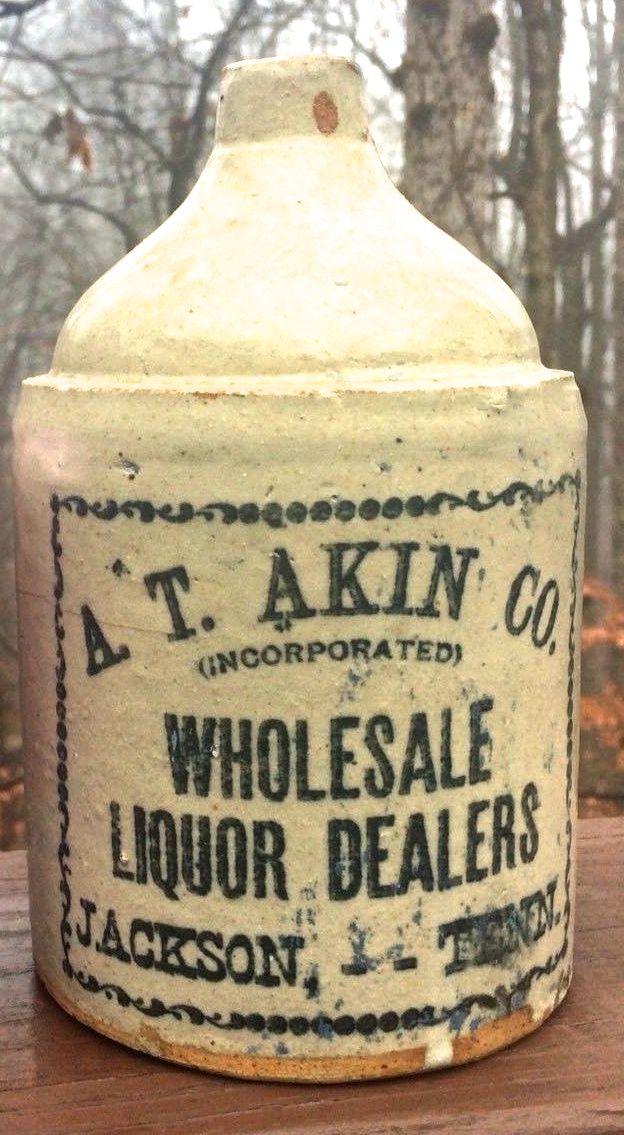
Indications are that Akins was taking advantage of the excellent train connection to ship whiskey from sources within Tennessee and reaching up into Kentucky where transit was easy.  He may have had difficulty initially in finding potteries to make his jugs as indicated by the two containers shown above.  Both are crudely stenciled.


As shown above and below here, Akin eventually was able to find a potter to provide him with an attractive design using an “underglaze transfer” of applying a distinctive label.  The size of his containers varied from quart (top left) to gallon (top right), two gallon (below left) and five gallon (below right).  The larger jugs would be for his wholesale customers, the whiskey to be poured into smaller containers before being served across a bar.


Although exact dates are hazy, Akin was established in Jackson by at least 1904.  That year he incorporated as A.T. Akin Company, with capital of $7,700.  He headed the incorporators joined by a W.T. Akin, relationship unclear, and two others in Jackson.  As the newly-come Tennessee whiskey man was to find out, that state was not immune to “dry” laws.  At the county level prohibitionist were whittling away at liquor sales. Jackson was not immune.  


By 1908 Akin had moved to still “wet” Memphis.  There he operated the A. T. Akin Company, Wholesale and Retail Whiskies at 150 South Main Street.  His son, Collins Akin, now an adult was the establishment’s manager.  By 1915 Akins’ liquor house had moved to 325 South Main, below, and Akin had taken a partner named Bates.  He also had put the management of the liquor house into other hands, including son Collins and retired with wife Amanda back to Aberdeen.  The same year a Tennessee law forbidding all alcohol sales passed court tests of its validity and began to be enforced.


From Aberdeen, Akin could watch the end of his peripatetic liquor house after a run of almost a third of a century.  Now 67 years old, his health was failing.  On March 14, 1916, Akin died.  He was buried in Aberdeen in the Old Fellows Rest Cemetery above.  His tombstone contains this tribute:  “None knew thee but to love thee.”  Amanda would join him there in 1923.  Her memorial reads:  “Thy memory will ever be a guiding star to Heaven.”


Note:  There are notable “holes” in this narrative about A. T. Akin, including how he was able to move from farm work to keeping a saloon.  I am hopeful some alert descendant will see this post and help me fill in the gaps.


A.E. Beitzell — A Capitol Whiskey Man and His Red Raven

Albert Ernest Beitzell, a prominent merchant in the Nation’s Capitol, sold whiskey, soft drinks, seafood and theater seats in a career that contained a lifetime of unpredictable events, including witnessing a suicide.  Nevertheless, Beitzell maintained his sense of humor, including advertising his whiskey with a red raven, a mythical bird of his own devising.

Albert was born in June 1869 in Wicomico, a community in the Northern Neck of Virginia, the northernmost of three peninsulas (traditionally called “necks” in Virginia) on the western shore of the Chesapeake Bay.  His father Josiah Beitzell was 35 at his birth, his mother Mary Agnes (Weser) Beitzell was 33.  Albert was their third child.  Four more would follow. The 1870 census found the family in Wicomico where Josiah was working as a sailor, almost certainly on an oyster boat.  Three oystermen in their early 20s boarded with the family.


As a youth Albert would soon become aware of the uncertainties of harvesting oysters from the Chesapeake Bay.  Weather and water related developments can affect the oyster catch, often leaving the watermen “high and dry.”  The 1880 census recorded the family having moved to Abell in St. Mary’s County, Maryland, still located on Chesapeake Bay.  Josiah apparently had given up the waterman’s life and listed his occupation as “farmer.”  Four years later he died at 50 years old, leaving behind five minor children.  As a likely consequence Albert was forced to end his formal education after the 8th grade.


Mother Mary Agnes apparently was able to weather the loss of her spouse as her older children took employment.   The family continued to live in Abell.  Five years later, however, she died.  Albert Beitzell was now an adult and on his own. Seeing more opportunities in the big city he moved to Washington D.C.  There, likely with the help of friends in the seafood trade, he went to work as an oyster wholesaler.  The 1900 census found him engaged in that occupation at 30 years old.  Bietzell also had been married for one year to Mary Margaret Cumberland, 26, the daughter of a boathouse keeper on the Potomac River.  The couple later would have two children, Louise and Albert Jr.


Beitzell’s rise as a D.C. merchant requires some speculation.  At some point in the early 1900s he appears to have left wholesaling seafood, perhaps discouraged by the the variability of the oyster harvest.  Instead he entered the liquor trade, a solid money-making occupation in Washington, D.C. as congressmen, government appointees, lobbyists, and political hangers-on provided a ready customer base for liquor stores and saloons throughout the Nation’s Capital.  Beitzell’s signature label was “Red Raven,” featuring a mythical avian not seen in nature.  He sometimes compounded the enigma with the puzzling slogan:  “Ask the Man.”  The brand proved to be popular. 


The success of his liquor house at 210 Tenth Street SW  brought Bietzell to the attention of the city’s business elites.  Among them was Harry Crandell, a local businessman who owned a chain of 18 theaters including the Apollo and others in Washington D.C.  His venues also could be found in Baltimore,  Martinsburg WV, and elsewhere.  Shown here, Crandall struck a friendship with Beitzell that blossomed into a business relationship.  The liquor dealer became vice president of Crandell’s theatrical corporation.


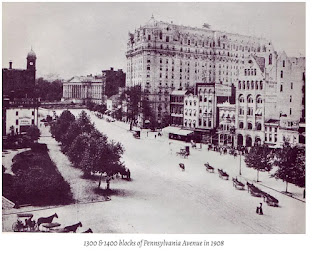
One result of Bietzell’s theater involvement was membership in the Washington Garrick Club, named for a famous British men’s club geared toward actors and others with ties to the stage.  Located on the second floor of a building at 1347 Pennsylvania Avenue, the Washington Garrick Club had a similarly theatrical membership.  Bietzell unexpectedly would find himself in the center of a drama that played out at the Garrick Club on the morning of July 1, 1907.


As reported at length in the Washington Evening Star of that date, Bietzell was visiting the club that morning with Raleigh F. Luckett, the 27-year-old brother of a well-known local theater manager.  Although seemingly in good spirits, Luckett was involved in a two month separation from his wife, Gertrude, who had left him and taken their two children.  They greeted the club manager, E.S. Doughty, shown left, and chatted. Then Luckett excused himself. He said he intended  to read a newspaper in the club’s front room.


The Star reported ensuing events: Those in the back room about five minutes later heard the report of a pistol….Mr. Beitzell, stepping into the front room, discovered young Luckett collapsed in his chair with a bloody wound in his breast and a smoking revolver in his hand.  ‘It is all over. it is all over’…the wounded man gasped.  ‘What did you do this for?  asked Mr. Beitzell; but the only reply was, ‘It is all over.’


Beitzell and others summoned an ambulance.  Luckett was rushed to a hospital where doctors thought there was a chance of saving him.  The young man, however, was too badly injured and died shortly after.  The liquor dealer never forgot the shock of seeing his young acquaintance so unexpectedly mortally wounded.


As the 20 Century moved forward Beitzell experienced another devasting event.  Enacted by Congress, prohibition came to D.C. in 1917, three years before it was enacted into law nationwide. All legal bars in the District were ordered to be shut down. In a single day wholesale liquor dealers like Beitzell saw their customer base wiped out.   But Prohibition didn’t succeed in eradicating alcohol from the nation’s capital. Instead, some 267 licensed saloons morphed into nearly 3,000 speakeasies, disguised in a variety of forms. Ostensibly Beitzell moved into selling soft drinks, near-beer, and fountain supplies.  A  favorite brand was “Checonia Evans.”  When asked his occupation by a census taker in 1920, Beitzell told him “Temperance Manager.”


Shown here is a Beitzell truck from that era, advertising “beverages and fountain supplies.”  The owner’s great grand-niece who supplied the photo hinted that it also might have been used to carry illicit alcoholic beverages.  She also suggests that the photo shows Albert Beitzell himself behind the wheel.  While that might be questioned, the modernity of the truck for the time is indisputable.  Instead of hard rubber wheels, this vehicle featured pneumatic tires on the front wheels. The tread pattern of the pneumatics lessened the amount of direct contact with the road and made steering considerably easier.  


Was this truck used to haul bootleg liquor?  Family lore tends to raise that suspicion without actual proof.  Clearly Beitzell never lost his interest in “the hard stuff.”  When it became clear that National Prohibition had been a gigantic mistake, expanding the drinking public and forcing the trade underground into criminal hands, he sensed Repeal coming and in the early 1930s began negotiations overseas to represent Johnny Walker Scotch and Bols Liquors from Holland in anticipation of the “dry” laws being terminated.


At this time Beitzell was living in a spacious home at 7316 Alaska Avenue, shown here.  Still standing,  the house and grounds are valued today at $1.2 million. His great grand niece, Christina, suggests that he suffered business reverses during Prohibition, had returned to the oyster trade afterward and was recovering his fortunes in the late 1930s.  


About 1938 Beitzell suffered setbacks in his health and retired.  He died in May 1942 at 72 years old, survived by his widow, Mary Margaret, and both children.  Following a funeral Mass at the Church of the Nativity in Washington, he was buried in Mount Olivet Cemetery, honored as a 50-year resident of the District of Columbia, a member of the Association of the Oldest Inhabitants of Elk’s Lodge 15, and active in the Washington Aerie of Eagles.  Mary Margaret would join him at Mount Olivet in 1952.  Their grave stones are below.


Note:  This story of Albert Beitzell was largely revealed on an internet site provided by his descendant, Christina, whose last name was not given.  She also included the Evening Star report of the suicide.  A variety of other sources provide other details of this Washington D.C. whiskey man.


The Hessbergs: Whiskey in Four Virginia Cities


The whiskey “empire” founded by Matthew Hessberg and his son Benjamin encompassed four major Virginia cities, at the time the state’s largest liquor chain.  The Hessbergs’ success in business, however, was plagued by the frequent early deaths of family members.  The Hessbergs named their flagship brand “Satisfaction Rye” but found that satisfaction did not include longevity.


Matthew Isaac Hessburg was born in Danville, Virginia in January 1821, the son of Isaac Hessberg, an immigrant from Bavaria.  Isaac, according to the 1860 census, worked as a leather tanner and currier (expert in preparing hides).  His mother, Rachel Gunst Hessberg, was native born from Orange, Virginia.  Both Isaac and Rachel died when Matthew was just a youngster, nine when his father died at age 31, eleven at his mother’s passing two years later, also 31.


The ensuing years while Matthew and a sister were orphaned are a blank slate. My guess is that members of the Gunst family may have taken them in.  Henry Gunst, likely a relative of Rachel, was a highly successful and wealthy liquor dealer in Richmond, Virginia. [See post on Gunst, August 3, 2011.]  Too young to have been a Rebel soldier, Matthew apparently grew up in the capital of the Confederacy, apparently witnessing its surrender, reconstruction, and the city’s post-war rebirth.  


Details are hard to come by about the timeline during which the Hessberg liquor interests came to encompassed four major Virginia cities.  Richmond, Danville, Roanoke and Bristol created a chain of liquor stores stretching from Tidewater to the Appalachians and beyond, a spread of some 325 miles.  Matthew’s initial liquor establishment appears to have been in postwar Richmond called Hessberg Bottling Company.  Matthew and Charles Gunst, likely a cousin, were proprietors. This was followed by the purchase of the Cousins Supply Company, a Richmond mail order liquor house, by Matthew, who now was working with his son, Benjamin, a traveling salesman and later a partner. 


Shown above are two whiskey jugs that display the company label, one and three gallons in size.  They identify their establishment as Cousins Supply and the address at 1100-1102 East Cary Street in downtown Richmond.   The Hessburgs, like other liquor dealers, were generous in gifting saloons and bars carrying their liquor with corkscrews and shot glasses. 


From Richmond the Hessbergs branched out into Danville, where Michael had been born, almost 150 miles southwest of Richmond.  Danville directories record Matthew as a partner in a liquor store and bottling company at 158 Main Street as early as 1888, but I have found no artifacts with that address.  The Roanoke liquor outlet was even farther from Richmond, an estimated at 184 miles.  Given the difficulty with ground transportation in that era, my assumption is that the Hessburgs hired local managers.  Again, I have found no Hessburg Roanoke marked bottles, jugs or other items.


In October 1875, Matthew had married a local Richmond girl, Yetta Rose, 19.  She would bear him four children, Benjamin R., destined to be the heir apparent, and daughters Ray and Merle.  A fourth child, Isaac died in infancy.  Yetta Rose  would sicken and die three years later, only 30 years old.  Five years after her death Michael married Frances Rose “Fanny” Hirsch.  She was 38 at the time of their 1889 nuptials, Matthew was 36.  There would be no children. 


By 1900 the census taker recorded Matthew living in back in Danville in a crowded household.  With him was his wife Fanny; her father Henry Hirsch; children Ray, Merle, and Benjamin;  a live-in cook and her husband.  Three years later, Fanny died, only 41. Gravestones for both women are shown above in Richmond’s Hebrew Cemetery.  Matthew did not marry again, instead concentrating on the Virginia liquor “empire” he was building.   As the years progressed the Hessberg household shrank considerably in size.  By 1920, it contained only Matthew, Benjamin and a nephew.  The three men lived in Richmond at 1102 West Street, shown right.


The Bristol, Virginia, outlet appears to have been the last to be established by the Hessburgs in 1909.  A whopping 324 miles from Richmond, this liquor house, located at 516-518 Cumberland Street, had local managers, W.H. Everett, followed by Otto B. Heldreth.  The output of artifacts from the Bristol location was impressive, including the labels shown above for “Old Eureka Whiskey” and “Satisfaction Rye.”


The Bristol outlet featured whiskey jugs in four sizes, an unmarked gallon ceramic and two, three and five gallon containers.  All displayed the same under-glaze label, “M.I. Hessberg Son & Co., Inc, High Grade Liquors, Bristol Virginia.” A Hessburg shot glass bore the same label. 


As Matthew aged his health began to falter and he came to rely increasingly on Benjamin to manage the sprawling liquor business he had created.  He died in October 19, 1920, at age 72 just as National Prohibition was about to be imposed, shutting off all whisky sales for the next 14 years. Matthew is buried in the Hebrew Cemetery next to Fanny.  His gravestone shown below.


Matthew Hessberg deserves a final word:  Orphaned at an early age, with limited education, and the all too frequent deaths of loved ones, he responded to adversity by creating a series of prosperous liquor stores in cities that virtually encompass the map of Virginia.  Only the coming of America’s short-lived experiment with Prohibition could bring down his accomplishments.  


Note:  Although this post contains artifacts from Matthew Hessberg’s liquor business it lacks information on how he was able successfully to manage his chain of Virginia stores.  I am hopeful that some sharp eyed descendant will find the post and help fill in the blanks.


Singing Along with Prohibition: Part Two


Foreword:  In the previous post, “Singing Along with Prohibition:  Part One,” the emphasis was on songs and sheet music that pre-dated National Prohibition, with the song writers asking or predicting what life would be like in a completely “dry” America.  This post examines the music and lyrics generated by the actual imposition of what came to be known as “The Great Experiment.”


The topic is ushered in by a 1919 song by Andrew Sterling and Harry Von Tilzer that  on the July passage of the Volstead Act that implemented the 18th Amendment to the Constitution that had many Americans thinking that alcohol sales had been immediately banned.  The legislation, however, simply set the date for the following January first, 1920.  In this song the gent is moaning “Whoa January, oh January, I hate to see you come around, July was mighty tough but we could get enough…” Von Tilzer was a prolific songwriter who wrote “Shine on Silvery Moon” and “Wait Til the Sun Shines, Nellie.”


When January and National Prohibition did occur, the liquor firms going out of business did brisk sales of their barrels, jugs and bottles of liquor.  Long lines of people stood outside the stores to buy as much as their budgets would let them.  The wealthy established liquor cellars in their homes in which they stock wines and whiskeys.  Author H. L. Mencken created his behind a locked medal door with dire imprecations against anyone trying to enter.  When he died in 1956, long after Repeal, he still had a liquor stash.  


American songwriters were not long in noting these events. Grant Clarke and Milton Ager in 1920 teamed up to give America “Its a Smart Little Feller Who Stocked up his Cellar That’s Getting the Beautiful Girls.”  The lyrics suggested a new era in wooing and winning a “girlie full of charm:”


Oh, they won’t call you honey, because you’ve got money,

It isn’t for money they sigh,

You could once grab a queen with your big limousine

But now times are changing, you know what I mean,

Oh, they won’t know you’re livin’ if all you can give’em

Is just pretty diamonds and pearls;

It’s the smart little feller who stocked up his cellar,

That’s getting the beautiful girls.


Clark and Ager were not the only songwriters to see possibilities in the burgeoning liquor caches of America.  A trio of writers gave the country the song, “Everybody Wants a Key to My Cellar,”  with the sheet music featuring six hands grabbing toward the key.  In the opening verse the owner confesses to having changed things around in his cellar, stockpiled liquor, tried to keep it a secret but told his wife.  She blabbed:


Now ev’rbody wants a key to my cellar, my cellar, my cellar,

People who before wouldn’t give me a tumble,

Even perfect strangers beginning to grumble,

‘Cause I won’t let them have a key to my cellar,

They’ll never get in just let them try.

They can have my money,

They can have my car,

They can have my wife

If they want to go that far,

But they can’t have the key that opens my cellar,

If the whole darn world goes dry.


The “I write the songs,” crew also picked up on another phenomenon of the Dry Era — the sudden popularity of doctors.   During America’s dry age, the federal alcohol ban carved out an exemption for medicinal use, and doctors nationwide suddenly discovered they could bolster their incomes by writing liquor prescriptions. They typically charged $3.00 for such and prescribed it for a wide range of supposed ills.  Pharmacies filled those prescriptions and were one of the few places whiskey could be bought legally.  They raked in the dollars. Through the 1920s, fueled by whiskey prescriptions, the number of Walgreen stores soared from 20 to nearly 400.


On this sheet music, entitled “Oh Doctor,” a gent is whispering his needs to a doctor who is in the process of writing a prescription for whiskey.  Meanwhile behind him a line of well dressed men are calling for similar assistance.  According to the song, the petitioner is pleading, “Write the prescription and please make it say, ‘Take with your meals,’ I eat ten times a day.”  The authors, Billy Joyce and Rubey Cowan, were New York songwriters who also worked as publishers.


Even the famed American songwriter, Irvin Berlin, took a turn at writing a Prohibition ditty, both music and lyrics.  Remembered far and wide for “White Christmas,” his song, “I’ll See You in C-U-B-A,” falls far short of that classic.  Written in 1920, Irvng B. is going to Cuba “where wine is flowing,” and “dark eyed Stellas light their fellers pan-a-gel-as.”  That apparently is Stella on the cover of the sheet music, looking saucy and sexy.  Berlin ends the verse by asking everyone to join him in C-U-B-A.  In that island country, as might be fathomed from the song, alcoholic beverages flowed freely.  


The cover of the sheet music for “I’m the Ghost of that Good Man John Barleycorn” may be be the most interesting part of that song.  It depicts a ghost-like figure in a mist looking over a broken whiskey barrel and some broken and intact bottles.  The words were by George A. Little and the music by Earl K. Smith.  Another Geo. Little song, “When a Black Man is Blue” was recorded by Duke Ellington’s band and is still available on disc.


Some new words and phrases were coming into the vocabulary of the average American, words like bootlegger, rum-runner, speakeasy, home brew, and moonshine.  Actually moonshine had been around for a while.  Bert Williams, a black man who performed in black face, had a hit song in the Ziegfeld Follies called “The Moon Shines on the Moonshine.”  Williams was by far the best selling recording artist before 1920 and is said to have done much during his career to push back racial barriers.


The cover of the 1923 song, “The Moonshine Shudder,” is austere enough to induceat least a slight chill.  It shows five empty bottles on a window sill silhouetted in the light of a smiling moon.  The cover design is by Jan Farrell, about whom I was able to learn nothing, nor anything about the songwriter, Wade Hamilton. Given the lyrics, perhaps their obscurity is deserved:


                                   Oh, could you ever keep from doing it,

I mean the moonshine shudder,

After gurgling, guzzling, lapping up home brew

First you shiver at your throat,

Then you shimmy at your chest;

You wiggle out of your coat,

And you nearly shed your vest.

But you cannot keep from doing it,

I mean the moonshine shudder,

After gurgling, guzzling, lapping up home brew.


As Prohibition wound on through the 1920s and into the 1930s, the songs continue to come.  Some representatives titles were “Kentucky Bootlegger,” “Bootlegger’s Story,”  “Moonshiner,” “Prohibition is a Failure,”  “The Old Home Brew,” “Whiskey Seller,” “Down to the Stillhouse to Get a Li’l Cider,” and “Drunkard’s Hiccups.”  The last-mentioned song is also known as “Jack of Diamonds,” a euphemism for hard drink.   An excerpt from it seems a suitable way to end this post:


Wherever I go

Jack of diamonds, jack of diamonds

I’ve known you from old

You’ve robbed my poor pockets

Of silver and gold.

Singing Along with Prohibition: Part One

 Foreword:  From “Yankee Doodle,” to the “Battle Hymn of the Republic,” to “Blowin’ in the Wind,”  many American songs have had a strong political content.  National Prohibition spawned many such a lyric,  both in anticipation of the Nation going “dry” in 1920 and during the 14 year experience of “The Great (Failed) Experiment.”  This post and the one to follow will explore some of those songs and their messages.  This post deals with the anticipation of Prohibition; the second will feature songs spawned by the actual experience.  


The lyrics below are from an 1918 ditty by writers William Jerome and Jack Mahoney, two of the best known songwriters of the early 20th Century.  Jerome created many popular songs of the era as well as musical comedies.  Mahoney, a lyricist, is best known for his co-authorship of the American favorite “When You Wore a Tulip and I Wore a Big Red Rose.”  Their anti-Prohibition song was entitled “Every Day Will be Sunday When the Town Goes Dry,” alluding to the general Lord’s Day ban on alcohol sales.   The cover of the sheet music shows a well-dressed gent in a top hat contemplating the doom destined to fall with National Prohibition. 


Goodbye, Hunter; So long, Scotch; Farewell Haig and Haig;

Oh my darling old frappe, they will soon take you away,

At the table with Lola they will serve us Coca-Cola;

No more saying: “Let me buy,”

No more coming thru the Rye;

Old Manhattan and Martini have received the big subpoena,

Ev’ry day’ll be Sunday when the town goes dry.


In something of the same vein is “How Are You Going to Wet Your Whistle (When the Whole Darn World Is Dry?”)  It shows a similarly tuxedoed man about town asking the crucial question outside a cafe that once sold whiskey and draft beer that tried to get by on candy and soda.  Apparently the attempt failed since the sign on the door says “for rent.”  One of the authors, Percy Wenrich, began his career as a music demonstrator in a Milwaukee store and staff writer for music publishing companies.  Moving to New York Wenrich became one of the Nation’s most successful song writers, remembered even today for “Moonlight Bay,” “Sail Along, Silv’ry Moon,” and “Put on Your Old Gray Bonnet.”


Like the foregoing, several pre-Prohibition songs speculated on the kinds of effects the alcohol ban would have on daily life.  Among them was “What’ll We Do on a Saturday Night (When the Town Goes Dry).”  It shows a young swain talking his lady friend to the movies but worried about what to do afterward:


What’ll we do on a Saturday night,

When the town goes dry?

Where will we go after seeing a show

to make the weary hours fly?

Imagine a fellow with a cute little queen,

Trying to win her on a plate of ice cream;

        What’ll we do on a Saturday night,

           When the town goes dry?


The songwriter was Harry Ruby, who with his longtime partner Bert Kalmar were a successful songwriting team for nearly three decades.  In 1950 MGM made a musical of their lives called “Three Little Words,” starring Fred Astaire as Kalmar and Red Skelton as Ruby.


Another anti-Prohibition song of 1919 contemplated massive unemployment as a result of shutting down saloons and cafes.  Called “No Beer — No Work,” the cover of the sheet music shows four men, all apparently unemployed, standing outside a closed drinking establishment with a for rent sign. It is padlocked and someone has thrown a rock at the front window.  The lyrics told a story about a miner named Johnny Hymer who being told impending about National Prohibition, threw his tools on the ground and intoned:  “No beer, no work will be my battle cry;  No beer, no work when I am feeling dry.”  Hymer’s unemployment seemingly would be self imposed:  “I’ll hide myself away, until some brighter day.”


Naturally the thought of National Prohibition would bring on “The Blues” for many and songwriters were there to express it.   Al Sweet, a rather obscure composer who died in 1945 at the age of 59, wrote both the music and words to a 1917 “Prohibition Blues,” that included this lyric:


Oh! my Brothers and Sisters, listen to what I say

By nineteen twenty dere’ll be no boose sold in the U.S.A.

De whole country am goin’ bone dry,

Prohibition am de battle cry,

‘Scuse me while I shed a tear,

For good old whiskey,gin and beer.

Goodbye forever, Goodbye forever

Ah got de Prohibition, Prohibition, Prohibition blues.


The cover for the sheet music is particularly interesting for the image of the distraught diner over not having any wine, the weeping waiter, and the bottles of wine, whiskey and beer flying away.  The man in the top hat peering around the corner was known as “Mr. Dry,” the creation of a New York cartoonist. [See my post on “Mr. Dry” on December 23, 2023.]


Since it is not possible to copyright a title, a second “Prohibition Blues” followed in 1918.  This one was produced by two celebrities.  Ring Lardner, noted as one of America’s prime short story writers and novelists, also was a composer and lyricist.  His co-author, Nora Bayes, was a well known American singer, comedienne and actress of the period.  In 1918 she was at the height of her fame, having been heavily involved in morale-boosting activities during the First World War.  Her photo and credits on the front of the sheet music would have boosted sales.  A year later Bayes recorded “How Ya Gonna Keep Them Down on the Farm (After They’ve Seen Paree),” a huge hit for Columbia Records.


As the months rolled on toward total abstinence, the song “I’ve Got the Prohibition Blues (for My Booze)” was rolled out in 1919 by the Elite Music Company of St. Louis.  The sheet music featured a waitress and two customers faced with a choice of tea, coffee, milk or soda, and clearly unhappy with any of them.  The lyrics to many anti-Prohibition songs are far from distinguished, but this one is among the worst.  Penned by an obscure songwriter named Carl Zerse, part of it goes like this: “I’m so thirsty that I’m blue, Old friend Booze I long for you.  I never knew that I’d miss you, the way I do, Boo-hoo, Boo-hoo.”  Think of that verse put to music.


Joseph McCarthy was an American lyricist whose most famous songs include “You Made Me Love You,” and “I’m Always Chasing Rainbows.”  For this 1919 song — “I’m Going to Settle Down Outside of London Town (When I’m Dry, Dry, Dry)” — he teamed with four time Academy Award nominee, James Monaco.  The words tell the story of a man who loves America but will settle in an English village by the sea come June.  He hates to say “goodbye,” but he is man “who must have a little liquor when I’m dry, dry, dry.”  He then pledges to come back when America has changed its mind.  That, unfortunately would be more than 14 years away.


Others apparently saw no reason for such drastic action.  Another 1919 song seemed to take the alcohol ban with some aplomb.  Written by a trio of New York “Tin Pan Alley” songwriters, it was entitled:  “(For If Kisses Are Are Intoxicating As They Say) Prohibition, You Have Lost Your Sting.”  The cover of the sheet music indicated that it had been successfully introduced by Sophie Tucker, backed by her band, the Five Kings of Syncopation.  Known as “The Last of the Red Hot Mamas,”  Ms. Tucker was one of the most popular entertainers in America during the early to mid-20th Century.  With the advent of television in the 1950s she had a rebirth of popularity and I remember her well.  Over the years she spawned almost as many imitators as Elvis.


As January 1, 1920, hove into sight, one song captured the dread.  As the cover of the sheet music made clear, even as the couples waltz around the floor, the hour was about to chime midnight ushering in an “alcohol-free” America,  The Grim Reaper — perhaps Mr. Dry in disguise — was lurking there to point out the lateness of the hour.  The song is entitled “At the Prohibition Ball.” Written by Alex Gerber and Abner Silver, the lyrics provide a fitting conclusion to the songs antecedent to “The Great Experiment.”


We’ll be at the Prohibition Ball,

There we’ll mix with Mister Alcohol;

Folks will pay their last respects

to Highballs and to Horse’s Necks.


Note:  The songs above all were penned and published in advance of the imposition of National Prohibition.  The next article, to be posted shortly, treats some of the songs that followed during the ensuing 14 (ostensibly) “dry” years.


The Highs and Lows of Louisville’s Pattersons

The label on a whiskey bottle that opens this vignette is an important part of a story that involves an immigrant father, William Patterson Sr., and his son, William Patterson Jr., both engaged in the distilling business in Louisville, Kentucky.  Both men experienced success mixed with failure, one with tragic consequences.  Both Pattersons, however, must be reckoned among the “whiskey barons” of that state.


Shown here, Patterson Sr. was born in 1813 in County Tyrone Northern Ireland, likely of Scottish heritage, the son of  William and Mary Louisa Culver Patterson. His family apparently were reasonably affluent, allowing him to attend local elementary and secondary,schools and go on to higher education.  He then entered the Greenwich, England, Royal Navy College with the goal of becoming a naval officer.  After losing his right eye in an accident and having no chance at a military career, he became an apprentice to a London manufacturer.  Tiring of that occupation, at age 25 Patterson Sr. emigrated to America.  He headed to Eastern Kentucky, settling in Louisville.


Patterson Sr. almost immediately began working in the iron and steel industry.  Because of his ability he rapidly rose to ownership and, a biographer commented, “soon amassed a large fortune.”  In 1848 he was helped along the way by his marriage to the daughter of a wealthy local merchant.  She was Mary Culver, likely a distant cousin, a woman who would bear him eight children, four girls and four boys.  Among the latter was William Patterson Jr.


As his family grew, the members watched the Patterson fortunes rise and fall.  With the outbreak of the Civil War, although technically part of the Union, Kentucky was riven with conflict.  The result resulted in ruin for Patterson Sr. He lost his business and post-war was required to go to work for an iron and steel works in an adjoining county.  When that company shut down a year later, the Scots-Irish immigrant, in a startling change of occupation, bought an interest in a Louisville distillery.


It was the Swearingen & Biggs whiskey operation, called Mellwood Distillery. “Beginning on a small scale it became one of the largest and most successful institutions in the state.” Shown above, insurance records indicate a large facility built of brick and equipped with a fire-proof roof.  The property contained seven warehouses, one a “free (no federal regulation) that stood 70 feet southwest of the still and six “bottled in bond” warehouses, all within 300 feet of the still. The Mellwood Distillery could mash 1,200 bushels of grain daily and had the capacity to hold 65,000 barrels of aging whiskey.  Later the warehouses would be expanded slightly to 70,000 barrels. [See post on Swearingen and Mellwood, October 8, 2015.]


Although Patterson Sr. continued his interest in distilling, his entrepreneurial spirit also led him to found the Louisville Mantle & Casket Company.  Not long after, however, bad health caused him to end his business career.  For the next five years he lived as an invalid attended by wife Mary and six children still at home.  On January 29, 1891, Patterson Sr. died.  The cause given was apoplexy, probably a stroke.  His death was expected and his family was gathered at his bedside as he peacefully expired at the age of 78.


The Louisville Courier Journal headline of the news read:  “A Highly Respected Citizen Passes Away.”  The story continued: “During his long residence in this city Mr. Patterson had formed extensive acquaintances. He was a man of conscientious character, and during severest hardships in business, his friends never deserted him.”  Patterson’s funeral took place at St. Paul’s Episcopal Church, his pallbearers drawn from the Louisville business community.  He was buried in Cave Hill Cemetery where many of the city’s “Whiskey Barons” are interred.


His father’s interest in the liquor trade was carried on by William Patterson Jr., his eldest son, who was 36 years old when his father died, and already involved in Louisville’s whiskey industry.  Widely known as “Billy,” Patterson Jr. began his career at the age of 16 when he went to work for a distillery, likely Mellwood.

He proved to have ample business acumen.  Before reaching 21 he already had amassed a considerable fortune by buying old malt from local distilleries and selling it at a profit.


Unlike his father, who primarily was an investor, Patterson Jr. was full bore into the whiskey trade.  In 1866, J. G. Mattingly, of a noted distilling family, had built a distillery  on Rudd Lane in Louisville, calling it The Marion County Distilling Co.  In December 1887 the plant and brand were sold to Patterson Jr. and two partners.  By the following year, the distillery was turning out 5,000 barrels of whiskey a year.  Insurance records indicate that the property included four warehouses, all brick with metal or slate roofs.  Three were bonded with one “free” warehouse located 115 feet north of the still.  A cattle shed and a six-story aging facility adjoined the cistern room.


In addition to his own warehouses, Patterson Jr. was making use of other storage opportunities.  Louisville investors in 1884 had built a large warehouse, shown here, on Main Street, a block from the area known as  “Whiskey Row.”  It principally provided public storage for aging whiskey as well as tobacco and other local manufactures.  The company also came to own a similar warehouse in Bremen, Germany, the city shown below, that allowed local distillers to ship their whiskey abroad.  Because of taxes, it was cheaper to age whiskey out of the country and pay import duty.  The cost of transport across the Atlantic was relatively inexpensive and the sloshing inside barrels on the high seas was generally believed to enhance quality.


Patterson Jr. was among the Louisville “whiskey men” to take advantage of the opportunity.   The note that opens this post tells the story.  The bourbon had been distilled by Patterson’s Marion County Distillery in 1894, sent to Bremen by ship in February 1902, returned to the U.S. in 1906, and bottled in July 1911.This 17-year-old, well-traveled bourbon subsequently was put on sale in New York City by liquor dealer C. A. Van Rensselaer, shown here.


Annual production of the Marion County Distillery put Patterson Jr. squarely in the ranks of the whiskey-making elites of Kentucky.  He featured a number of house brands, none of which he copyrighted.  They included “Old Patterson,” “William Patterson Rye,” Marion,” and “Portland.”  He had, however, arrived on the Kentucky whiskey scene as a major player at a difficult time.   There was a growing glut of whiskey on the American market.  According to industry spokesmen, Kentucky distillers by 1895 had 85 million gallons of whiskey in bond, worth $34,000,000 that they feared “cannot be gotten rid of.”


Patterson Jr. was a member of  a small group of leading distillers who met at Louisville’s posh Gall House Hotel in July 1895 to discuss the crisis.  As the board of managers of the Kentucky Distillers Association their purpose was to discuss endorsing a yearlong shut down of the state’s distilleries.  “To further manufacture whiskey means further glutting the market and a ruinous slackening of profitable business.”  Characterized as a “strike” by the Louisville Courier Journal, the board unanimously voted to propose that Kentucky distilleries shut down for a year beginning in July 1896.  The action, it was claimed, would yield between $20 million and $25 milllion additional value to the bonded whiskey stocks currently on hand.


In order for this strategy of “shut-down” to work, however, ninety percent of Kentucky’s distilleries would be obliged to comply.  The advocates expressed the hope that the state’s liquor dealers also would agree with the yearlong “dry” period. Advocates, however, were hard-pressed to declare any advantage for dealers.  Since the objective of the strike was to raise the price of whiskey from the distilleries, the increased cost would be felt in the first instance by the dealers.  A dissenting distillery owner also argued that an increase in the price of whiskey to the consumer would have the effect of leading the drinking public to consume the “cheapest and impurest” whiskey, and encourage dealers to compound and mix their own liquors.  He argued that “the man who drinks will drink whether the drink be fine or bad.”  In the end the one year strike fell far short of enlisting the necessary numbers of cooperating distillers.  The proposal failed and the glut of whiskey continued.


The resulting downturn in the profitability of Patterson Jr.’s Marion County Distillery continued into the 20th Century.  By 1905 he decided to sell out to the Whiskey Trust that was taking advantage of the downturn in the profitability of Kentucky distilleries to buy them up.  Although the Trust’s strategy was to close many of them, it kept the Marion County Distillery open and producing until the advent of National Prohibition.  The property was razed in 1904.


Patterson Jr. pivoted to becoming a whiskey wholesaler, operating from locations in the 200 block of West Main Street, a denizen of “Whiskey Row.”  As National Prohibition loomed ever larger on the horizon, he advertised as a mail order house seeking to serve “dry” cities and towns.  When Congress passed new legislation to outlaw that practice and the Supreme Court upheld it two years later, Patterson Jr.’s days selling whiskey were over.


He became despondent.  At 61 years old, this once recognized millionaire Kentucky “Whiskey Baron” was found dead in the bathroom of his residence.  He had committed suicide by cutting his throat with a razor. It lay on the floor by his side.  That morning he had told his wife he was going to shave himself.  When he had failed to emerge from the bathroom two hours later, his wife, alarmed, went looking for him and discovered his body.  Although medical aid was summoned, Patterson Jr. already was dead.  The Coroner was summoned and ruled the death self-inflicted.


Friends of Patterson Jr. told the press that he had been despondent for some time because of business losses and attributed his suicide to that cause.   After a funeral in Calvary Episcopal Church, he was interred in Cave Hill Cemetery. His grave, shown right. is adjacent to that of Patterson Sr.  Both men had faced the highs and lows of doing business in post-Civil War Kentucky.  For one of them the experience had proved fatal.


Notes:  The major source of information about the Pattersons are articles from the Louisville Courier Journal, the city’s leading newspaper.


Mike Owens and His Revolutionary Bottle Machine

Foreword:  The late 19th Century was a time of many important inventions, among them the light bulb, the automobile, and telephone.   None was more important to the whiskey trade, however, than the automatic bottle machine.  Before its coming all glass containers had to be blown one by one by hand at the potential health peril of the glassblower.   After its advent,  glass containers proliferated in the whiskey industry and costs plummeted. The man responsible for this invention, Mike Owens, is recognized here as a pre-Prohibition genius.

On February 26, 1895, a Toledo, Ohio, glassworks employee named Michael J. “Mike” Owens, shown right, was granted a patent on his machine for blowing glass and 2,000 years of making bottles other ways went crashing into shards.  Early next year  we celebrate the 125th anniversary of that defining moment in glass manufacturing.


Glassblowing as a technique is believed to have been invented by Syrian craftsmen in the first century B.C. somewhere along the Syro-Palestinian coast.  The rise of the Roman Empire served to spread the technology to other areas and blown glass became common for household and other uses.  Over two centuries, techniques for glass blowing were tweaked but did not change significantly.  The worker attached molten glass on the end of a blowpipe and with his breath pumped air into the blob until it reached a desired shape. After the glass had cooled it was broken away from the pipe, rough edges smooth and, voila!, a bottle.


Growing up Mike Owens knew a lot about blowing glass.  Born on January 1, 1859 in West Virginia, he was the son of an Irish immigrant coal miner.  Sent early to work for the family, by the age of fifteen he became a glassblower in a Wheeling WV factory.   Through intelligence and hard work he advanced to master glass worker, leaving his native state to help organize a glass company at Martins Ferry, Ohio.


Owens’ reputation soon reached north to Toledo, Ohio, where rich and well-born Edward Drummond Libby, left, had taken control of a glass factory and in 1888 offered Owens a better paying job.  His talent evident, within three months the Irishman was managing the glassworks department.  Several years later he approached Libby to say that he had idea for an automatic bottle machine and asked for money, time, and assistance to bring it to reality.


Many industrialists might have scoffed and told Owens to get back to work.  Libby, for whom my aunt, Nell Sullivan, was a secretary, was an enlightened entrepreneur. (Around my Toledo home we always referred to him reverentially as MR. Libby.)  He gave full backing to Owens and on February 26, 1905, the inventor was awarded Patent No. 534,840 for a glassblowing machine, the drawing shown here.  In the paperwork accompanying his application, Owens stated:  “My invention relate to an apparatus for blowing glass and has for its object to perform mechanically, what has heretofore been done manually.”


With that announcement, two centuries of making bottles by human breath came to an end, except for artisanal purposes.  By automating the manufacture of glass containers Owens helped eliminate child labor in glassworks — a practice of which he was well aware.   Two diseases were eliminated that plagued the workers, an inflammation of the the lungs and digestive tract and clouding of eye lenses, both resulting from exposure to hot gases.  


On the economic front, the cost of glass bottles was reduced by 80%, leading many canners, brewers and distillers, to move rapidly to machine-made containers.  At the same time, however, it left many glassblowers and their helpers unemployed since the mechanized process needed many fewer workers.


Within three years of the invention, the early Owens machine produced an estimated 105 million bottles.  As he gained experience with the process, this mechanical genius continued to improve on his invention, ultimately producing the “Owens Automatic Bottle Machine.”  It is shown below, one of the rare views of the inventor with his brainchild.  By 1915 this machine increased production numbers to over one and one half BILLION bottles manufactured annually.


Owens was fortunate that Edward Drummond Libby was an individual of integrity. A lesser man might have tried to marginalize the unlettered inventor and “stolen” his invention.  Libby, on the other hand,  encouraged Owens to continue inventing, financed his efforts and advanced his name to the forefront of American industrialists. Note Owens Bottle Machine Co. (now Owens-Illinois), Libbey-Owens Sheet Glass Co. (later Libby-Owens-Ford), and Owens-Corning Fiberglass.


In 1915 the Franklin Institute of Pennsylvania awarded its coveted Elliott Cresson Metal to Owens.  Established by philanthropist Cresson in 1848, the medal was awarded annually  “for discovery or original research adding to the sum of human knowledge, irrespective of commercial value.”  Because of its “novelty and utility” the automatic bottle machine earned Owens the honor.  Seen here front and reverse is the Cresson Medal.


 As additional evidence of the importance of Owens’s machine to the industry, within 20 years nearly all bottles manufactured in the United States, like this Libby “glacier glass” example, were produced automatically.  Standardization of bottle sizes and quality led to high-speed filling capabilities in industries that used  glass containers.  As a result, the bottle machine had a huge impact on food, soft drink, pharmaceutical, and alcoholic beverage producers.  Shown below are glass paperweights issued by the Owens Bottle Machine Co., depicting early  glass blowing mechanisms.


In the summer of 1956, I worked as an intern at Owens-Illinois in Toledo, writing items for plant newspapers.  As a result I was allowed on the factory floor to see the contemporary version of the Owens machine in action.  It was an unforgettable experience.  The heat and glare of the molasses-like glass, the long mechanical arms reaching into the inferno and scooping up a blazing orange glob, blowing air into the molten mass, shaping it in a revolving mold, dislodging the glass as it cooled, and reaching back for more — it was an unforgettable experience.


Mike Owens died in Toledo on December 23, 1923, at the age of 64, having revolutionized an industry.  His passing came unexpectedly. He was attending a meeting of Owens Bottle Company directors when he got up, walked a few steps, sat down in a chair, complained of feeling ill, collapsed and died within 20 minutes.  He was buried in Toledo’s Catholic Calvary Cemetery, his gravesite shown here.


In a memorial booklet to Owens, Libby providrd this tribute:  “Self-educated as he was, a student in the process of inventions with an unusual logical ability, endowed with a keen sense of far-sightedness and vision, Mr. Owens is to be classed as one of the greatest inventors this country has ever known.”   Libby commissioned a pressed glass bust, shown below, given to a limited number of Owen’s relatives, associates and friends.


The Love and Death of Maria Rupp, Saloon Keeper

This is the true story of a brutal and senseless murder.  It is also the story of a love that extended beyond the grave.  At the center is a beautiful young immigrant German woman calling herself Maria Rupp who ran a saloon in Sacramento, California. The statue shown here is from her grave. Its hands broken off by vandals, its face disfigured, this damaged angel captures the tragedy of Maria’s murder.

Maria was born Mary Schleider in Hesse, Germany, about 1832.  What little we know of her background was revealed in a deposition given by Eliza Green, hired to work in the saloon, who declared she was Maria’s half-sister. Her sibling she said had emigrated to America in 1855, embarking on a ship from Brussels, Belgium, at the age of about 22.  Perhaps drawn to Sacramento by the news of gold strikes, Maria began running a saloon there in January 1856.  She was accounted a beautiful young woman and talented pianist.  Said to be “a darling of Sacramento’s close-knit German community,” her Sacramento Beer Saloon on K Street, below, was prosperous. 


The historical record does not disclose when Maria changed her name or how an immigrant girl would have the resources to open and run a drinking establishment.  A clue to the latter may be in a statement by Mark Twain who called Sacramento “the City of Saloons.”  In 1866 Twain wrote:  “…I have been in most of the saloons, and there are a good many of them.  You can shut your eyes and march into the first door you come to and call for a drink and the chances are you will get it.”  He implied that a Sacramento “watering hole” could be established for minimal capital.


Quite naturally, Maria attracted considerable attention from the largely male. population of Sacramento but her affections were reserved for another relatively new man in town.  He was Francois Noiset, an immigrant from French-speaking Belgium, a medical doctor about two years older than she.  Although most of the men who frequented her Sacramento Beer Saloon were aware she and Francois were planning to marry, one man — Peter Metz, sometimes given as Welz — refused to accept her intent.


Little is known of Metz’s background, other than he was an immigrant from Germany, that he was in his early 30s, and by occupation he was a cook who may have worked for Maria in the past.  He had developed a mad passion for her that she had rebuffed repeatedly, citing her engagement to Dr. Noiset.  Half crazed by her rejection, on November 18, 1857, Metz told people that Maria had agreed to marry him, fantasizing that he soon would take over her saloon business.   When met with scepticism, he avowed:  “If she did not have him she would not marry anyone else.  She would die first.”  After drinking heavily Metz told his hearers that he would go over to Maria’s “ to see if the business was all right.”


Much of this may have been bravado on Metz’s part.  John Andrew, one of Maria’s bartenders, testified that upon arriving at the saloon, Metz approached him to inquire about a knife he had misplaced there the previous evening.  Having found the blade and stuck it on a shelf, the bartender returned it to Metz who claimed it was his.  After retrieving the knife, the erstwhile suitor joined a group of patrons standing around the piano where Maria was entertaining.  He threw his arm around her as if to give her a kiss, but instead cut her throat.  Dropping the bloody knife, Metz headed for the door unimpeded.


The bartenders and patrons immediately were occupied with the dying Maria. In his deposition, patron Louis Noll attested:  “I was present and saw Peter Metz while Madame Mary was singing and playing upon the piano, put one of his arms around her neck and with the other hand inflict a stab in the right breast or side, with a butcher knife.  I saw him pull the knife out and throw it on the floor…”

Noll then recounted how he had picked her up in his arms from the piano, as she fell back, and placed her on a chair, shortly after carrying her upstairs to a bedroom.


Marie was bloody but conscious enough to say “get a doctor.”  The patron sent for the task initially could not find one but upon going to the Western Hotel, located a physician.  Precious minutes went by until a doctor appeared but found there was nothing he could do.  Fifteen minutes later the lovely and talented Maria Rudd, 25, was dead, the victim of a deranged suitor.


 Meanwhile her killer walked to a friend’s house where he spent the night.  The next morning, telling his host what he had done, Metz was advised to give himself up to the local sheriff whose men were even then scouring Sacramento to find him.  If not, the friend told him, he would raise a “hue and cry” about the fugitive’s whereabouts and an angry crowd would hang him on the spot.  Thus warned, Metz went to the sheriff’s office that morning and surrendered.


The sheriff transferred Metz to the city jail to await trial.  A coroner’s jury composd of five local men was convened and returned a verdict that Maria had met her death from the effects of a wound inflicted by Metz.  A newsman, visiting him in jail reported that the accused: “…stated that he had been acquainted with the deceased some sixteen or eighteen months, that she had promised to marry him, and obtained $500 of his money.  In regard to proceedings subsequently, his remarks were unintelligible.”


After a trial that lasted several weeks, Metz was convicted of murder in the second degree and sentenced to life imprisonment, to be served at San Quentin, California’s maximum security state prison for men.  When he early demonstrated signs of insanity, he was transferred to California’s first mental hospital at Stockton, shown here.  In a matter of days Metz escaped from that facility.  Spotted traveling north through the state, he was captured in Siskiyou County and returned to the Stockton asylum.  He is said to have remarked “very coolly” that all the return travel expenses “would cost him nothing.”


Several days after Maria’s brutal murder, her many friends and admirerers arranged an elaborate funeral for her. Pallbearers wore white scarves and white flowers. Singing was provided by Sacramento’s German Leider Kranz chorus.  Her funeral cortege stretched several blocks as some 23 carriages and buggies accompanied her body.  She was accorded a Requiem Mass at St. Rose of Lima Catholic Church, by the pastor, Father Cassin.  Not long after the church would be destroyed by fire.


Dozens of mourners gathered at Maria’s gravesite, marked by two monuments, one the statue of the damaged angel that opens this vignette, the other a cross with an elaborate description memorializing her life.  The site is set off by itself, surrounded by a brick wall and marked by a proliferation of flowering plants and bushes, carefully tended.


Among the mourners on that sad November day was Francois Noiset, anguished by the loss of his Maria.  The doctor remained unmarried and died six years later, apparently of tuberculosis.  Francois is said to have given his body to a medical college but his heart was buried next to Maria’s.  His gravestone is below in two views. One shows it adjacent to her memorial.  The other shows two hands clasped, one larger than the other, and bears the inscription: “To you Maria.”  Separated in life by a cruel murder, the couple are united in death.


Notes:  Visitor to Sacramento can take a tour of the historic Sacramento City Cemetery with docents dressed to resemble the individuals involved.  The Rudd-Noiset burial site is a “must” stop where their story is told.  This article is based on long articles published at the time in the Sacramento Daily Union and the book, “Sacramento’s Gold Rush Saloons,” (2014), by the Special Collections staff of the Sacramento Public Library.


Pocket Mirrors & Pre-Pro Whiskey Advertising

If it had not been for the efforts of a New York inventor named John Wesley Hyatt to find a substitute for elephant ivory in billiard balls, the artifacts shown here would not exist.  As the result of his experiments he created a substance we call celluloid — the world’s first industrial plastic.  

Put into mass production in 1872, celluloid rapidly became popular for its ability to be shaped and to carry elaborate colored lithographic images. In particular it was suited as backing for small mirrors that could be stowed away in a pocket.  Because celluloid took color well it proved a good venue for advertising, as the pre-Prohibition whiskey merchants quickly realized.

Walter B. Duffy of Rochester, New York,made the unsupported claim that “malt whiskey” really was medicine and even convinced some Temperance advocates.   Duffy backed up his fiction by concocting a story that his remedy was made from a formula worked out fifty years earlier by “one of the World’s Greatest Chemists.”  The distiller featured a trade mark of a bearded scientist who apparently had discovered this wonder liquid.  The old gent appeared on many Duffy items, including a giveaway hand mirror.  

Among others who recognized the marketing value of these artifacts were J & A Freiberg whose Cincinnati liquor house enjoyed a 62-year life from just after the Civil War until the coming of National Prohibition.  One of their many brands was “Puck Rye,” a mischievous character in Shakespeare’s play, “Midsummer Night’s Dream.”  Puck is represented here  on a pocket mirror by a small boy with a top hat and whiskey bottle.  

Comely women often were depicted on pocket mirrors.  George Alegretti, a grocer, liquor dealer and saloonkeeper in Stockton, California, provided the world with the archetype beauty of the time, replete with bouffant hairdo and bee-sting lips.  Alegretti’s giveaway mirror illustrates in the flowers how well celluloid took delicate colors.

The “Harvest King” mirror presents a photographic image of a woman in advertising its brand of whiskey, said to make “A sick man well and a well man happy.”  This brand originated with the Danciger Brothers of Kansas City who fashioned themselves as the Harvest King Distilling Company.  In fact, they were “rectifiers,” blending whiskeys bought from authentic distilleries.  

Pocket mirrors came in two shapes, both round and ovals, with typical size for the latter at 2 3/4 by 1 3/4 inches. An ad was on the back, a reflective surface on the front.  As shown on this example for “Good Friends” whiskey, often the ovals represented a whiskey barrel with one end devoted to the advertising.  Although Samuel Goodfriend of Wellsburg, West Virginia, meant his to represent comity between Quaker and Native American, they could be passing a bottle.


It is not a coincidence that the pocket mirror for Bald Eagle Whiskey, would advertise the flagship brand of S. F. Petts & Co. The driving force behind the Boston liquor wholesalers, Sanford Petts, was himself a certifiable Yankee Doodle Dandy. Many of his forebears had served General Washington gallantly in the Revolutionary War.  By using the national symbol to sell whiskey Petts was invoking his patriotic heritage.

Originally from Bowling Green, Virginia, Henry Gunst, a Confederate soldier, migrated with his wife and children to Richmond after the war and founded a liquor firm, claiming to be both a distiller and whiskey blender.  Although his partner Straus appears to have exited early, Gunst kept the original name.  The liquor firm advertised widely in regional newspapers and claimed outlets for its whiskey and other liquor in the Mid-Atlantic region and as far south as Florida.  Gunst also carried on a vigorous mail order trade, particularly in states and localities that had enacted anti-liquor laws.


John Casper, a well-known distiller in North Carolina, was dislodged from the state by prohibition laws.  He thereupon moved some of his operation to Arkansas, as the “proprietor” of the Uncle Sam Distilling Company in Fort Smith. An ad for this firm indicates he took Casper brands like “Gold Band” and “Golden Rose” whiskey with him.  His pocket mirror is unique for showing a primitive still.


Calvert Whiskey was named after Lord Calvert, the first governor of Maryland.  It was a brand from the Maryland Distilling Company, under the leadership of Albert Gottshalk with his son, Joseph.  Organizing about 1894 and closing only with National Prohibition, the Gottschalks successfully marketed Calvert Whiskey to become a highly popular national brand.


The Orinoco brand of whiskey, advertised by a pocket mirror, was created by an Irish immigrant named Edward Quinn in Alexandria, Virginia. His son, also named Edward, subsequently took the label over the border to Washington, D.C. where he established a saloon and liquor store on Pennsylvania Avenue.  When as a young father he died about 1911, his widow sold the business to another local Irishman named D. J.O’Connell.  O’Connell also got the rights to the Orinoco brand name and made the most of it.


James Maguire was thumbing his nose at the notorious “Whiskey Trust” when he refused to buckle under to the monopoly and issued his Montezuma Rye. Retail customers could buy Montezuma Rye in glass bottles, sized from quarts to flasks, or get their liquor in an attractive canteen sized metal bottle that carried a bronze plaque on each side.  McGuire also featured giveaway items to customers, including pocket mirrors.  Through the excellent color qualities of celluloid, the mirrors provided an effective merchandising tool.

Longer post on many of the “whiskey men” here may be found elsewhere on this website: Duffy, April 12, 2022; Freiberg Bros., February 3, 2014; Danciger, January 26, 2012; Petts, July 4, 2011; Gunst, August 3, 2011, Gottschalk, November 5, 2018; Casper, June 30, 2011; Quinn/O’Connell, June 25, 2013; McGuire, Nov. 18, 2017.

Scroll to Top