Author name: Jack Sullivan

Louisville’s Moses Schwartz—Distiller, Deceiver, Defaulter

 This Moses — Moses Schwartz — was a Louisville distiller and banker who did not lead his followers to the Promised Land, instead legitimately was accused of siphoning off their money, resulting in financial ruin for some and even suicides.  Moreover, Schwartz seems to have escape punishment for his wrongdoing and, indeed, thrived.

Moses grew up poor.  He was born in 1852 in New York City the son of immigrant parents from Poland, Michael and Paulina Schwartz.  His father was a peddler, an individual selling a range of commodities on the street from a cart or case.  Although it was hard work with meager returns, it often was the only alternative for immigrants speaking little or no English.  Assuming the elder Schwartz initially was peddling in New York, he faced considerable competition.


When Moses was still a youngster, the family moved to Nashville, Tennessee where working conditions for his father might have seemed brighter.  The 1860 federal census found the family there.  The father was working as a peddler and an older daughter was employed as a milliner.  Moses was nine, a younger brother, Jacob, three.   A second peddler, an immigrant from Russia, with his wife and baby boarded with the Schwartz family.


The history of America is replete with stories of gifted entrepreneurs who sprang from peddler families.  Moses Schwartz was among them.  After completing his education in Nashville, he moved to Louisville, Kentucky, above.  There his fortunes took a major leap forward when he met, and in a ceremony at the city’s Jewish Temple, married Jennie Lehman, accounted in the press as “handsome and sprightly.”  More important for Schwartz’s future, Jennie’s father, I. L. Lehman, was a prosperous wholesale liquor merchant. In the same article the groom was described as “a young gentleman well known and respected…and having a high character.”  That description would be challenged in days to come.


During the next few years,  Schwartz presumably was working for his father-in-law or another of the many whiskey-related enterprises in Louisville.  About 1880, he incorporated the Sweetwood Distillery Company, with capital of $100,000.  His office was located at 126 East Main Street on Louisville’s “Whiskey Row” where Schwartz carried on a wholesale liquor business.  He also claimed to operate a distillery located at 26th Street and Broadway.  According to Byron Bush, author of Bluegrass Bourbon Barons, “His distillery had the capacity for ten thousand barrels annually. The product of his distillery was fire copper whiskey.  His business extended to every part of the United States, with shipments coming directly from his distillery.”  


While this may have been Schwartz’s advertising pitch, things were not exactly as they might have seemed.  The peddler’s son did not own the distillery or even a significant share.  The facility, shown below, was constructed and owned by the J.B. Wathen Distilling Company, composed of three members of the well known and respected Wathen family.  J.B. Wathen was president; R.N.and M.A. Wathen, respectively, secretary and treasurer. 


Also known as the Kentucky Criterion Distillery, the plant produced and marketed a variety of whiskeys under the Wathens’ own label but also leased warehouse space to liquor dealers from which they could draw product under their own brand names.  I have counted 31 such “on paper” distilleries, of which Schwartz’s “Sweetwood” was one.  This was a genius stroke by the Wathens. The system tied a plethora of liquor dealers to them as customers, charged those dealers for storing barrels of whiskey, and permitted them, with the Wathens’ compliance, to advertise themselves as “distillers.”   A downside were defaults.  J.B. Wathen later told a Louisville Courier-Journal reporter that Schwartz “caught me for $45,000.”


At some point during the estimated 14 years in which Moses was actively involved in the liquor business, he decided to change course.  A member of the Louisville Board of Trade, the Commercial Club, and boasting of contacts throughout Kentucky and beyond, he seemingly had deduced that the whiskey trade was too slow and tedious a way to become very rich.  The financial sector beckoned.  He became a director of the German National Bank, the Germania Vault and Trust Company, and in 1891 organized and was elected founding president of the Louisville German Deposit Bank. With a name like “Schwartz” his credentials seemingly went unquestioned.


By 1850, immigrants represented about half of the population of Louisville, and about two-thirds of them were Germans.  During ensuing decades the German population of Louisville was large enough that entire German-speaking neighborhoods existed. Germans established their own churches, bilingual schools, and kindergartens. Social and benevolent organizations, such as singing societies, orphans’ asylums, and a Turnverein (athletic club), thrived.  Banks designated “German” had a ready constituency.


Louisville’s citizens of German origin flocked to Moses Schwartz’s new bank. Hundreds of residents became depositors.  Almost overnight, the owner began spending money lavishly on himself and his family.  Schwartz bought a home for himself, wife Jennie,  and their four children, Amy, Corrine, Morton and  Charles.  Shown here undergoing repairs in recent times, it was a large three-story dwelling in a fashionable neighborhood.  It still stands.


On August 2, 1893, a local newspaper declared sardonically: “This will prove a memorable day in the financial history of Louisville.”   It had taken only two years of Schwartz’s maneuvering to send the Louisville German Deposit Bank into failure.  Moreover, he had not registered his bank in the city’s Clearing House Association.  “In its time of need none of the other banks would give it any assistance whatever.”   A bank official assured reporters that the institution was abundantly able to meet its assets and assured depositors they would lose nothing.  But Schwartz’s bank had been gutted.  Depositors lost everything.  A few were ruined to the point of suicide.  Hundreds of others faced a future of poverty.


Meanwhile Schwartz continued his financial finagling.  He declared the Sweetwood Distillery bankrupt, welching on his debt to the Wathens, and assigned all his personal assets to the Germania Vault and Trust Company, on which he sat as a director.   According to press accounts:  “Mr. Schwartz could not say what the liabilities amounted to and felt too bad to talk about the matter.”  But not too bad to plan his next move.  When irate depositors tried to see him about the situation, they found that Moses had fled Louisville.  With him had gone money from the German Deposit Bank and the German National Bank.


As expected, the multiple bank failures generated a series of investigations and lawsuits.  Moses was not present for any of them.  Leaving behind the intense legal wrangling, the former distiller led his family unscathed to a new “promised land” — New York City.  In 1901, a report came from The Big Apple that indicated Schwartz was practicing a swindle in that  city similar to the one he had pulled off in Louisville.  This time he was running an outfit called the Manhattan Merchantile Company and had borrowed $100,000 on the basis of phony asset

statements provided by him to the Seventh National Bank of New York.  When J.B. Wathen found Moses in Manhattan and accosted him over the $45,000 debt,  Schwartz pleaded that he was impoverished.  Wathen noted, however, that the former whiskey dealer was living at a posh address and appeared to be “on the high wave of prosperity.”


When the Seventh National Bank recognized the fraud behind its loan, it confronted Schwartz who responded by running again, first to Chicago and then to Philadelphia.  Discovered there by authorities he was arrested as a fugitive and taken back to New York.  The Seventh National Bank had gone belly up in the meantime, apparently the victim of its own dubious loan practices as reported by the New York Times.  So far I have been unable to find what happened to Schwartz as a result of his arrest. There are no indications that he was convicted of forgery or spent time behind bars.


Isaac Bernheim

Skip forward in time a decade later.  Schwartz came to notice living in upacale Palm Beach, Florida. In April 1911 the Louisville Courier Journal reported that Moses and his wife had been encountered there by distiller Isaac Bernheim, apparently enjoying the life of the wealthy.  He had not seen Moses in some eighteen years but was greeted warmly.   As Bernheim communicated to the newspaper, the former fugitive told  him at length how he had prospered.  


About the time Moses was on the run from authorities in 1901 his twin sons, Morton and Charles, had gone two work for a “big Wall street plunger” and were quick to learn the financial game, apparently without the need of paternal chicanery.  Both had become millionaires as a result and were among New York elites. Schwartz had invested with his sons, retired from business, and enjoyed a substantial income, Bernheim related.


All this rings true.  Moses sons, particularly Morton, had made strong reputations on Wall Street.  Said one observer of Morton:  “Schwartz quickly became well-known as a banker by making smart financial decisions that set him apart from others in the industry. His ability to spot good investments and plan strategically led to his success as a financier.”  Morton and Charles apparently also were dutiful sons, attentive despite their father’s breaches of law.


Moses lived to be 72 years old, dying in December 20, 1923.  After a Jewish funeral service, he was buried in the Bronx, New York, at Woodlawn Cemetery.  Shown below, the Schwartz Mausoleum (Sassafras Plot, Sec. 120) is an elegant resting place, replete with sculptured panels and stained glass windows. In time Jennie and other family members also would be buried there.  Thus was ended the career of a master scam artist whose ability to escape justice and continue to prosper deserves to be the stuff of legends.


Note:  For this post I leaned on the book by Byron Bush cited earlier, leaving out much of the copious information he provides on the legal wrangling in Louisville over Schwartz’s bankruptcies.  The Louisville Courier Journal was another major source.  This website also contains posts on the Wathen distilling family, August 1, 2020, and the Bernheim Brothers, December 10, 2014.


“Chicago Joe” and Her Reign in Helena, Montana

During her relatively short life, she was known by multiple names:  Mary Welch, Josephine Airey,  “Chicago Joe,” Mrs. James Hensley, and the “Richest Woman in Helena. Montana.”  She perhaps is best remembered today for her career as a saloonkeeper and brothel madam of the Old West.

She was born about 1844 as Mary Welch, a fairly common surname in Protestant Northern Ireland.  Evidence indicates that the family was Catholic, which may have contributed to their decision to emigrate to America in 1858 when she was 14 years old.  The family landed in New York and apparently determined to stay there.  Her parents doted on the girl, making sure of her education, including attendance at a “etiquette school.”  As Mary grew to maturity in “The Big Apple,” the Irish lass determined to change her name and settled on Josephine Airey, a surname with Scottish origins.  


As Josephine, she soon tired of New York and looked west to Chicago as a likely place to seek her fortune.  In Chicago, where she would be no embarrassment to her family, she gravitated to prostitution.  Although she would carry the nickname “Chicago Joe” for the rest of her life, Josephine’s stay in the Windy City was relatively short.  Still restless and scouting for quick riches, she was attracted to Helena, Montana, founded as a gold camp and established as a city in 1864. Three years later Josephine arrived and immediately went to work.  She had come to the right place.  As a result of the gold rush, Helena rapidly was becoming a wealthy city.  By 1888 an estimated 50 millionaires resided there. 


Helena MT in late 1880s


Josephine knew exactly what the miners needed.  At the age of 23 she opened a brothel in Helena in a log cabin.  Despite the primitive surroundings, she employed a small orchestra to provide additional entertainment for the male patrons.  Noted one observer:  “Josephine’s brothel took off in terms of popularity.”   Before long she moved to larger, more elegant quarters. 


In May 1884, Chicago Joe’s establishment was challenged when a passenger on a train stopping in Helena headed straight to the local police.  He reported that seven girls who had come into town on the same train with him had been lured to Montana from the East by Josephine on the promise of work in a local hotel. Their true destination, he claimed, was dancing and selling drinks in her bawdy house.  As reported in the Helena Daily Independent:  “The report soon gained pretty general circulation and a good deal of interest in this affair was shown.”  The mayor sent two officers to investigate.  Upon returning from Josephine’s establishment the men reported that in Chicago when the girls boarded the train — a trip paid for by Josephine — they knew “what service would be expected of them.”


Still skeptical, the newspaper sent a reporter to investigate further.  “The reporter rang the doorbell of Chicago Joe’s residence and the summons was answered by the proprietess herself.”  She gathered the seven women, all of whom attested that before embarking to Helena they fully comprehended the work they were to do.  “This of course settled the matter, and the reporter withdrew.”   The women clearly had found themselves more affluent than they had ever been as they shared in the profits of drinks sold, dancing with customers and “personal services.”  The prospect of meeting and marrying one of Helena’s millionaires was further incentive.


The reporter might have inquired but apparently did not about an incident that had occurred at Josephine’s several days earlier.  A longtime employee, a “dancer” named Martha Hughes, better known as “Dutch Leina,” was found dead on the premises, seemingly from the effects of morphine, self-administered.  “An empty envelope marked “15 grains “ morphine was found in the room…It is supposed that the the diseased took it all at one dose.” reported the Daily Independent.  A coroner’s jury ruled Dutch Leina’s death a suicide.  No motive was given for her act other than she had been drinking heavily on that day and had to be put to bed.


No amount of controversy seemed to impede Josephine’s upward trajectory in Helena.  When a fire in 1874 damaged buildings owned by residents who lacked the resource to rebuild, she bought up the properties, refurbishing them and renting out the space.  A shrewd business woman, Josephine is said to have mortgaged each property, including “three dozen pair of underclothes.”  As a result, she became one of the largest—and richest— landowners in Helena.  By this time she also opened the largest brothel in town, shown here, located at the corner of State and Joliet Streets.  Josephine called it the “Grand,” a building that stood until torn down in the 1970s.


Possibly because her real estate dealings brought her into frequent contact with the businessmen of Helena, Josephine decided to marry and have a man around able to assist her.  She met James T. Hensley, decided he was a likely prospect and wed him in 1878.  Hensley may not have been her first husband, it turns out.  I have found a document indicating that under the name “Mary Welch” she was recorded marrying an Albert Jenkins in Montana in April 1869.  After that nothing more is heard of Jenkins.


With Hensley as a partner, Josephine continued her ascent in Helena.  With her husband’s help she built and opened the Red Light Saloon and a large variety theatre, costing $30,000 to construct.  (That is equivalent to just short of $1 million today.)  The couple called it “The Coliseum.”  The venue was a success with its fancy furnishings, beautiful girls who performed — and an adjoining brothel.


Josephine became known for her elegant dress, fancy lifestyle and the elegant parties she and Hensley threw.  Shown here is an open invitation from Josephine for a “masked ball” on Christmas Eve 1883 at the Red Light Saloon.  As shown here, at such occasions Josephine would appear in all her finery.  Wearing diamond rings on her fingers, elegant earrings, a large necklace, and a fancy tiara, she had every inch of a regal bearing.  The madam known as “Chicago Joe” had become the “Queen of the Red Light District.” She also gained a reputation for her generous donations to local charities and political candidates.


Her example set a business model for other Montana women, including her former “girls.”  In 1875 Lou Couselle, after a stint with Josephine, opened her own brothel in Bozeman, Montana.  She also used mortgages and the profits of prostitution to her advantage.  At the time of her death Lou had an estate of $20,000 (current value $616,000).  “Mollie “Crazy Belle” Crafton was another woman in Helena reputed to have followed the path blazed by Josephine:  “Mollie built the Castle Bordello, which cost over $12,000 in the early 1880s. Josephine’s success clearly had a profound effect on the minds of other women in the area at this time,”  recorded one observer.


Power and popularity, however, could be fleeting in the Old West.  As an absentee owner, Josephine was vulnerable to theft of her horses and cattle.  An incident occurred in April 1882 when John Miles, alias Bronco Johnny, with an accomplice, raided her ranch in nearby Silver Creek.  Although forewarned, lawmen waiting in ambush caught the sidekick.  Johnny got away with a stolen horse, at least temporarily.


Josephine also faced legal problems.  In 1885 the Montana legislature instituted a ban on brothels, key to her business empire.  Many such houses in the state were forced to shut down.  When she did not, authorities took her to court.  Able to afford the best legal talent in Montana, her lawyer ensured she was found innocent.  He pointed out to the court that the law plainly stated that the brothels to be shut down were “hurdy gurdy” joints, where music was provided by turning a crank on a box.  He was able to demonstrate that Josephine had never used that method of entertaining.  Nonetheless, for a time afterward, she closed her houses, quietly opening a new one later as adjunct to her “Variety Theater.”


Apparently reluctant to leave him, Josephine was also having difficulty with husband Hensley.  He was drinking heavily and, often when drunk, gambled away her money. In January 1883 she placed a notice, seen above, in the Daily Independent notifying liquor dealers in Helena not to sell Hensley intoxicants, gambling houses not to let him play, and for no one to lend him money.  “Any one that does contrary to this notice I will prosecute.”  She signed the notice:  “Mrs. Josephine Hensley.” 

A crushing financial blow for came for Chicago Joe with the Financial Panic of 1893.  Apparently caused by a series of negative worldwide economic developments, including a stock crash on Wall Street, the ripple effect reached Helena where Josephine found herself highly leveraged and her creditors demanding immediate payment.  She watched as one by one her large property holdings were gobbled up by others.  Left virtually penniless, except for the Red Light Saloon, she and Hensley were forced to live in small rooms above the drinking establishment they had built.


In October 1899 Josephine was struck down by pneumonia at the age of about 55.  The glory of her early days in Helena was gone.  Nonetheless her death saddened many who had come to know her and made front-page news in the Daily Independent.  Her obituary there emphasized her generosity and charitable giving.  Following rites of the Catholic Church, Josephine was buried in St. Mary’s Cemetery in Helena.  She is remembered today in Helena’s Montana Historical Society Museum where her ornate make-up box, below, is on display. 


Notes:  Josephine’s story is told in several sites on the Internet as well as articles in the Helena Daily Independent, that consistently referred to her as “Chicago Joe.”  Wikipedia also contains information and photographs of this enterprising woman of the rowdy Old West.


Eureka! I Spy a $2,600 Bar Token.

The image that opens this post is of a celluloid bar token with a face value of 12.5 cents.  Two of them would be enough to buy a shot of reasonably good whiskey at the Owl Liquor Company and saloon in Eureka, Nevada.  Not long ago that token was sold at auction for $2,600,  enough to buy 5,000 shots and set ‘em up for most every drinking man, in 19th Century Eureka.

Shown below in the late 1800s, Eureka was a boom town.  The community, shown above, had been settled in 1864 by a group of prospectors who had discovered silver-lead rock, attracting two competing mining companies to the area.  Mining for silver and lead triggered an economic boom town to emerge, one that in 1873 became, and still is, the county seat.  The town’s population surged, reaching 10,000 by 1878.


To satisfy the ever-thirsty miners, liquor companies and saloons proliferated,  among them a “watering hole” called The Owl Liquor Company.  Although the identity of the proprietor has faded into the mists of history, he left us a trade card that purports to offer a bit of “Western philosophy.


The Eureka saloon keeper showed similar imagination in issuing bar tokens, usually minted from metals like copper and iron.  He was using celluloid — celluloid — the world’s first industrial plastic.  Put into mass production in 1872, celluloid rapidly became popular for its ability to be shaped and to carry elaborate colored lithographic images. In particular it was suited as backing for small items that could be stowed away in a pocket.  Because celluloid took color well it proved a good venue for advertising, as the proprietor of the Owl Liquor Company saloon realized.


He provided his customers with a winsome picture of a baby girl with long curly hair, wearing a frilly dress and holding a large red rose.  It is a highly attractive image, one that a customer might wish to keep as a “lucky piece” rather than trade it at the Owl bar for half a drink of whiskey.  The company and artist behind the token are not revealed.  My surmise is that it may have been the product of the Celluloid Manufacturing Company of Newark, New Jersey.


Owl Liquor also produced a second celluloid drinks token.  This one, however, lacks the innocence of the first.  Shown below it depicts a semi-nude woman with a “come hither” look and gesture, wearing what appear to be a few shreds of clothing.  This token shows signs of discoloration typical of many aging celluloid artifacts. It also has sold in recent years, fetching $1,300 at auction despite its less than pristine condition. 


The Owl Liquor Company likely went out of business as national prohibitionary laws and finally a “dry” Constitutional amendment was adopted in 1919.  By that time the silver and lead mines had played out.  Eureka’s population plummeted from about 10,000 to 414 today. (2020 census).  The town is shown here as it currently looks.


Eureka exploits its isolation. It is located in the southern part of Eureka County at 6,461 feet elevation in the Nevada’s Diamond Mountains.  Shown here is a sign that greets visitors: “You are entering the friendliest town on the loneliest road in America.”  The nearest towns via the highway that bisects the Eureka are Austin, 70 miles west (pop. 167), and Ely 77 miles east (pop. 3,924).  


As “The Loneliest Road in America,” U.S. Route 50 at Eureka is one of the locations where the U.S. National Park Service provides a stamp for its travel “passport.” attesting that the user has accessed Eureka and its main street.  Of course the town museum, in a former newspaper office, must be open to obtain the certification. 


My assumption is that the Owl Liquor Company had its own house brand of liquor, as did most other saloons that advertised themselves as companies, indicating a business beyond just serving drinks over a bar.  That tradition is being carried on by Joe and Lauren Luben in Eureka.  They are owners of a blended whiskey line they call “Two Bitch,” named after their dogs.  Three bourbon varieties are created in their building shown in the photo.  In Eureka’s boom days the structure was a Methodist Church and now a tourist stop.


Eureka is living proof that no place in America is too small or too isolated to produce whiskey.

Joseph Stonebraker: The Once and Always Maryland Rebel

In his memoir of his Civil War service,  entitled “A Rebel of ’61,”  Joseph Stonebraker cites the British politician, Charles Fox:  “The term of Rebel is no certain mark of disgrace.   All the greatest asserters of liberty, the saviors of their country,  the benefactors of mankind in all ages have been called Rebels.”  

Throughout his life, whether as a young firebrand or Baltimore liquor dealer, Joseph enjoyed the role of rebel. Although he was born in Missouri, his family roots were strong in Maryland.  Through his mother, Anglica, he could trace his lineage in the state back to the arrival of an ancestor to America in 1772.   

Shown left, his father, Henry Stonebraker, was an immigrant reputed to be escaping from religious persecution who landed in Maryland.  After marrying Angelica, right, in 1837, the father settled down on a farm in  Washington County, Maryland, but yearned for something more.


Lured by stories of greater opportunities in the West, in 1840 Henry uprooted his wife and  an 18 month old baby girl and headed to Missouri.  After an arduous three week journey, the family arrived in Shelby County, received a land grant and worked to create a farmstead.  Henry also erected a grist mill and a distillery, Cheated by a partner, he lost all his property, including a black slave girl belonging to Angelica.  In 1845, Henry moved his family, now with three babies, to LaGrange, Missouri, a town of fewer than 400 people. There he opened a small hotel.  Joseph Stonebraker was born there in February 1844, the sixth in a line of nine children.


When the boy was three, Henry and Angelica abandoned their Missouri dreams and returned with their children to Maryland, settling in Antietam where Angelica’s family lived. There Joseph grew up and was educated in the local public schools.  Maryland was a slave state and from childhood the youth was accustomed to seeing blacks in servitude, assisting in homes and working on farms.


When the Civil War broke out Joseph was 17, working for his father who was actively disobeying military orders by selling farm products across the Confederate Virginia border.  Both Stonebrakers came under scrutiny of Federal authorities and young Joseph, unabashed and vocal in his support for the rebellion, was arrested and kept in a stockade with other prisoners in Fort McHenry, near Baltimore.  Released without a trial, Joseph, shown left,  almost immediately traveled south to join Confederate troops as a private in Company C of the Maryland First Cavalry.  His family assisted his move by buying him a horse.  He named it “Bill.”


So mounted, Joseph saw considerable combat as recounted in his book, engaged in numerous battles in General Lee’s Army of Virginia. Shown here, a memorial to the Maryland cavalry stands at Gettysburg.  Joseph fought in that battle and succeeding ones until the last. Lee’s army was forced to leave the capital, Richmond, and withdraw to western Virginia.   Engaged in desperate encounters and suffering from lack of food, the Rebels took a final losing stand at Appomattox, Virginia.  Lee was forced to surrender.  


Members of the Maryland Cavalry, however, were not persuaded to cease fighting. Heeding the call of their commanding officer, General Thomas Mumford, they disbanded temporarily, planning to regroup near Wayesboro.  When Joseph reached there, he found that Mumford himself had surrendered and written his Maryland troops:  “Let me urge upon you to remain quiet and keep your armor burnished — You who struck the first blow in Baltimore and the last in Virginia have done all that could be asked of you.”


With that admonition, Joseph Stonebraker started for home, likely on foot because he had traded “Bill” to a farmer in return for two weeks of meals.  On May 7, 1865, he formally surrendered to the Provost General at Union Army headquarters pledging that:  “…If I am permitted to remain at my home I will conduct myself as a good and peaceable citizen, to respect the laws in force where I reside, and will do nothing to the detriment of, or in opposition to the United States Government.”  This Rebel’s war was over.


Although Joseph had joined the Confederate cavalry as a boy, he emerged as a 21-year-old man who had seen months of hot combat and enough death and suffering for a lifetime.  Matured well beyond the hot-tongued youngster jailed for his support of the Southern cause, Joseph, as he walked the approximately 230 miles back to his Maryland home, likely contemplated what the future would bring.


In the meantime, his father Henry, abandoning farming for the streets of Baltimore, had found his true calling creating and selling patent remedies, livestock medicines, and pesticides.  Located at 84-86 Camden Street, Henry advertised  as “Stonebraker’s Valuable Family Medicine & Preparations.” His merchandise ran the gamut from “cough syrup.” to “rat killers.” Joseph joined him in the Baltimore store, followed shortly by his younger brother Charles.  By 1873 the company had become “H. Stonebraker & Sons.”


Joseph quickly took to the mercantile trade but soon decided that selling booze was more lucrative than bug spray.  Apparently with his father’s consent and  Charles’ help in 1876 he opened a liquor store at 89 Camden, across the street from Henry’s store.  When other space became available at 88 Camden next door to his father, Joseph moved there. 


Jos. Stonebraker & Co. featured a number of house liquor brands, none of which the proprietor trademarked.  They included: “Oriola Baltimore Rye,” “Setter,” ”Tarpon Maryland Rye.” “Wide Awake Maryland Rye,”  and “Zeigler Pure Rye.” Joseph appears to have been a successful merchant, apparently moving occasionally to increase his space or to achieve other commercial advantages.  Leaving Camden Street in 1883, he spent the next five years at 16 Light and then moved to 16 Hanover.


As Joseph was building his liquor company, he also was having a family life.  In 1870 he married Mary Catherine Bosler, from a well established Carlisle, Pennsylvania, family.  She is shown below. Mary was 27, Joseph 26.  Over the next several years, the couple would have four sons, one of whom died in infancy.  As the boys matured they were put to work in the family liquor establishment.


Joseph also was expanding his business interests, involved in the formation of the Fidelity and Deposit Company, a Baltimore banking institution, serving as a vice president for eight years.  The man who had survived the “whiz” of bullets, as he described, it was not fated for a long life.  Almost without warning in October 1903 Joseph was taken ill with what later was determined to be kidney failure.  


Seemingly on the mend, the end came while liquor dealer was being visited by a doctor friend.  A local newspaper reported:  “They talked for a while and Mr. Stonebraker jokingly referred to his having to remain indoors and said he expected to be up and out again very soon.  Almost without warning he rolled over on his side and closed his eyes in death.”  He was 59 years old.


As Joseph’s family gathered, including his 90-year-old mother, Angelica, his funeral services were held in his home, conducted by the pastor of the local Presbyterian church. With pallbearers that included leading Baltimore businessmen, Joseph Stonebraker was buried in Greenmont Cemetery.  His monument is shown here.  Under the guidance of his sons, the liquor house continued on for another 13 years.


To the end Joseph Stonebraker remained a Rebel.  In 1897 he published a memoir largely devoted to his military service, so that: My children may know the part I took in the War between the States.”  One critic has called it “a charming little book that sold very few copies, overshadowed by the hundreds of other Civil War memoirs published at the same time.”  Nevertheless, “A Rebel of ’61″ has been reprinted numerous times since and is available today in reprints from several publishers.


In an introduction Stonebraker reasserted his support of the Confederate “Lost Cause.” He wrote:  “My view of the conflict was not so much to protect the right to property in the slaves as it was to maintain the great principle that the Creator was greater than the creature — the States made the Government and not the Government made the States.  It is now more than thirty years since the conflict ended and I have never had a regret for any part I took in the strife.”


John Lobmiller and the Whiskey Shakes

John Lobmiller was a glassmaker and inventor from Wellsburg, West Virginia, whose most memorable contribution to mankind may well have been a paperweight that contained shakable bar dice.


In 1885, together with other Wellsburg investors in that Ohio River town, Lobmiller founded the Venture Glass Works shown below.  According to an 1886 newspaper account. the glassworks specialties were brown flint glassware and private mold work. The article praised the operation: “These works are operated with natural gas, and while the establishment is not quite so large as some others, the work turned out is equal to those of more metropolitan pretensions.”


As an inventor, Lobmiller had a number of ideas to improve existing tools and artifacts. In 1901 he filed with the U.S. Patent and Trademark Office an application to make a new kind of paperweight. Most weights of the time were solid glass with an image pasted or sealed in the base. Lobmiller created a paperweight of glass and metal with a cavity. His application noted that “Moveable devices of circular or other form can be confined in the cavity….” Such devices, he noted, would add “novelty and attractiveness” to weights.


Two years later, on August 18, 1903, the U.S, Government issued Lobmiller his patent. There was an immediate interest in the invention from a source that Lobmiller may or may not have had in mind. Although his illustrations show small marbles in the cavity, whiskey dealers and saloonkeepers saw the open space as perfect for holding bar dice.


Shaking for drinks at the bar has been an American tradition almost as old as the Republic. Patrons gamble against the bartender or against each other about who picks up the drink tab. Bar dice games typically are played with a set of five six-sided dice. Each player takes a turn rolling the dice either to outdo opponents or to accrue points.   Bar dice that advertised a particular whisky was “a natural.”


Pre-Prohibition whiskey distributors like Harald Schmidt in Indianapolis (1903-1918) were quick to see the advantages of Lobmiller’s invention. The paperweight with dice would advertise Schmidt’s Fairmont Whiskey, reminding patrons of its availability behind the bar. 


In Memphis, Tennessee, Italian immigrant Dominic Canale had the same idea. He distributed five-dice paperweights to those saloons carrying his “Old Dominick” whiskey. Canale’s company (1885-1915) also featured brands, “B-Wise” and “Dominick Special Rye.”


On Milwaukee’s South Side, George Frank ordered up Lobmiller paperweights for his drinking establishment on National Avenue. His “sample room,” a high flown name for a saloon, is now the site of an apartment building. The base of all three of the weights above bear the Lobmiller patent date. It is unstated but likely that they were fabricated at his Wellsburg glassworks.


In addition to the artifacts featuring a round cavity inside a square glass, a second Lobmiller patent variety was a broader, round paperweight. This is exemplified by the Clingstone Rye weight, shown below, one that also bears the 1909 patent date. This item was distributed by the Shiff, Mayer Co. of Cincinnati, in business from 1906 until 1911. Clingstone Rye was its flagship brand.


Lobmiller’s success almost inevitably drew copycats. Shown below are four whiskey weights, all possibly from the same manufacturer and all bearing a “patent applied for “ designation. No evidence exists of a patent actually being granted, not surprising given how close the concept was to Lobmiller’s weight. Among the whiskey merchants making use of this “knockoff” were the Old Kentucky Fine Whiskey Co. of Kansas City, Missouri (1900-1902) and Winner Rye, the product of Wm. Mulherin & Sons, Philadelphia (1887-1918). 


A third was a weight advertising “Pennsylvania Pure Rye.”  It is unusual because it features only three dice. This weight was distributed by Buffalo, New York, whiskey rectifiers known as C. Person’s Sons Company (1850-1920).   The final “shaker” weight was issued by the Whallen Brothers, John and James, of Louisville, Kentucky (1902-1908).   In addition to their liquor house, one emphasizing mail order, the brothers were major power brokers in Louisville politics while running bawdy stage shows.


Despite the interesting legacy of whiskey memorabilia that John Lobmiller made possible, his own life apparently was plagued with difficulties. He committed suicide in Wellsburg in 1913. An obituary in a glassworkers trade paper cited “business troubles” as the cause.   


Note:  Four of the “whiskey men” cited here have individual posts on this website:   Canale, Nov. 26, 2011;  Persons, Jan. 2, 2012;  Mulherin, Jan. 8, 2013, and Whalen, Jan. 29, 2014.  All four were notable in the liquor trade.


No “Little Town Blues” for Distiller Fred Weaver

Containing a substantial scattering of small towns, Daughin County is located in Pennsylvania coal country.  There Fred Weaver spent much of his working life distilling and selling whiskey, merchandising his liquor in those limited surroundings with a flair that matched “Big City” houses. Devoting an entire page of memorials to Weaver’s career, the local newspaper declared: “He met with marked success in all his undertakings….”


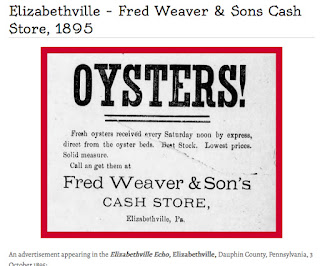
Weaver was born in 1830 in Westmoreland County, Pennsylvania, the son of Frederick Weaver, a blacksmith who later moved his family to Pottsville where the son, working beside his father, learned the smithy’s trade.  From there the young man gravitated to Daughin County, engaged as a carriage builder in Berrysburg (pop. 426) and eventually opening a general merchandise store there.  Apparently finding that hamlet too small, Weaver moved the business a short distance to Elizabethville (pop. 1,218). At Market and Main Streets he constructed a building that became his headquarters.  Eventually that building became known as the Fred Weaver & Son’s Cash Store.


Main Street,  Elizabethville


Sales of liquor from his Elizabethville store apparently convinced Weaver of the profits to be achieved from not just selling whiskey but producing it.  In 1875 at the age of 45, Weaver opened a distillery there that in time became Weaver & Son Company as earlier partners departed. It was registered as Distillery No. 2. 9th District of Pennsylvania. A label for his whiskey, shown left, provides an accurate picture of the facility.  Note the adjacent railroad siding. Weaver’s liquor from Daughin County could be shipped throughout Pennsylvania and other adjacent states.


To his wholesale customers, Weaver sold his whiskey in a variety of ceramic jugs, each holding a gallon or two of his whiskey.  Shown right is a vessel with a brown glaze and a blue cobalt script label, a rather unique format.  Below are company jugs with a more traditional branding.  Those would have been sold to wholesale customers who would pour them into smaller containers for serving across the bar.


The distillery featured several “house” brands, including “That Weaver Whiskey,” “Silver Spring Whiskey,” and “Copper Double Distilled Rye.”  These were marketed to retail customers from Weaver’s Elizabethville general store in flasks and quart-sized glass bottles as shown here and below.  The labels were professionally designed and executed, in no way inferior in designs originating in Philadelphia or Pittsburgh.


Another “big city” attribute of Weaver’s were the shot glasses he gave away to his wholesale and retail customers.  As with his other merchsndise, these were well designed.  He also was willing to spend extra for the white embossing that graced many of them, as shown below.


Profits from whiskey sales fueled other Weaver enterprises.  These included the firm of Weaver & Wallace, an enterprise that controlled a tri-weekly freight line that ran between Daughin County coal towns to Philadelphia.  To service this transport activity, Weaver built the first railroad stations at Lykens (pop. 2,450) and Williamstown (pop. 2,344) and a terminal freight station in Philadelphia.  He also served for many years as a director of the Bank of Millersburg (pop. 1,527) and the Bank of Lykens.  Shown below are the railroad station and Lykens bank.


Weaver also was having a family life, a somewhat confusing one.  His obituary identified two marriages.  His first wife is identified only as “a Miss Conrad of Pottsville” with whom, the newspaper reported, “…He had four children, three of whom survive both their parents.”   The survivors from this marriage were three daughters, all married, two living in Philadelphia and one in Elizabethville.  I have identified this first wife as Caroline Conrad Weaver, buried in a Pottsville, Pennsylvania cemetery but can find no information about her date of birth or death.  Weaver’s second wife was Catherine “Kate” Helfrich of Lehigh County.  They had one son, Henry, who upon reaching maturity would become a partner in managing his father’s enterprises, including the distillery and general store.


Even as Weaver approached his late 60s, he continued to be active in running the distillery, seemingly although aging “full of life and vigor.”  In November 1898, however, after attending a funeral for a family friend Weaver told his wife he was not feeling well.  According to the Elizabethville Echo newspaper:  “…Upon returning home he at once repaired to the radiator, with the remark that his feet were cold…Scarcely a dozen words were exchanged and barely ten minutes had elapsed after entering when he was seen falling from his chair.  He was dead!”   The cause of death apparently was a massive stroke.


Said to be a regular member of the St. Johns Evangelical Lutheran Church in Elizabethville, Weaver was buried from there after services conducted by Pastor Pflueger.  Interment was in Maple Grove Cemetery.  His widow, Catherine, would join him 16 years later.  


The Elizabethville Echo memorial page devoted to Fred Weaver contains this eulogy, summarizing his life and achievements:  “In the death of Mr. Weaver [a] marked personality and excellent character passes from the stage of action. He had been a  citizen of this town for nigh on thirty-five years, and there is not one who would not testify to his generous traits of character, his commendable enterprise as a citizen and his excellent social bearings.”


Note:  Son Henry Weaver continued the operation of the Elizabethville distillery until at least until 1905 when withdrawals of liquor from company warehouses ceased to be recorded by Federal authorities.  As shown above, glass and ceramic containers bearing the Weaver name continue to come to attention reminding subsequent generations of a Pennsylvania distiller who achieved distinction despite never straying from his small town roots.


John Morrin Made Whiskey Where Buffalo Roamed


In Kansas City during the late 1880s, liquor dealer John Morrin faced a dilemma.  Although his proprietary brands of whiskey sold well in Missouri and neighboring states, he was finding it difficult to get whiskey to blend as numerous dealers vied for supplies and the Whiskey Trust fought to dominate markets.  By looking 600 miles east, Morrin found a small distillery in a Kentucky village named for a buffalo wallow — bought it and prospered.


Morrin was born on a farm in Delaware County, Pennsylvania, to Patrick and Honora Graham Morrin, both natives of Ireland.  He received his elementary and secondary education in Pennsylvania, moving to Missouri when he was 18 as his family sought a larger farmstead.  Apparently with some training as a bookkeeper, he moved to Kansas City where in 1881 he appears in city directories keeping the books for W.C. Glass wholesale liquor dealers.


Morrin apparently showed a strong aptitude for the whiskey trade and in 1883 was advanced to traveling salesman for Glass.  By 1887 he was performing the same work for another local liquor firm, Martin, Perry & Company.  Before long Morrin decided to start his own liquor house in Kansas City.  About 1890, with associates E. T. Powers as vice president and George Beamish as secretary,  he opened Morrin, Powers & Company on Delaware Street in Kansas City, the major thoroughfare shown below.   Within four years he changed the firm’s name to Morrin, Powers Mercantile Company.  


From the outset Morrin demonstrated a flair for advertising his whiskey brands. They included “Fairmount Club,” “Grand Canyon,” “Palmetto,” and “Setter Pure Rye.”  He trademarked Grand Canyon in 1905 and Fairmont Club and Palmetto whiskies in 1906. Initially “King Bourbon” was his flagship brand, along with “Setter Pure Rye.”  Shown here is a serving tray made of porcelain that advertises both brands.  It was made in Carlsberg, Austria, by the Victorian pottery factory and was a fairly pricey item to be gifted to the saloons and restaurant carrying Morrin’s whiskey.


Both brands warranted his issuing saloon signs, shown above, featuring a lion  on a King Bourbon print and a Setter Rye wall hanging.  To his customers Morrin also gave away a picture of a nude model lying on a bearskin rug next to a pile of her discarded clothing.  Interestingly, this sign does not advertise any specific whiskey.


In apparent effort to move beyond selling his own proprietary brands, Morrin looked to one of Kentucky’s premier distillers, Col. E. J. Taylor Jr. of Frankfort, Kentucky [See post on Taylor. January 10, 2015].  Two of Taylor’s most popular brands were Carlisle and O.F.C whiskeys.   Morrin advertised both vigorously as: “The most perfectly distilled of any on the market and their purity recommends them as especially desirable for medical use.”  


In another ad shown above, Morrin made an effort to distinguish his liquor house from the many other dealers in Kansas City by a series of claims:  “We import more liquors than all other firms on the Missouri River.” “We own more Straight Whiskies than all other Liquor Firms in Kansas City.”  “We carry more insurance than all other wholesale liquor firms in Kansas City.”  Morrin also claimed a one year increase in business amounting to $100,000, several millions in todays dollar.


Morrin’s boasts did nothing to ameliorate the dilemma, he was facing.  Supplies for his house brands were becoming increasingly expensive and more and more difficult to secure. The Whiskey Trust was buying out distilleries and shutting many down in an effort to increase prices for liquor stocks.  Morrin looked for opportunities to buy his own distillery.  In 1890 he found it in a place in called Stamping Ground, Kentucky, population 331.


Both the location and the distillery bore histories.  The area had gained its name, Stamping Ground to memorialize the American bison (buffalo) that once roamed there.  Before being wiped out by hungry settlers, the animals were attracted to the site by salt licks, availability of spring water, “seeps” for wallowing, and a tasty clover species the locals called “buffalo clover.” 


Originally constructed as a woolen mill, the building had been converted to a distillery by Robert Samuels.  Not a full time distiller, Samuels is said to have made a barrel of whiskey only occasionally and eventually was forced to dispose of the property at a sheriff’s sale in 1873.  A series of owners followed.  


The first was Kinzea Stone, shown here,  an entrepreneur with property holdings in nearby Georgetown,  Kentucky, and four other states.  Although Stone indicated an interest in producing and selling a whiskey commercially, other distractions intervened.  In 1882 he sold the distillery to the Crigler family of Cincinnati [See post on Crigler, January 10, 2012].  They began producing 15 gallons of whiskey a day under the name “Buffalo Springs.”  The company name became Mullins, Crigler & Company.  In time the Criglers departed and the name was changed once again to A. B. Mullins Company.


This was the distillery that John Morrin, in far off Kansas City, saw as an opportunity to break out of the dilemma of finding sufficient liquor to blend, bottle and merchandise.  In about 1890 he bought the plant, continuing to produce whiskey using the recipes from the Criglers.  Applying his talents as a salesman, according to whiskey historian Sam Cecil, Morrin’s distillery “soon made a wide reputation, particularly in the West.”  


Morrin’s two main brands were “Buffalo Springs,” a sour mash bourbon, and “Stamping Ground,” a rye whiskey  Other labels were “Buffalo Bourbon” and Scott County.”  By the mid-1890s, the Kansas City proprietor had increased distillery mashing capacity to 100 bushels a day and had four warehouses with capacity for aging 2,500 barrels.  Morrin issued a whetstone as a customer giveaway that emphasized the buffalo ties.


After almost a decade operating the Stamping Ground distillery, Morrin sold it to a Paris, Kentucky, partnership of Haynes & Trumble, whose company had been major customers for his whiskey  The reason for the sale may well have been the distance of the distillery from Kansas City.  A decade of constant travel between sites and the need for employee supervision from afar may have been wearing on Morrin and his family life.  


Like many young Irishmen, Morrin had married relatively late.  At 32 he wed Caroline, a woman just slightly younger, who apparently had been married earlier and brought two daughters, Juanita and Eulalia, to their union.  Morrin provided them with a large home in a fashionable neighborhood of Kansas City, shown here.  The household included one live-in maid.  


Despite the success of his Kansas City liquor house, Morrin could see his sales being curtailed by Prohibitionist pressures.  Missouri was safely “wet,” but one after another Western states were going “bone dry.”  Several years after selling the Buffalo Springs distillery, Morrin closed down his liquor business and retired to invest in other local enterprises.  Those included the Traders’ Bank of Kansas City and the city’s Racing and Fair Association.


Morrin lived long enough to see National Prohibition repealed, dying in 1934 at the age of 75.  He was buried in the Mount Calvary Catholic Cemetery in nearby Holden, Missouri.  His memorial and gravestone are shown below.


After Repeal new ownership bought the the distillery and after a fire rebuilt it.  Shown below, as refurbished, the Stamping Grounds facility once again was turning out good whiskey.  In 1941 the property was purchased by Schenley who operated the plant for almost 20 years but shut it down in 1960.  Today all that remains of the distillery John Morrin put on the “whiskey map” is the old stone headquarters building. 


Note:  This post was created from a variety of sources.  Two primary references were “Bourbon in Kentucky, A History of Distilleries in Kentucky,” by Chester Zoeller, Butler Books, Louisville 2010, and “The Evolution of the Bourbon Whiskey Industry in Kentucky,” by Sam K. Cecil, Turner Publishing, Paducah KY, 2000.  Unfortunately I have been unable to find a picture of John Morrin to enchance this story but hope some alert reader may be able eventually to supply one.


The Edgar Kane Scandal — Booze and Bigamy in Brooklyn

While reporting on a lawsuit involving the estate of Edward Kane, a well known New York liquor dealer, the Brooklyn Daily Eagle of February 19, 1909,  made this observation:  “Fiction has produced few stranger stories….”  While that may have been an exaggeration, the newspaper revealed a situation so bizarre that it might well have come from a novel.

Edward was not born “Kane,” generally considered of British or Irish origin. His birth surname was “Kohn” and he had been born in Germany about 1826.  He told the 1880 census taker his birthplace was “prison.”  Kane’s childhood days are lost in the mists of history but much of his extraordinary life upon arriving in the United States can be documented, including a surrounding cast of characters, several bearing the name Kane.


By the time Edward Kane arrived on these shores in 1865, he was 39 years old and  married.  His wife was Julia Bertha Kane.  Their only recorded child, a boy, was born in the U.S. in 1854.  He was Henry E. Kane, a son who figures in this story.  Granted citizenship in August, 1873, the Kanes settled in Brooklyn.  For unknown reasons, possibly related to her husband’s conduct, Julia left him in the mid-1870s and returned to Germany. She did not return to America until after Kane’s death.  There was no indication of a formal divorce.


Meanwhile Edward Kane was making his mark as a “whiskey man.”  From his main headquarters at 24 Union Street in Brooklyn, he rapidly expanded his outlets.  “From one liquor store to another and another, and finally he had a chain of them in Brooklyn and Manhattan.”   Kane advertised extensively by issuing trade cards featuring youngsters, often with their pets, with an advertisement on the reverse as a “Importer, Rectifier [blender], Wine and Liquor Merchant,”  Early cards, shown below listed two stores in Brooklyn, and one each in New York City, Jersey City, and Tompkinsville, Staten Island, a total of five.


Several years later the number of Kane’s liquor outlets had grown significantly as detailed on the reverse of the trade cards below,  Now there were eight liquor stores, four in Brooklyn, and one each in Manhattan, Jersey City and Staten Island, and a distant location in Stoney Brook, Long Island.  As before, Kane chose to advertise his stores through depictions of winsome youngsters on trade cards.


The Stoney Brook Grist Mill, founded about 1751 some 60 miles from Brooklyn, marked a new departure for Kane, although once again he chose child images on trade cards to advertise.  The rear of the two cards below describes the entrepreneur’s plan for the property designed to provide flour — “purer, sweeter, and more healthful than patent process can ever be” — and “delivery of all kinds of Grain and Feed in the market.”


In this way, Kane introduced his purchase of Stoney Brook Grist Mill, shown below as it looks today as a heritage site, adding:  “Having recently purchased the Stoney Brook Mill property and added new and improved machinery to do first class work and meet the requirements of the public, and being aware that success depends on the quality of the project as well as honest and just treatment, I extend a special invitation to the public to give me a trial, feeling assured of giving full satisfaction in price, quality, and business management.”  The opening of this mill may have been the high water mark of Edward Kane’s entrepreneurship.


As he entered middle-age, Kane’s attention increasingly seemed to focus on his personal life.  He had become enamored with a young woman named Annie Rose Gilzinger, born 1863 in Kingston, New York, the daughter of Margaret and Lewis Gilzinger. a wagon maker.  Annie Rose was about 37 years younger than her lover but they became a devoted couple, living together, despite Kane’s seeming lack of a divorce from Julia Bertha.  They had at least one child together, a girl, whom they named “Mamie.”  Legally adopted by Edward, she took his name and would play a part in the long roll-out of the family scandal.


With many stores to manage and now the distraction of his unusual family life, Kane recognized that he needed help.  Enter Henry D. Schwab, shown here, who first went to work as a bookkeeper at L. Kane & Company.  Proving to be a highly able employee, Schwab eventially was raised by Kane to a full partnership in the liquor empire he had created, sharing the complicated management burden.


Moreover, with advancing age Kane’s health began to falter.  While Annie Rose continued to care for him in his infirmities, their conjugal relationship ended after several years, as reported in her obituary, an article that openly recounted the liaison with the liquor dealer.  That account also reveals that while still caring for Kane, Annie Rose married another man.  His name was Simon Strauss, listed in Annie Rose’s obituary as the father of her next four children, namely Samuel, Carol, Edward, and Frances.  The official birth record for Samuel, however, lists Edward Kane as his father.  


When, after a long decline, Kane died on December 11, 1897, newspaper reports suggested suicide.  The Brooklyn Eagle said:  “…There was a possibility he died of carbolic acid poisoning. Self-administered.”  The prospect that Kane took his own life also was suggested when he registered his will just a week before his death.


Kane left his estate solely to his daughter Mamie and named her mother, now Annie Strauss, as the administrator.  In Annie’s petition filed with the court, Kane’s wealth, mostly real estate, was valued at $60,000, equivalent to more than $2 million today.  Indicating a severe decline of Kane’s fortunes near the end of his life, most of that value was “encumbered by mortgage, taxes, and other liens, which amount, in the aggregate, [is] about the value of the…real property.”  The net value of the liquor baron’s bequest to Annie and family was about $10,000.


Edward’s son,  Henry E. Kane, on behalf of himself and his mother,  Bertha,  still married to Kane, initally made an effort to contest the will.  The effort drew Bertha back to the United States after decades in Germany.  For several  years Henry had played an important but subordinate role in the operation of the Kane liquor empire, apparently responsible for managing several liquor stores.  The whiskey jug shown here bears his name.  Henry at some point seemingly disappointed his father who turned to Henry Schwab as his partner.  Together they bought out Henry’s interests.  Although Kane’s son and wife initially challenged his will, the many encumbrances to be dealt with and relatively small remaining bequest may have discouraged their efforts and the pair ultimately withdrew their suit.


Henry Schwab came to the fore.  With Annie as the administratrix of the estate, Schwab quickly was able to reach a settlement and bought the deceased Kane’s share of the business.  The former bookkeeper pointed to his personally having paid off $50,000 in company debts earlier as Kane’s health had faltered.  After his death Schwab assumed all liabilities, freeing up the estate from financial claims and greatly increased the financial benefit to Mamie and Annie. When Simon Strauss died a year after Kane, Annie married again and bore her second husband three more children.


None of the details of Edward Kane’s conjugal adventures might have come to light had it not been for Mamie.  After almost a decade had passed, now as Mrs. Mamie M. Ague, she cast an envious eye on Henry Schwab who had pulled the Kane company out of debt and apparently was prospering.  She claimed that her father’s former business partner, had experienced an altogether too rapid rise in wealth after her father’s death and challenged the earlier settlement of Kane’s estate.  Mamie demanded an new accounting, her expectation apparently further payout from Schwab.  Her petition provided steamy details of her father’s love life previously unknown by the public, including his bigamous relationship with her mother, Annie. The story raised eyebrows all over New York that a well known wealthy businessman had put a former mistress in charge of his estate.  The Brooklyn Daily Eagle speculated:  “Many of the facts alleged by the plaintiff are found in the papers and indicate that the trial will be a mighty interesting one.” 


As it turned out, despite the scandalous details, the trial turned out to be a rather

humdrum affair.  Schwab argued that Mamie’s suit was an unwarranted attack on his reputation.  With his own funds he had freed the bequest from outside claims, thus making more of Kane’s money available to Mamie, her siblings, and her mother.  Instead of gratitude, he now faced legal action. Clearly unimpressed with the case presented by Mamie’s lawyers, the judge ruled in favor of the liquor dealer.  Mrs. Ague got nothing and paid court costs.


Schwab subsequently made his own reputation in Brooklyn business circles. To the company list of offerings, he added and copyrighted his own brand of bitters, called “Dr. K’s Stomach Bitters.”  With the growing threat of National Prohibition, however, the bookkeeper cum proprietor eventually shut the doors on E. Kane & Company after more than a half century of operation.


Today visitors to Stony Brook, New York, can arrange for a tour of the restored Kane Grist Mill given by the local heritage organization.  The tour also includes the viewing of Long Island’s very first vineyard and a docent’s recitation of “the scandalous story of Edward Kane.” But, of course, that is a story you already know.


Note:  This post has been crafted from a range of sources.  Important among them were news stories from the Brooklyn Daily Eagle of April 7, 1908 and February 18, 1909, and  the obituary of Annie Rose Gilzinger reprinted on ancestry.com.  I have been unable to find a photo of Kane or identify his burial site.  Am hopeful that an alert reader will help fill in those details.

Saloon Cards, Risqué and Profane

In the days before National Prohibition when women, at least respectable women, were barred from saloons, proprietors felt free to distribute cards advertising their establishments that often included “double entrendre” messages, often provided in verse.  Shown here are six such offerings from watering holes across America and reaching into Mexico.

The first example comes from Becker’s Saloon in Reno, Nevada, a place where one might get a limburger cheese sandwich and a beer for 15 cents.  It was located in the Becker Building on Commercial Row in Reno and held the saloon, a restaurant and a card playing center.  Its trade card depicted a comely woman with a monkey shaking hands with a farm boy and reads:


The boys all like Mary, and

Like her monkey too,

And when they play so 

Nice with it, what can Mary do?


This saloon card was one of a series of six about Mary and her “monkey.” The next card shows Mary swimming with the animal and the verse is:


Mary went in swimming and 

She took her little pet

A wave hit her in the “good 

Old supper time…” and she

Got her monkey wet.


The 1911 city directory of Springfield, Illinois, lists almost three full pages of saloons, indicating that the competition for customers among them must have been fierce.  That may explain the number of trade cards from that city that carried suggestive poetry.   Zimmerman & Co. called its place The “Budweiser,” a designation that suggests a “tied” saloon, that is, one that served only a single kind of beer in return for financial support from a brewer.  Its “poem” read:


With fond regret I now remember,

Those happy days of youthful fun,

When all my limbs were lithe and limber, 

Did I say all?  Yes all but one.


Those glorious days have ceased forever,

The happy days of youthful fun,

All limbs are daily growing stiffer

Did I say all?  Yes all but one.


Another saloon was the Sullivan Bar on Springfield’s North Sixth Street.  But Sullivan was not there.  Instead the proprietor was another Irishman named William Greenhalgh.  Noting that Sullivan’s “thirst parlor” also had “rooms in connection” a question arises about what additional activities might have been going on there.  The verse on the card back side may give a clue:


Tis said that in these days of progress and push,

That ONE bird in the hand is worth TWO in the bush;

But the summer girl says, if birdie will stand,

ONE bird in her bush is worth TWO in her hand.


William J. Cordier, the cravated chap shown here was proprietor of the Schlitz Forum & Cafe, another “tied” saloon, just down the street from Sullivan’s in Springfield.  Cordier felt the poetic urge to issue two risqué’ cards.  One of them contains eight suggestive quatrains, of which the following are two:


Here’s to the girl that dresses in the sailor hat,

Pink shirtwaist and white cravat,

Patent leather shoes and blue parasol,

And a little brown spot that pays for them all.


Here’s to the girl that dresses in black,

She alway looks neat and never looks slack,

But when she kisses, she kisses so sweet,

She makes things stand that have no feet.


Cordier also issued a second card that featured a story in verse about a fly that intrudes into a grocery store and, after defecating on a piece of ham, proceeds to elude the storekeeper and then:


When he had done his deadly work

He flew right over to the lady clerk

And up her leg he took a stroll

And took bath in her hole.


Proprieties deteriorate further in subsequent stanzas until the fly meets an untimely — and unseemly — death. 


Tommy Sookiasian, an Armenian, was proprietor of a saloon in Juarez, Mexico, a short distance over the Rio Grande River from El Paso, Texas.  He issued a trade card that, while ostensibly involving cattle and their tails is meant to remind us of the deterioration in the male organ of generation as the years take their toll.  Tommy ran a bar and cafe featuring a mostly fish menu and was a wholesale liquor dealer.


Contemplating the unusual name of “The Humorist Saloon,” perhaps it was the proprietor,  T. E. Tobin,  depicted on the trade card, who fancied himself a funny man.  His St. Louis watering hole seems never to have closed, being open ”day and night.”  His rhyme on the reverse while not having sexual overtones, was laced with profanity, as exemplified in the stanza that follows:


Beer is a beverage,

That works upon the mind;

It makes men and women talk,

When they are not inclined.

It works like a figure,

And works without a rule,

And make people think they are smart

When they are a G—D—d Fool.


This is just a small sample of the artistic achievements contributed to the American poetic lexicon by the Nation’s saloonkeepers.   Their works seldom receive attention, particularly in literary (as opposed to drinking) circles.  I am happy to remedy that omission here.


Labels:  Risque’ saloon cards


Posted by Jack Sullivan at 12:46 PM

Labels: Becker’ Saloon Reno, Humorist Saloon St. Louis, risque’ saloon cards, Saloon poetry, Springfield Illinois saloons


No comments:


Post a Comment


To leave a comment, click the button below to sign in with Google.


SIGN IN WITH GOOGLE


Newer Post

Older Post

Home


Subscribe to: Post Comments (Atom)

Ed Brinkman: Asst. Bookkeeper to Boss & Beyond

Edward H. Brinkman (Brinkmann), who apparently jettisoned the Germanic “n” at the end of his name during World War One, spent most of his working life employed by the Union Distilling Company, rising from bookkeeper’s assistant to president of the Cincinnati distillery and liquor house. Demonstrating unique staying power, Brinkman’s imprimatur continued to appear on whiskey even during the years of National Prohibition.

Born in August 1871 in Cincinnati, Brinkman was the son of German immigrants.  His father Christian Frederick Brinkmann had emigrated to the United States in 1855 from Germany at age 19 and settled in Cincinnati, a very Germanic city where he worked as a tailor.  Ten years later he met and married another German immigrant, Anna Warneke.   Edward was born six years later.  Educated in Cincinnati schools, known for their quality throughout Ohio, the boy apparently demonstrated a flair for mathematics.


Before reaching 21 Brinkman was hired as assistant bookkeeper at the Union Distilling Company, a Cincinnati liquor house that had been founded about 1884,

headed by president George Gerke, another German immigrant. Beginning at the lowest rung in the company hierarchy, young Brinkman apparently proved to be an able bookkeeper, working closely with George Dieterle. the compay secretary and treasurer, and gaining his confidence.  


In 1895, Brinkman became a member of the Dieterle family, marrying Augusta Dieterle, George’s sister.  Both 24 years old, the couple would go on to have one child, Anna Hilda.  The marriage signaled Brinkman’s steady move up the promotion ladder.  In a 1894 directory he was listed as a “clerk” at Union Distillery.  By the early 1900s, Brinkman had been raised to vice president. In 1914 the Cincinnati Chamber of Commerce reported a shake-up in the distillery hierarchy.  Edward Brinkman, former bookkeeper, now was recorded as president of Union Distilling.  


The company clearly had found a foothold in the booming and crowded Cincinnati liquor trade, adopting the slogan, “None Better.”  Company brands approached thirty.  They included:  “Anchor,” “Azax,” “Biltmore,” “Bob Pepper,”  “Bucktail,” “Bull Run,” “Camelia,” “Dave Crockett,” “Davy Crockett,” “Dexter,” “Diamond Mills Rye,” “King Rex,” “Lenox,” “Lone Star,” “Mayflower,” “Middle Brook,” “Old Club House,” “Old Eagle,” “Old Glory,” “Old Gold Metal,” “Old Silver Medal,” “Old Yacht Club,” “Smoky Hollow,” “Southern Bouquet,” “Tippecanoe,” “Union,” “Universal,” and “Zeno.”


Under Brinkman’s leadership Union Distilling trademarked 15 of those brands.  Beginning slowly in 1905, following Congressional strengthening of trademark laws, he registered Tippecanoe and Zeno.   Despite the cost of hiring lawyers and artists to prepare government applications, the company followed in 1906 to add ten more brand names to the registered list.  Following years saw Biltmore trademarked in 1907, Anchor in 1908 and Azax in 1909.


On its letterhead, Union Distilling featured three brands, Old Glory, its flagship label, along with Lenox and Tippecanoe.  As shown below, Old Glory, while carrying the Union Distilling imprint was given two labels that different in details.  At left is one in which the Stars and Stripes are evident and it is twilight.  At right the flag is not evident and a sun has been added. 


During this period of Brinkman’s ascendancy, Union Distilling was growing steadily.  In an open letter to customers dated November 1, 1910, the company announced that it had purchased “…The entire stock of  bonded whiskies and other liquors, the brands, copyrights and trade name of the Diamond Distilleries Company, of this city.”  The letterhead listed six brands, Old Glory, Lenox, and Tippecanoe, adding the Diamond labels, King Rex, Middlebrook and Diamond Mills Rye.  The letter also references Union Distilling “rebuilding” a distillery — and presumably warehouses —and promising that the company soon would begin full operations.


My assumption is that Brinkman and his colleagues had purchased an interest in and refurbished a plant that after several prior identities became known as the Latonia Distillery, built shortly after the end of the Civil War. It was located four miles south of Cincinnati, at the juncture of the Louisville Short Line & Kentucky Central Railroads near Latonia Station.  Insurance underwriter records of 1892 indicate that the distillery was brick with a metal or slate roof. The property included a cattle shed, a “whopping” 23 bonded warehouses and one free warehouse, all of constructed of brick with metal or slate roofs. The warehouses were listed according to the various aliases used by liquor houses owning their alcoholic contents.  Union Distilling claimed two warehouses, designated “I” and “W.”  Those structures apparently allowed the company to declare the entire distillery as its own, as shown below.


In 1903 the Cincinnati papers announced that Edgemont Springs Distilling Co. was being absorbed into Brinkman’s Union Distillling. Its founder Christopher Sandheger had sold out [See my post on Sandheger, Nov 6, 2013.]  According to the press notice, the value of Union Distilling had been increased from $300,000 to $750,000.  As a result of the acquisition, it was reported, Union Distilling had moved more firmly into production of whiskey as well as marketing it.  It was issuing back-of-the-bar bottles to saloon customers.


At that point Brinkman and Union Distilling renamed its slice of the Latonia facility as “The Edgemont Springs Distillery Company.”  Government documents record that “Edw. H. Brinkman” representing Edgemont, added and subtracted whiskey from Latonia warehouses twice in 1901, again in 1903 and 1904.  By the next decade Brinkman had reverted to using Union Distilling as the entity involved in the transactions.  His last activity was recorded in 1920 as National Prohibition was taking hold.


The 14 years of “dry” were not to be the end of Ed Brinkman as a Cincinnati “Bourbon Baron.”  Despite National Prohibition, for a time he was allowed to hold and sell liquor that had been distilled earlier.  His role was providing liquor to the few privileged dealers licensed by the government to market “medicinal” whiskey.  Shown below is a 1931 bottle of “Schenley’s Aged Medicinal Whiskey” at 100 proof, “bottled in bond” and touted as “recommended by physicians and surgeons.”  The label on the back credits Brinkman for the whiskey produced in 1917 and bottled in 1931 by Schenley.

Brinkman had  other suitors for his whiskey stocks. Shown below is a pint bottle of “Silver Grove” straight bourbon from the Geo. T. Stagg Co. of Frankfort, Kentucky. [See my post on Stagg, April 30, 2016].  The rear label credits Brinkman as the distiller and identifies the distillery as Ohio #2 (apparently Latonia).  When those liquor supplies were exhausted Brinkman turned his attention to producing industrial alcohol.


In 1938 at the age of 67, Edward Brinkman died and was buried in Cincinnati’s Spring Grove Cemetery.  As he aged the Cincinnati native could look back on a lomg career and note his humble beginning as an assistant bookkeeper and his step-by-step ascendancy to the top of a prominent and respected liquor company.  Ironically, his rapid rise had coincided with the fall of the industry.


Note:  This post has been written from a comparatively meager number of sources.   It also lacks a photo or description of this “whiskey man.”  I am hopeful that a descendant will help fill in the gaps about Edward Brinkman and Union Distilling, and correct any errors in the narrative.


Scroll to Top